
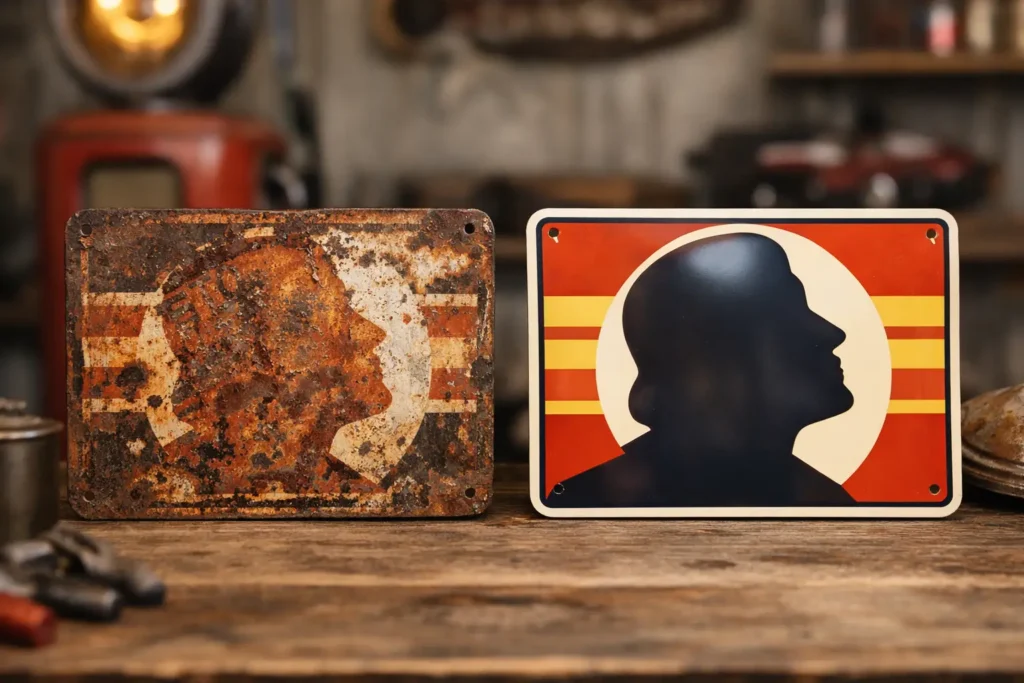
You can feel the difference when a real one is in front of you. The weight, the wear, the depth of color, the way the surface has aged over decades instead of being forced in a workshop last year. That is the heart of original signs vs reproductions. To some buyers, both may look good on a wall. To a collector, they are not even in the same category.
An original sign is a historical object. A reproduction is decor. That does not mean reproductions are automatically bad. It means they need to be understood for what they are. If you are spending serious money, building a collection, or trying to bring true Americana into a garage, showroom, bar, or retail space, the distinction matters.
Why original signs vs reproductions matters
The biggest difference is not just age. It is authenticity, scarcity, and long-term value. An original porcelain gas and oil sign, dealership piece, soda sign, or trade sign was made for actual use in its own time. It was built to advertise a real business, product, or service. It belongs to a specific era and carries the wear of real life.
A reproduction is made later. Sometimes it is honestly sold as a decorative remake. Sometimes it is dressed up to look older than it is. That is where buyers get hurt. A good-looking reproduction can still have wall appeal, but it does not carry the same collector value, historical importance, or market strength as an original company-issued piece.
If you collect to preserve history, originals matter. If you collect with resale or investment in mind, originals matter even more. And if you simply do not want to overpay for something made last decade, the difference matters immediately.
What makes a sign original
Originality starts with period manufacture. The sign had to be made in the era it represents, by or for the company it advertises, for actual commercial use. That sounds simple, but in the vintage sign world it gets complicated fast.
A real original often shows the right kind of age. Porcelain may have honest chipping around mounting holes, edge wear from decades of handling, and a gloss that feels deep rather than artificial. Tin signs may show oxidation, paint loss, or surface scratching consistent with age. Neon signs may have construction details, housings, transformers, and glass work that fit the period.
Original signs also tend to have the right proportions, typography, color balance, and manufacturing methods for their time. You start to recognize it after years around authentic material. The sign does not just look old. It looks right.
That last part is where experience counts. Many reproductions copy the image, but they miss the construction. Others get the size wrong, the porcelain too heavy or too bright, the mounting pattern off, the edges too clean, or the back too fresh. Some are aged on purpose, but artificial wear usually tells on itself.
How reproductions fool people
Most buyers do not get fooled because they are careless. They get fooled because reproductions have improved and because online photos hide a lot.
Some reproduction signs are obvious. They are sold openly as decorative pieces with modern printing, fake rust, and intentionally distressed finishes. Those are easy enough to separate from true antique advertising.
The problem is the better-made reproduction that borrows the look of a scarce original. It may use porcelain enamel, old-style graphics, and enough edge wear to create a first impression. In pictures, that can be enough to convince an inexperienced buyer. Once it is in hand, the issues become clearer, but by then the money is already out the door.
Fantasy pieces create another problem. These are signs for designs or combinations that never existed in period at all. They might use a real brand name, but the style, slogan, shape, or format was never actually produced by the company. They can be attractive, but from a collector standpoint they are modern inventions.
Original signs vs reproductions in the real market
This is where buyers need to be practical. Originals bring stronger money because they are finite. No one is making more 1930s porcelain dealership signs for actual roadside use. Every year, the best pieces are harder to find, and condition becomes even more important.
Reproductions are replaceable. That keeps their value in a different lane. If you buy a reproduction for decor and pay reproduction money, fine. If you buy it believing it is a rare original and pay original money, that is an expensive lesson.
Condition is part of this too. A worn original with honest age can still be far more desirable than a perfect reproduction. Collectors will often choose real surface wear over fake perfection every time. It depends on rarity, color, subject matter, and how the sign displays, but originality remains the foundation.
For decorators and commercial spaces, there is sometimes a trade-off. A reproduction may give the visual effect without the cost or risk of hanging a valuable original in a busy environment. That is a reasonable choice as long as it is an informed one. Trouble starts when a reproduction is expected to perform like an original in value, prestige, or authenticity.
How to judge a sign before you buy
The first question is simple: is the seller clearly stating that the piece is original? If the language is vague, be careful. Words like vintage style, antique look, collectible sign, or old gas sign can be used to dance around the truth.
Ask direct questions. Is it period original? Is it company-issued? Has it been restored? Are there repairs, added holes, touch-up, replaced neon components, or repainted areas? A serious seller should answer without hedging.
Study the photos closely. Look at the front, back, edges, mounting holes, and areas of wear. The back of a sign often tells more truth than the face. So do the grommets, the enamel edge, the pattern of rust, and the consistency of wear across the piece.
Dimensions matter more than many buyers realize. Reproductions are often close, but not exact. If a known original is supposed to be a certain size and shape, even small differences can be a warning sign.
Provenance helps, but it should not be used as a crutch. A story about a barn find is not proof. Long-term ownership, old photos, collection records, and auction history can all support authenticity, but the sign still has to stand on its own merits.
Why specialist knowledge changes everything
This is not a category where general antique knowledge is enough. Vintage advertising has its own rules, and each segment has its own traps. Porcelain signs, neon signs, embossed tin, advertising clocks, dealership pieces, and folk art trade signs all age differently and get reproduced differently.
That is why serious buyers lean on specialists who know the differences from handling real material over decades, not from scanning photos online. A seasoned dealer knows what should be there, what should not, and what questions to ask before a piece is ever offered for sale.
At Road Relics, that standard is simple: original means original. Not reproduction, not replica, not fantasy. That kind of directness matters because buyers should not have to decode sales language when they are spending real money.
The right reason to buy each one
If you want a true piece of American roadside history, buy an original. If you want rarity, collector credibility, and a sign that has lived a life before it reached your wall, buy an original. If you care about long-term desirability, buy the best original you can afford.
If you want the look without the price, or you need something for a high-traffic space where damage is a real concern, a reproduction may make sense. There is no shame in that. The mistake is pretending the two are equal.
The best collections are built with clear eyes. Some buyers start with reproductions and eventually move into authentic pieces. Others go straight for originals and never look back. Either way, know what you are buying, know why it matters, and trust your money only where authenticity is stated plainly and backed with confidence.
A real sign does more than decorate a room. It carries the grit, color, and memory of the American road, and once you learn to spot the difference, it is hard to settle for anything less.