
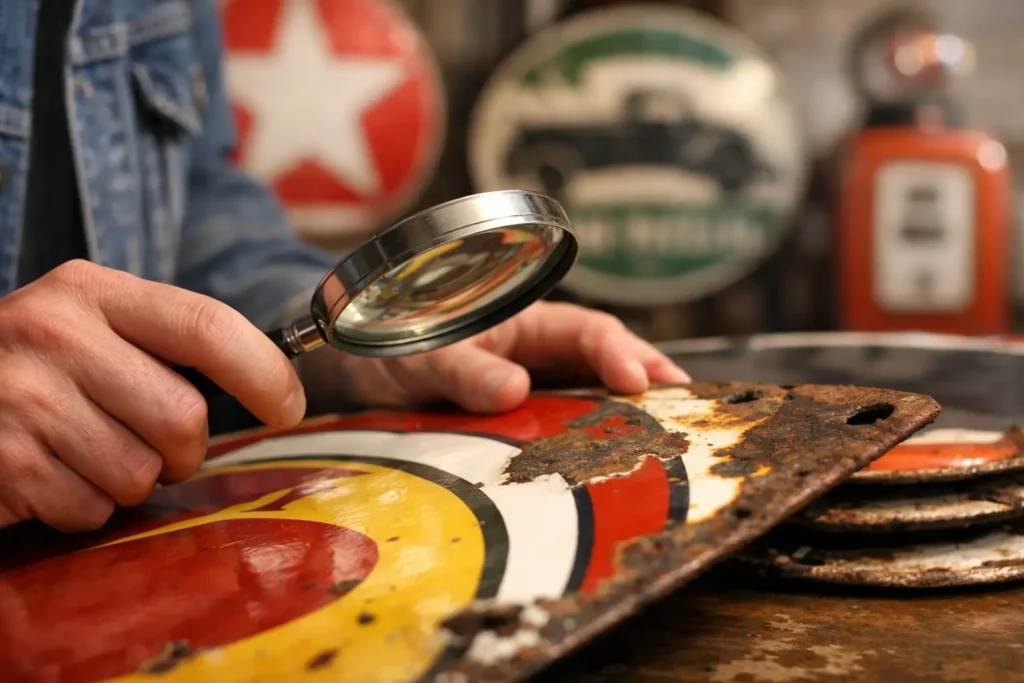
You can learn a lot from the first chip.
Anyone can fall for bright color and a familiar logo. What separates a real collector from a hopeful buyer is knowing what that damaged edge, that rust halo, or that heavy steel blank is telling you. If you want to understand how to identify original porcelain signs, you have to stop looking at the graphic first and start reading the sign itself.
Original porcelain signs were built for service, not for nostalgia. They were made to hang outside dealerships, gas stations, farm buildings, and roadside businesses through rain, sun, wind, and hard use. Reproductions are made to look old. Authentic signs actually got old. That difference sounds simple, but it shows up in very specific ways.
How to identify original porcelain signs from the steel up
Most buyers make the same mistake early on. They judge a sign by the artwork, not the construction. The porcelain and the steel are usually more honest than the image.
An original porcelain sign typically starts with a substantial steel base. The piece should feel right in hand for its size. Older signs tend to have a density and stiffness that many reproductions miss, especially cheaper ones made on thinner steel. If the sign feels light, flimsy, or oddly flat for what it is supposed to be, that is your first reason to slow down.
The porcelain itself should have depth. On authentic examples, the glass coating usually sits with a hard, rich gloss rather than a sprayed shine. Colors often have real saturation, but not the plastic look that modern baking and printing can create. White areas are particularly revealing. On originals, the white often has a creamy or slightly toned character from age and firing. On many repros, the white looks too cold, too clean, or too even.
Then look at the edges. Real porcelain signs often show edge wear that makes sense for decades of handling, hanging, stacking, and storage. The wear is rarely uniform. One side may be rougher. One corner may have taken a hit. Artificial aging often overplays this, with chips sprinkled around in a way that looks staged rather than earned.
The chips, rust, and gloss should agree with each other
This is where experience starts to matter.
Porcelain chips on original signs usually expose dark steel beneath the enamel. Over time, moisture gets into those breaks and creates oxidation that spreads naturally from the exposed points. The key word is naturally. Real rust follows damage, exposure, and gravity. It forms in pockets, around mounting holes, along lower edges, and in areas where water could sit. It does not appear as a decorative effect scattered evenly across the face.
Pay close attention to the relationship between chips and gloss. On a true old sign, the wear pattern, the fading, the oxidation, and the surface shine tend to make sense together. If a sign has heavy chipping but looks freshly glossy everywhere else, something is off. If it has lots of fake rust but no believable age to the mounting holes, that is another problem. Originality is often about consistency.
The same goes for scratches. Old porcelain can scratch, but those scratches usually have direction and logic. They come from handling, from rubbing against other metal, from hardware, or from years in a barn or shed. Random surface abuse that seems designed to advertise age usually does the opposite.
Study the mounting holes and grommets
Mounting holes are one of the best places to catch a bad sign.
Original holes tend to show real use. You may see wear where washers sat, where bolts tightened down, or where a sign shifted slightly in the wind. The porcelain around the holes may be nicked or compressed in a believable way. Rust may build where bare steel was exposed. If grommets are present, they should fit the period and the sign type. Fresh-looking hardware on a supposedly untouched sign deserves a hard look.
Reproductions often miss this area because it is hard to fake honestly. The holes may look too clean, too sharp, or artificially distressed. On fantasy pieces, the mounting pattern itself may be wrong for the size or intended use of the sign.
Maker marks help, but they do not settle everything
Collectors like to find a maker stamp because it feels definitive. Sometimes it is. Sometimes it is just one more piece of the puzzle.
Original porcelain signs were often made by known manufacturers such as Ingram-Richardson, Veribrite, Baltimore Enamel, or other period makers depending on the era and category. Marks can appear small, partly hidden, or worn. They may include patent dates, location names, order numbers, or maker identifiers. These details are useful, but they should support the sign, not rescue it.
A reproduction can copy a mark. A forged mark can be added. And some authentic signs were made with minimal markings or none that survived clearly. So yes, study the stamp. But do not stop there. The construction, porcelain quality, layout, and wear still have to line up.
Graphics can fool you faster than metal can
Good art sells bad signs.
Popular gas and oil names, soda brands, transportation pieces, and dealership signs get reproduced because demand is strong. The more desirable the brand, the more careful you have to be. Many modern fakes are based on real originals but miss subtle details in typography, border width, spacing, and color tone.
Lettering on originals often has a precision that came from period manufacturing, but it can also show slight quirks tied to the process. Repros may look too crisp in the wrong way, especially if modern digital methods were involved. Other times they are too soft, as if the design was copied from a photo rather than from the original production artwork.
Border areas are another tell. On real signs, border thickness and alignment generally feel intentional. On copies, borders can drift, corners can look awkward, and the overall spacing may seem just a little off. Serious collectors learn to trust that instinct. If the graphic feels wrong before you know why, keep looking.
Size, shape, and curvature matter more than most buyers think
Many porcelain signs were made in standard formats for specific uses. Pump plates, dealer signs, farm signs, flange signs, and larger self-framed pieces each followed patterns tied to function and era. If a sign appears in an odd size that does not match known originals, be cautious.
Curved flange signs are especially worth studying. On authentic examples, the bend is part of the sign’s construction and age. The porcelain should behave accordingly at the fold and edges. A recently bent piece or a made-up flange often reveals stress, finish issues, or poor proportions.
Double-sided signs bring another layer. Originals can show natural differences between sides because one faced weather or sun more directly. That kind of uneven aging is often a good sign. Two sides with identical wear can be suspicious if the sign supposedly lived outdoors for decades.
Provenance and seller knowledge still count
A sign does not become original because a seller says it came from an old barn. Stories are easy. Knowledge is harder to fake.
Ask where the sign came from, how long the seller has had it, whether it came out of a known collection, and what they see as the strengths and weaknesses of the piece. A real sign guy will usually talk plainly about condition, chips, touch-up concerns, porcelain loss, and why the sign presents the way it does. Someone selling fantasy material tends to stay vague or lean on excitement instead of specifics.
This is one reason experienced buyers return to specialists. At Road Relics, the market is approached from the collector side first, because originality is the whole ballgame. If a seller cannot explain what makes a sign right, you should wonder whether they know enough to stand behind it.
The hardest truth in this hobby
Some signs are obvious. Many are not.
There are original signs with unusual wear, signs that were never hung, signs that lived indoors, signs with factory flaws, and signs that look too good because they simply survived well. There are also reproductions that fool people for years. That is why absolutes can get collectors in trouble. You are not looking for one magic detail. You are looking for a stack of details that agree with each other.
When in doubt, compare the sign to known authentic examples from the same maker, era, and category. Study the steel thickness, the gloss, the chips, the holes, the back, the border, the mark, and the dimensions. Handle as many real ones as you can. Pictures help, but hands-on time teaches faster.
The best collectors are not the ones who never make mistakes. They are the ones who learn to slow down before buying a pretty lie.