
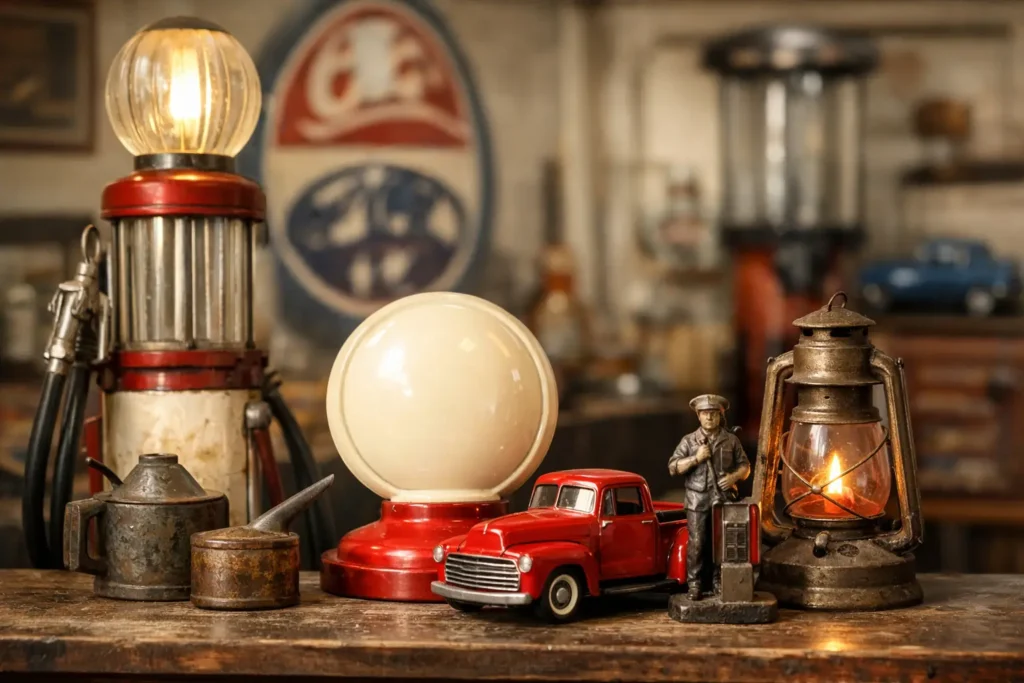
A single piece can set the whole room. Put a real early porcelain gas sign on the wall, or an original visible gas pump by the door, and suddenly the space stops looking decorated and starts looking collected. That is the difference with the best antique petroliana display pieces – they carry history, scarcity, and the kind of surface wear that repros never get right.
For serious collectors, petroliana is not one category. It is a broad field with different price levels, different display demands, and very different standards for originality. For decorators and business owners, the goal is usually simpler: buy one or two pieces with real visual authority and avoid the fake-looking stuff that floods the market. Either way, the best display pieces are the ones that still read clearly from across the room, hold their value because they are original, and fit the space without looking forced.
What makes the best antique petroliana display pieces
The strongest pieces usually do three things at once. They have immediate brand recognition, honest age, and enough presence to anchor a wall, corner, or showroom. A small but dead-original motor oil sign with strong color can out-display a larger but weaker piece if the graphics are right and the condition is clean enough to show well.
Condition is where collectors separate from casual buyers fast. Mint examples bring top money, of course, but display value and investment value are not always identical. A sign with edge wear, light chips, and good gloss can still be a far better display piece than a polished-up example with suspect restoration. Originality comes first. After that, color, graphics, rarity, and size all matter.
Brand matters too, but not in a lazy way. Everyone knows Shell, Texaco, Gulf, Mobil, Sinclair, and Standard. Those names stay popular because the graphics are strong and the nostalgia is built in. But there are regional oil brands, dealership pieces, and obscure service station items that can be tougher to find and, in the right room, more interesting than the usual headline names.
Porcelain signs still lead the field
If you ask experienced collectors what belongs at the top of any list of best antique petroliana display pieces, original porcelain signs are going to come up first. They were made to be seen. The color is deep, the gloss is hard to beat, and even worn examples have real character.
Single-sided porcelain pump plates, dealer signs, and large station signs all have their place. A small pump plate can work in a home garage, office, or bar where wall space is tight. A large two-piece or three-piece porcelain sign is a different animal – more money, more wall, more impact. If the mounting holes are clean, the porcelain has not been touched up, and the colors are still lively, these pieces tend to stop people in their tracks.
There is a trade-off here. Large porcelain signs are expensive and increasingly hard to source in strong, untouched condition. Smaller originals sometimes make more sense for buyers who want quality without forcing a room around one oversized piece.
Why porcelain displays so well
Porcelain enamel has depth. Under good lighting, the surface reflects differently than tin or paper, and that is part of why original gas and oil signs look right in person and flat in photos. Chips, spidering, and edge wear are not necessarily problems unless they overwhelm the graphics. Honest wear often helps prove the piece has lived a real life.
Gas pumps are statement pieces, not filler
An original visible gas pump or early restored-frame pump with original components is one of the strongest freestanding forms in petroliana. It gives a room height, shape, and period presence that flat wall pieces cannot. In a showroom, garage, dealership lobby, or restaurant entry, few things work harder.
But pumps are not casual buys. Size, weight, and restoration history all matter. Many have had parts swapped over the years. Some are dressed up with reproduction globes, faces, and decals. That may be fine for pure decor buyers, but for collectors it changes the whole conversation. An honest pump with correct age, proper hardware, and real surface history carries more credibility than a slick hybrid built to impress from ten feet away.
Visible pumps versus later pumps
Visible pumps tend to have more sculptural appeal and are often the first style decorators want. Later electric pumps can be easier to place, and some have excellent art deco lines. It depends on the room. If you want one hero piece, go bigger and earlier. If you want a cleaner row display, later pumps can make more sense.
Original globes bring color and lightness
Gas pump globes are among the most flexible display pieces in the category. A strong original globe can sit on a shelf, top a pump, or work inside a glass case. They do not need a lot of space, but they still carry major visual punch.
Collectors pay attention to body color, script style, manufacturer markings, lenses, and whether the globe is complete and period-correct. Milk glass examples with bold graphics are especially popular, and original lenses with the right paint and age are far better than cleaned-up marriages. A rare globe on the wrong body is still a compromised piece.
For buyers who want genuine petroliana without committing to a six-foot sign or full pump, globes are often one of the smartest entry points. They are display-friendly, highly collectible, and easy to rotate with the seasons or with other pieces in a room.
Oil cans and lubricants add depth to a collection
Not every strong display starts with a wall sign. Original motor oil cans, grease tins, and lubricant containers add texture and variety that larger pieces cannot. On shelving, counters, and workshop displays, they create the kind of layered look serious collections need.
The best examples usually have great graphics, strong lithography, and enough original paint to read clearly. Full cans often bring more interest than empties, but condition, rarity, and label survival matter just as much. Paper labels can be tougher than lithographed metal because they rarely survived without staining, fading, or tears.
This is also one of the easiest categories to get wrong. Repainted cans, fantasy labels, and assembled groupings are common. If a can looks too fresh, too glossy, or too convenient, slow down.
Clocks, thermometers, and service station accessories
Some of the best antique petroliana display pieces are the pieces that make a room feel lived in rather than staged. Original advertising clocks, thermometers, oil bottle racks, tire ashtrays, and shop service pieces do exactly that. They break up a display and make the larger signs feel grounded.
Clocks are especially strong because they combine utility with brand graphics. A real station clock with period face, correct movement, and original housing has more life than a static sign. Thermometers are another favorite because they fit narrow spaces and bring good vertical lines to a wall.
These accessory pieces are often better bought with a collector’s eye than a decorator’s eye. Small differences in backs, faces, housings, and mounting details can separate original from assembled. That is where dealing with a specialist matters.
Neon is powerful, but originality gets tricky fast
Original petroliana neon has enormous appeal. It is bright, architectural, and hard to ignore. A true period gas or oil neon sign can carry a room on its own, especially in commercial spaces, garages, or finished basements built around American roadside style.
It is also one of the toughest categories in the hobby. Tubing gets replaced. Transformers get updated. Housings get repainted. Sometimes that is unavoidable if the sign is meant to function, but buyers need to understand what they are paying for. Original can mean original sign body with later working neon, or it can mean a mostly untouched survivor with age throughout. Those are not the same thing, and they should not be priced the same way.
How to choose the right piece for your space
The best antique petroliana display pieces are not always the rarest ones. They are the ones that fit the room and still hold up under scrutiny. A restaurant may need one dramatic porcelain sign and a cluster of smaller cans and clocks around it. A private collector might prefer a rare regional pump plate that other collectors recognize instantly. A home garage can often handle better quality if you buy smaller and stay original.
Think about sightlines first. What do you see when you walk in? What reads from twenty feet away? Then think about scale. Oversized pieces can dominate a room in a good way or make it feel like a set. There is no prize for cramming too much on the wall.
And be honest about your tolerance for restoration. Some buyers want untouched surfaces only. Others are fine with professional stabilization if the piece remains honest and displays well. The mistake is paying untouched money for altered material.
Buy originality first, rarity second
This is the part that saves people money. Originality beats almost everything else. A common brand sign that is unquestionably real will always be more satisfying than a rare piece with bad questions around it. The market is full of reproduction signs, fantasy globes, married pumps, and dressed-up accessories. Some are obvious. Some are made to fool people who should know better.
That is why collector-led sourcing still matters. At Road Relics, the appeal has always been simple: original stock, straight answers, and no confusion about what is real and what is not. In this category, that kind of clarity is worth a lot.
If you are building a display that will still look right ten years from now, buy fewer pieces and buy better ones. One real porcelain sign, one honest globe, and one good clock can do more than a room full of copies ever will. The right piece does not just decorate the space – it gives the space a backbone.