
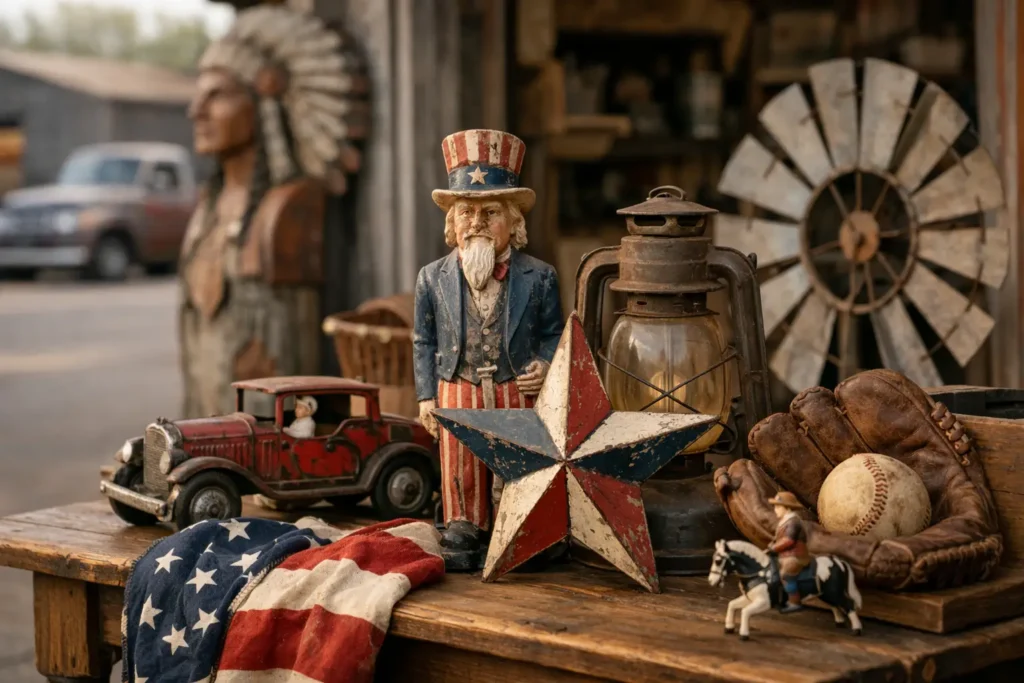
A real porcelain gas sign tells on itself the moment you get close. The gloss sits deep, the colors have age, the steel has the right wear, and the backside usually says more than the front. If you want to buy authentic Americana antiques, that is the difference that matters – not staged patina, not a made-up story, and not a cheap reproduction dressed up as old.
For serious collectors and smart display buyers, Americana is not one category. It is a broad field with very different standards of rarity, condition, and value. A country store trade sign, a dealership neon, a Coca-Cola tin, and a gas and oil porcelain piece may all fit the look, but they do not carry the same market behavior. Some are decorative first. Others are collector-grade objects with long-established demand. Knowing where one ends and the other begins is what keeps you from overpaying.
How to Buy Authentic Americana Antiques Without Guesswork
The first rule is simple. Buy the item, not the pitch. Original Americana has physical evidence that tends to hold up under scrutiny. Reproductions usually depend on atmosphere – fake rust, exaggerated distress, fantasy graphics, or a seller who talks more about how “great it looks” than what it actually is.
Start with construction. On antique advertising, material is one of the fastest tells. Porcelain signs should show proper steel bases, real fired enamel, honest chipping, and wear that makes sense around mounting holes, edges, and high points. Tin signs should have correct lithography, age in the finish, and period fabrication. Neon signs need scrutiny at both the glass and the housing. A real old neon sign can have replacement transformers or later wiring and still be authentic, but the sign body, lettering style, can, and overall build need to line up with the period.
Then look at graphics and typography. Originals usually reflect the design language of their time in a way reproductions struggle to fake. Letter spacing, logo versions, color combinations, border treatments, and even the proportions of the panel often reveal whether a piece was company-issued or made later for decoration. Fantasy pieces are a major problem in this category. They may use a real brand name, but if the sign design never existed in period, it is not authentic Americana in any serious collecting sense.
Provenance helps, but it is not a substitute for knowledge. A good backstory is nice. A good sign is better. If a seller cannot explain why a piece is original, what era it belongs to, whether it is single- or double-sided, how the condition affects value, and where restorations may be present, you are already missing key information.
What Counts as Authentic Americana
Authentic Americana is not just “old American stuff.” In the collector market, it usually means original period objects tied to American commerce, travel, small business, industry, and popular culture. That is why advertising signs are such a strong category. They connect directly to roadside history, local stores, filling stations, bottlers, farm supply, transportation, and the rise of national brands.
The best pieces tend to have three things working in their favor. They were company-issued, they survived in unusually strong condition, and they came from categories with deep collector bases. Gas and oil, soda advertising, automotive, dealership signs, transportation, and regional trade signs all fit that profile. Folk art signage can also be exceptional, though values there often depend more on form, originality, and visual impact than brand recognition.
Condition is where a lot of buyers get tripped up. “Old” is not the same as “good.” Heavy damage can hurt value, but perfect-looking surfaces can raise other questions. In many cases, moderate honest wear is exactly what you want to see. Chips, edge wear, light fade, surface scratching, and backside oxidation can all be acceptable if they match age and use. Overcleaning, repainting, added gloss, and artificial distress usually do more harm than good.
The Best Places to Buy Authentic Americana Antiques
Where you buy matters almost as much as what you buy. The safest path is a specialist dealer with a long track record in original advertising and Americana. Not a general vintage seller. Not a decorator import business. A real category specialist who can stand behind the item and speak plainly about originality, condition, and rarity.
That matters because this market has layers. Anyone can sell an old-looking sign. Far fewer can identify whether a porcelain panel is period-correct, whether a clock face has been redone, or whether a neon assembly is an old body with later components. Specialists tend to know the common fakes, the scarce variants, the regional pieces that do not show up often, and the difference between a hard find and a common sign with a big price tag.
Auctions can be productive, but they are not automatically safer. Good auction houses do serious vetting. Others rely too heavily on consignor descriptions or broad disclaimers. If you buy at auction, you need to do your own homework and factor in the premium, shipping risk, and the possibility that photos are not telling the full story.
Private sales can be excellent if you know the seller or the collection. Many great Americana pieces still trade quietly between collectors. But private deals require even more confidence in your own eye. There is less structure, less recourse, and often more pressure to move quickly.
Online marketplaces are mixed. There are legitimate original pieces there, and there are also reproductions, altered signs, and outright fantasy items. If you shop online, treat photographs as the starting point, not the proof. Ask for close-ups of the edges, mounting holes, backside, corners, and any damaged areas. The backside of a sign is often one of the best places to judge age and originality.
A dealer like Road Relics earns trust in this market by doing what should be standard but often is not – clearly presenting original stock as original stock and standing behind it with a real guarantee. In a category flooded with copies, that kind of no-nonsense accountability matters.
Questions to Ask Before You Buy Authentic Americana Antiques
A serious seller should be able to answer direct questions without hedging. Ask whether the piece is 100 percent original, whether any restoration has been done, whether parts have been replaced, and whether the sign is company-issued or a later decorative item. If the answer gets slippery, move on.
Ask about dimensions because scale changes everything. A small original sign may be rarer than a larger one, but buyers often overfocus on rarity and forget where the piece will live. A six-foot neon can be spectacular, but if the install is wrong, the transformer setup is poor, or the room fights the piece, the result falls flat.
Ask about condition in practical terms. Not “Is it nice?” Ask where the chips are, whether there is touch-up, whether the metal is bent, whether the flange is solid, whether the clock runs, whether the can is original, whether the neon glass is old or replaced. Good sellers appreciate specific questions because they know specifics are what separate real buyers from casual browsers.
When Price Is High for the Right Reason
Authentic Americana is not cheap when it is right. That is especially true for scarce porcelain, strong Coca-Cola pieces, dealership signs, early transportation advertising, and clean neon with real visual presence. A high price by itself does not mean quality, but truly rare original material almost never trades at bargain-bin levels.
That said, expensive is not always better. Sometimes the smartest buy is a sign with honest wear, strong color, and unquestioned originality rather than a cleaner example with restoration issues. Sometimes a regional sign with lower national name recognition has more personality and better long-term appeal than a common national brand piece. It depends on whether you are buying for investment, display, or both.
The strongest collections usually mix eye appeal with discipline. They are not built by chasing every shiny object. They are built by buying fewer, better pieces with real age, real surface, and real place in American commercial history.
If you are going to spend real money, buy the piece you will still want ten years from now when the room changes, the market shifts, and the novelty wears off. Authentic Americana has a way of holding its ground when the object is the real thing.