
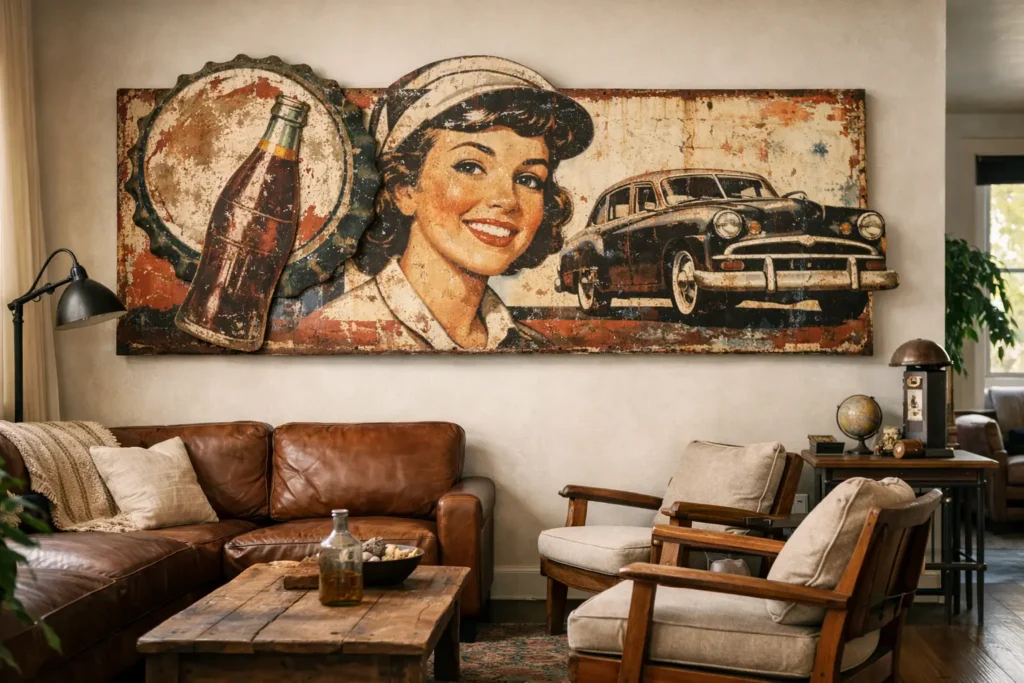
A big original sign can make a room fast. One piece of porcelain gas and oil, a dealership panel, or a double-sided trade sign has more presence than a wall full of filler. That is why collectors keep asking how to display large vintage signs without making the space look staged, damaging the sign, or doing something that hurts value.
The short answer is this: treat the sign like a real piece of history first, and wall decor second. Size, weight, condition, lighting, and originality all matter. A rare 1940s porcelain sign with edge chips and honest gloss does not get displayed the same way a lighter tin sign does, and an original neon piece brings a whole different set of demands.
How to display large vintage signs without hurting them
The first mistake people make is hanging a large sign based only on where it looks good. The better approach is to start with what the sign needs. Look at the material, dimensions, weight, mounting holes, and weak points. Original porcelain signs are tough, but that does not mean they should be stressed with bad hardware or pulled unevenly against a wall. Older tin signs can flex, crease, or bow if you force them flat. Framed cardboard or fiber pieces are even less forgiving.
If the sign still has original factory mounting holes, use them whenever possible. Those holes are part of how the piece was meant to live. Avoid drilling new holes into any original sign. That is the kind of shortcut that collectors notice immediately, and it can hurt both eye appeal and value.
Stud mounting is usually the right move for anything with real size and weight. Drywall anchors may hold on paper, but many large original signs are heavier than people expect, especially double-sided examples in metal frames or porcelain pieces with substantial steel behind them. Use hardware that spreads pressure evenly. Rubber or felt spacers can help keep the face off the wall slightly, which reduces abrasion and gives the piece a cleaner float.
There is also a basic collector rule here: never let a sign hang in a way that creates stress around chipped holes, cracks, or weak edges. A rare sign with honest wear is one thing. A rare sign that gets worse because it was displayed badly is another.
Picking the right room for a large sign
A large vintage sign needs room around it. If you cram it between shelves, door trim, and furniture, it loses the thing that made you buy it in the first place. These pieces were built to be seen from a distance – on roadsides, storefronts, service stations, and dealership walls. Give them some breathing room.
Garages, shops, game rooms, bars, and showroom-style interiors are the obvious fits, but a big sign can also work in a living room, hallway, office, or kitchen if the scale is right. The key is not whether the room is formal or casual. The key is whether the sign looks intentional there.
A large Coca-Cola sign over a polished back bar can look perfect. So can a big automotive dealership sign in a clean modern garage with just a few strong pieces around it. But if the room already has ten visual focal points, a large sign becomes noise. Sometimes the best display decision is editing everything else back.
Ceiling height matters too. A tall wall can handle a vertical sign or a large horizontal panel mounted with enough margin above and below. In a lower room, the same sign may feel cramped unless you keep surrounding furniture low. You want the sign to dominate the wall, not overpower the whole room.
Wall mounting, leaning, or freestanding
Most large signs belong on the wall, but not every one has to be hung flush. Some display better with a little depth or structure around them.
Wall mounting gives the cleanest look and usually makes the most sense for valuable collector pieces. It keeps the sign stable and lets the graphics read properly. For oversized porcelain or embossed metal signs, this is often the best answer.
Leaning can work with very large signs, especially in commercial settings, loft spaces, or garages where the sign is part of a bigger visual story. But it is only smart if the floor is level, the wall is stable, and the bottom edge is protected. Bare concrete can chew up an original edge over time. A simple padded block or display rail makes a difference.
Freestanding display is often overlooked. Large double-sided signs, lollipop signs, and signs with original brackets or can frames can look stronger on a fabricated stand than they do pinned to a wall. This is especially true if the sign was originally meant to project outward. A collector-grade display should respect the form of the piece, not force it into a flat presentation just because that is easy.
Lighting changes everything
If you want to know how to display large vintage signs well, pay attention to light. A great sign in bad light looks dead. A sign with strong color, gloss, and depth can come alive with the right setup.
Natural light can be beautiful, but direct sun is a long-term problem. It can fade paint, heat metal, and put stress on older surfaces. For paper-backed or painted pieces, it is even worse. If the sign is original and scarce, keep it out of sustained direct sunlight.
Track lighting, angled picture lights, and controlled overhead spots are usually safer and more effective. Porcelain signs especially benefit from raking light because it picks up gloss, depth, and those little surface variations that originals have. Tin signs and painted wood trade signs may need softer light to avoid glare.
Neon is its own category. An original neon sign is both sign and light source, which means the surrounding room matters even more. It looks strongest with some ambient darkness around it, but not in a room so bright that the tubes disappear or so dark that the sign becomes the only thing you can see. Original neon also needs proper electrical inspection and safe mounting. This is not the place to improvise.
Match the sign to the space, not the trend
A lot of people buy one big sign and then design the whole room around a social media version of “vintage.” That usually ends up looking fake, even when the sign is real. Original signs carry enough authority on their own. They do not need a pile of reproduction gas pumps, fake crates, and distressed furniture trying to help.
A cleaner approach almost always wins. One large original sign paired with a few honest period pieces has more impact than a themed room full of copies. If the sign is strong, let it lead.
This matters in commercial spaces too. Restaurants, bars, dealerships, and retail stores often want nostalgia, but the best rooms do not feel like movie sets. They feel collected. An original sign with age, gloss loss, edge wear, or old touch-up tells a better story than a perfect fantasy piece ever will.
Think like a collector, even if you are decorating
There is a difference between displaying a sign and storing one in plain sight. A proper display shows the piece without exposing it to unnecessary risk. Keep signs away from moisture, heat vents, active exterior doors, and areas where people brush against corners. In restaurants or bars, grease and smoke build-up can become a real issue over time.
Condition should guide placement. If you own a scarce sign with exceptional color and strong gloss, put it where it can be appreciated without being vulnerable. If a sign has heavy patina, edge loss, or a rough back but still reads well from the front, it may be better suited to a more casual room where wear makes sense.
If you rotate pieces, do it carefully. Large signs get damaged during moving, not just hanging. Gloves help with porcelain and polished surfaces. Padding matters. So does patience. Most of the damage seen on original signs did not happen in the 1940s. It happened last year in somebody’s garage.
At Road Relics, we have handled enough original stock to know that the best displays usually come from restraint, not overthinking. Buy the right piece, give it the right wall, mount it correctly, and let the age speak for itself.
When one large sign is enough
Not every wall needs a group. In fact, many large vintage signs look best alone. Big dealership signs, gas and oil porcelain, oversized soda pieces, and early embossed advertising can command an entire wall without any help. When you cluster too much around them, you dilute the impact and make the room feel busy.
If you do pair pieces, keep a clear hierarchy. Let the large sign be the anchor, then support it with smaller related material that does not compete – maybe a clock, a flange sign, or a modest framed ad from the same category. That kind of pairing feels collected instead of crowded.
A large original sign has already done the hard part. It survived. It still has presence. Display it with some respect, and the room takes care of itself. The best setup is usually the one that makes the piece look like it belongs there and still reminds you it came from somewhere else entirely.