
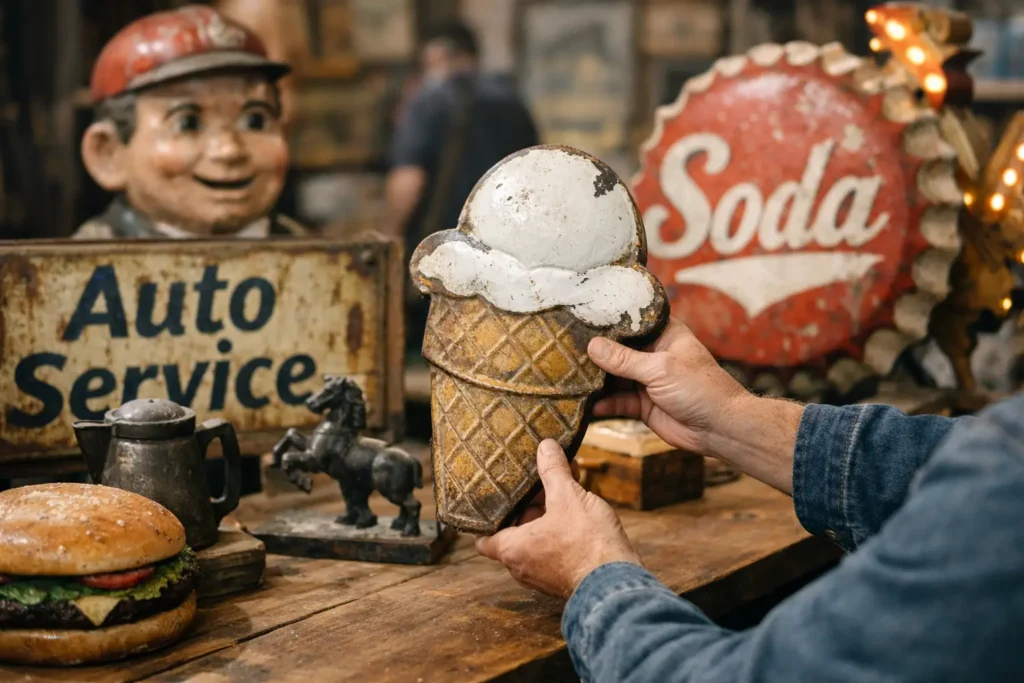
A real vintage trade sign has a way of stopping you cold. Maybe it is a hand-lettered butcher sign with hard-earned wear, or a porcelain barber sign that still carries the color and weight of the era it came from. Either way, if you are learning how to buy vintage trade signs, the first rule is simple: buy the piece, not the story.
Too many buyers get pulled in by age claims, vague provenance, or a seller who knows just enough buzzwords to sound convincing. Trade signs are one of the most rewarding corners of the advertising world, but they are also full of repaints, later copies, fantasy pieces, and honest misidentifications. If you want original material, you need to look at the sign the way a collector does.
How to buy vintage trade signs without getting burned
The best vintage trade signs were made to do a job. They advertised a business, marked a storefront, identified a service, or pulled a customer in off the street. That means the strongest pieces usually have utility, regional history, and visual punch all working together. A good sign does not need a dramatic backstory. It should show you what it is.
Start with the basic question: was this sign made in the period it claims to be from, and was it actually made for trade use? Original trade signs tend to have construction details that make sense for their age and purpose. Wood signs often show proper age in the grain, shrinkage, oxidation on hardware, and wear where they were hung or handled. Porcelain pieces should have honest edge wear, natural crazing where appropriate, and mounting holes that make sense. Tin signs can show scratches, fade, and weathering, but the wear should not look staged or evenly applied.
If the distress looks too artistic, be careful. Real age is usually uneven. It collects in corners, around edges, and where the sign met the elements. Reproduction wear often looks theatrical, like somebody tried to make the whole surface old at once.
Know what kind of trade sign you are buying
Not every old sign fits the same lane, and value can swing hard depending on category. A general store, butcher, tailor, druggist, shoemaker, barber, bakery, or gas station related trade sign all appeal to different buyers. Some cross over into folk art. Others lean more heavily into commercial history. Some are decorative first, collectible second. Others are serious collector pieces.
That matters because the buying standard changes with the category. A hand-painted wooden shop sign may carry major value in its lettering, layout, and untouched surface, even if it is rough. A porcelain dealership or service trade sign may need to clear a much higher bar on originality because that category has been copied hard for years. Neon and reverse glass signs bring another layer of complexity because restoration can either preserve or seriously hurt the piece, depending on how it was done.
Before you buy, decide what matters most to you. Are you buying for wall appeal, investment-grade originality, or a specific business category? There is no wrong answer, but there is a wrong price if you pay top collector money for a decorative piece with weak originality.
Originality matters more than perfection
This is where a lot of newer buyers get sideways. They want the cleanest example in the room, so they end up buying something over-restored, repainted, or flat-out wrong. In vintage trade signs, original condition usually beats pretty condition.
A sign with honest chips, fade, surface rust, or edge wear can still be the better piece if the paint, porcelain, lettering, and structure are period correct and untouched. Once a sign has been heavily repainted, clear coated, artificially aged, or rebuilt beyond recognition, the collector value drops. Sometimes a repair is acceptable. Sometimes a stabilization is necessary. But a repair should not rewrite the sign.
You want to ask direct questions. Has it been repainted? Has the frame been replaced? Are the grommets, mounting holes, or hardware original? Has porcelain been touched up? Has neon been retubed, and if so, was it done in a way that respects the original pattern and components? Serious sellers should be able to answer without dancing around it.
Study the construction, not just the graphics
The artwork gets attention first. The build tells the truth.
On wood signs, look for backboards, old nail patterns, oxidation, age splits, shrinkage, and whether the paint sits naturally on the surface. If the wood looks centuries old but the paint looks fresh, something is off. On metal signs, inspect the flange, mounting points, fold marks, and edge profile. Original porcelain signs usually have the right steel base, correct layering, and wear that follows actual use. Reproduction porcelain often misses the weight, gloss, hole pattern, or edge finish.
Lettering style matters too, but it should support the build, not override it. Plenty of fantasy pieces borrow old fonts and period colors. Good graphics can fool buyers who never turn the sign over.
That is one reason experienced collectors ask for back photos, close-ups of mounting holes, edge shots, and detailed surface images. A single front-facing glamour photo is not enough when real money is on the table.
Price follows rarity, condition, and desirability
A sign is worth what the market will pay, but the market is not random. Certain trades, brands, and forms carry stronger demand. Large porcelain signs, double-sided examples, strong graphics, regional pieces, and unusual businesses can all push value higher. So can untouched condition.
But rarity by itself does not always mean expensive. A rare trade sign for a narrow local business may be scarcer than a nationally known advertising sign and still bring less because fewer buyers are chasing it. On the other hand, a visually strong barber, soda, auto service, or gas and oil trade sign can bring aggressive money because it checks the boxes for both collectors and interior display buyers.
This is where experience helps. A sign can be rare and still be a hard sell if the color is dead, the wording is awkward, the subject is too narrow, or the condition is past saving. Another sign can be common by comparison and still outsell it because it looks right on the wall.
Buy from people who stand behind what they sell
If you are serious about how to buy vintage trade signs, pay close attention to the seller as much as the sign. A trustworthy seller will describe originality clearly, call out issues, provide dimensions, show detailed photos, and answer questions without getting defensive. They should know the category, not just the price.
A vague listing is usually a bad sign. So is language that leans on “style,” “in the manner of,” “vintage look,” or “estate fresh” without actually stating whether the piece is original. Some sellers simply do not know what they have. Others know exactly what they are doing.
That is why strong guarantees matter. If a dealer is selling original material, they should be prepared to stand behind that claim. At Road Relics, that standard is straightforward because original means original, not reproduction, not replica, and not fantasy material dressed up to look the part.
Patina is good. Damage is a judgment call.
Collectors like age, but not all damage lands the same way. Edge wear, mild fade, small chips, and stable surface rust often add character and prove authenticity. Structural damage is different. Heavy warping, active rot, major porcelain loss, severe metal fatigue, or crude repairs can hurt both appearance and value.
Still, it depends on the sign. A scarce one-of-a-kind trade sign may deserve a longer leash on condition than a common example. If the graphics are exceptional and the surface is untouched, buyers will forgive a lot. If the sign is already easy to find, condition becomes more important.
The key is to know whether you are buying a survivor, a project, or a problem. Those are not the same thing, and the price should reflect it.
Measure the sign against your space and your collection
This sounds obvious, but people get caught up in rarity and forget scale. A trade sign that feels huge in a photo may be underwhelming in person. Another may be so large and heavy that it becomes difficult to hang, move, or display properly.
Dimensions matter. So does presence. Double-sided projecting signs, carved wood pieces, and porcelain examples with bold color can dominate a room in the right way. But if you are building a focused collection, the sign should also make sense next to what you already own. A random buy that does not fit your lane can turn into shelf filler, no matter how original it is.
Good collecting is editing. You do not need every sign. You need the right sign.
Patience usually beats impulse
The biggest mistake buyers make is thinking they have to force the next deal. They see an old trade sign, they know decent originals are getting harder to find, and they talk themselves into a piece with too many questions attached. That is how collections get padded with compromises.
Better to wait for an example with real surface, solid construction, and a seller who can speak plainly about what it is. The right sign will cost more sometimes, but it usually hurts less than buying the wrong one twice.
A good vintage trade sign carries more than graphics. It holds the wear of actual use, the shape of the business it served, and a piece of American roadside and storefront history. If you stay disciplined on originality, condition, and source, you will end up with pieces that still look honest twenty years from now. That is the kind of buy you never need to explain.