
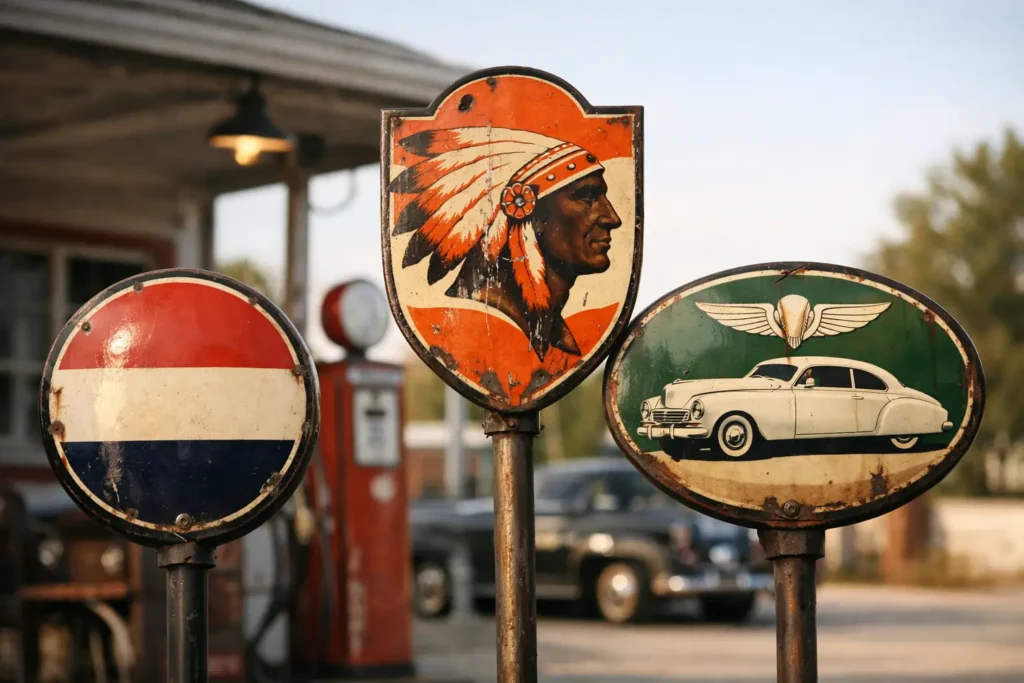
A real dealership sign does not need much help. Hang an original Ford, Chevrolet, Plymouth, or Cadillac porcelain piece on the wall, and the room changes fast. That is why porcelain dealership signs keep pulling in serious collectors, garage decorators, and buyers who want one authentic centerpiece instead of a wall full of copies.
These signs sit in a strong part of the market because they check several boxes at once. They are tied to the American auto trade, they were made to work hard outdoors, and many were produced in lower numbers than common gas and oil advertising. Good ones have color, scale, and instant recognition. Great ones also have scarcity, strong gloss, clean factory porcelain, and the kind of honest wear that tells you they lived a real life on a building or showroom wall.
Why porcelain dealership signs stand out
Dealership advertising has a different feel from general automotive signs. A dealership sign was not just selling a brand in the abstract. It marked a place of business. It told you where the local franchise was, what line they handled, and often what kind of service reputation they wanted to project. That gives these pieces a more grounded history.
Porcelain was the right material for that job. It held color well, handled weather, and gave manufacturers a clean, durable surface that looked substantial from the street. Multi-color porcelain on steel also gave dealership signs a presence that paper, tin, or cardboard pieces could not match. Even now, an original porcelain dealership sign has depth and surface character that reproductions rarely get right.
For collectors, that matters. You are not just buying a logo. You are buying a surviving piece of early roadside commerce, built to represent a brand in public and built well enough that some examples are still here generations later.
What makes a dealership sign desirable
Rarity is the first driver, but it is not the only one. Brand matters. Ford and Chevrolet have broad demand, especially from buyers with period garages, car collections, or dealership memorabilia walls. Cadillac, Buick, Oldsmobile, Chrysler, Dodge, and Packard can bring strong interest as well, particularly when the design is bold or the sign has a better-than-average presentation.
Size matters too. A small flange sign can be a sharp display piece and easier to place, but larger single-sided or double-sided dealership signs tend to carry more visual punch. Condition matters in a more nuanced way. Collectors expect edge wear, mounting bruises, chips, and some field damage on true outdoor porcelain. The question is whether the wear looks honest and whether enough of the original surface remains to give the sign strong eye appeal.
That last point separates average signs from memorable ones. A sign with scattered chips but rich color and strong gloss can still be a killer piece. A sign with heavy restoration, dead surface, or suspiciously perfect condition often raises harder questions.
Eye appeal beats perfection
This is where newer buyers sometimes get turned around. They chase the least damage instead of the best sign. With porcelain dealership signs, overall presence usually counts more than technical flaw count. If the graphics are strong, the lettering is clean, and the porcelain still has life, the sign can display beautifully even with wear.
On the other hand, a sign with less damage but weak color, over-cleaning, or bad touch-up can feel flat. Advanced collectors know that. They buy what looks right from across the room and still holds up when you get close.
How to spot original porcelain dealership signs
The hard truth is simple – dealership signs have been reproduced, fantasized, and “improved” for years. Some fakes are obvious. Others are made just well enough to fool buyers who are shopping on pictures alone.
Start with construction. Original porcelain signs were manufactured with steel under the glass-like porcelain coating. The weight, thickness, mounting holes, and formed edges should make sense for the era and intended use. The porcelain itself should have a natural baked finish, not a sprayed-on look. Color transitions, backing, and edge treatment often tell the story faster than the front graphics.
Then look at the wear. Real age usually shows up where it should – around mounting holes, edges, corners, and spots that would have taken weather or handling over decades. Fake wear often looks staged, repetitive, or disconnected from the sign’s design and shape. Fresh-looking damage on top of an otherwise artificial surface is a warning sign, not a selling point.
Maker marks can help, but they are not a shortcut. Many original signs were produced by known manufacturers, and certain back stamps or markings support authenticity. Still, marks can be copied or misunderstood. You need to judge the whole sign, not one feature.
Reproduction trouble spots
Some dealership brands get hit harder than others. Ford ovals, Chevrolet bowties, and signs tied to high-demand marques are regular targets. The more recognizable the image, the more likely somebody has tried to cash in on it. That does not mean every example is bad. It means you need to be more disciplined.
A seller should be able to speak plainly about originality, age, condition, and any restoration. If the language gets slippery, or everything is described with broad claims and no specifics, back up. In this category, confidence comes from knowledge, not sales talk.
Condition, restoration, and value
Porcelain signs are survivors, not time capsules. Most originals have some level of wear. The market accepts that. What it does not accept equally is undisclosed restoration or damage that has been dressed up to look better than it is.
Professional restoration has its place, especially for rare pieces that would otherwise present poorly. But restoration changes the equation. For a collector who wants untouched originality, repairs, re-porcelain work, in-painting, or rebuilt areas will lower desirability. For a decorator who mainly wants a big period-correct statement piece, restoration may be acceptable if the sign is priced accordingly.
That is why clear condition reporting matters. Chips, rust bleed, edge hits, extra holes, touch-up, replaced brackets, and repairs should all be discussed plainly. Originality and condition are where real value lives. If either one is fuzzy, the price should not be premium.
Where porcelain dealership signs fit in a collection
These signs work in more places than many buyers expect. In a serious automotive advertising collection, they anchor a wall because they carry both brand recognition and business history. In a garage or showroom, they often outperform smaller signs because they have that unmistakable dealership presence. In a retail or hospitality setting, an original porcelain sign gives the room credibility that reproductions just do not have.
There is also a practical angle. Buyers who are tired of generic vintage-style décor usually end up here. One original dealership sign with honest age does more for a space than a stack of newly made pieces pretending to be old. The difference is visible right away.
For collectors, dealership signs can also be a smart lane within broader Americana and automotive advertising. They are specific enough to build a focused group, but broad enough to allow real variety across brands, shapes, color schemes, and regional history.
Buying with confidence
The best porcelain dealership signs are not common, and that scarcity is exactly why buyers need to slow down. Ask direct questions. Is it original? Has it been restored? Are the holes factory? Is the porcelain original on both sides? Does the wear make sense? If the seller cannot answer without hedging, you have your answer.
This is one area where specialist knowledge pays for itself. A dealer who has handled original stock for years can usually spot problems quickly and explain why a sign is right or wrong in plain English. That matters more than glossy descriptions. At Road Relics, that collector-first approach is the whole point – original pieces, honest condition, and no confusion about what you are buying.
The strongest examples still stop people in their tracks because they were built to do exactly that. If you buy carefully, porcelain dealership signs give you more than decoration. They give you a real piece of roadside and showroom history, with all the character that comes from surviving the long way around. Pick the sign that still has presence, still has truth in the surface, and still feels like it belonged out front where people could see it.