
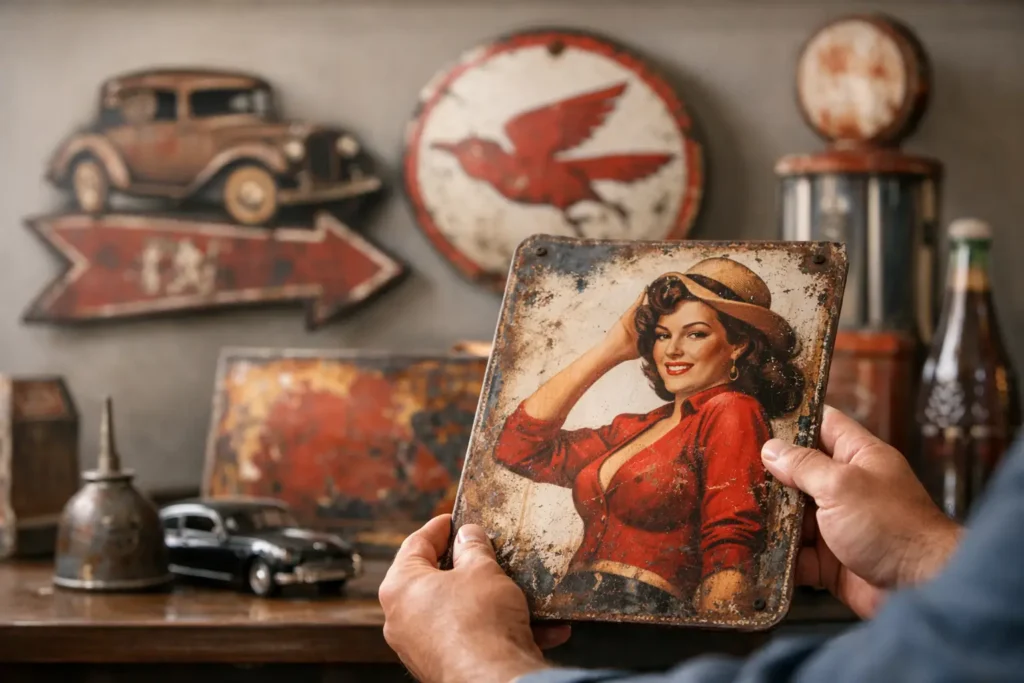
A real vintage sign tells on itself the minute you get close. The porcelain has depth. The wear sits where decades would actually put it. The back shows age that makes sense. And if the piece is right, it has presence that a reproduction never quite pulls off. That is why vintage signs still matter to serious collectors, decorators, and business owners – not just as wall décor, but as original American artifacts with history, scarcity, and real market value.
The problem is that the market is full of confusion. Plenty of signs look old. Plenty are aged on purpose. Plenty get called vintage when they are nothing more than modern decorative copies. If you are spending real money, whether for a garage, showroom, restaurant, or long-term collection, you need to know what separates an original piece from a fantasy item made to fool the eye.
Why vintage signs still have a strong market
People buy vintage signs for different reasons, but the strongest pieces usually appeal on more than one level. A collector might be chasing a specific oil brand, soda maker, dealership sign, or transportation piece because it fits a focused collection. A designer may want scale, color, and instant character on a blank wall. A business owner may need a centerpiece that does more than decorate the room.
The best signs do all of that at once. They carry strong graphics, period typography, and a clear connection to roadside America, gas stations, bottlers, farm supply stores, auto dealers, or old retail counters. They are not generic. They were made to work hard in the real world, and that practical purpose is part of the appeal.
There is also a simple truth that experienced buyers understand – originals have a ceiling that reproductions never reach. A fake might fill a space. An original can anchor a room, start conversations, and in the right category, hold or grow value over time. That does not mean every old sign is an investment-grade piece. It does mean that authenticity changes the entire equation.
What separates original vintage signs from reproductions
This is where buyers either protect themselves or get burned. Originality is everything. Not “old style.” Not “made to look vintage.” Not “from an old design.” Original means company-issued, period-made, and honestly surviving from the era it came from.
Materials matter
Porcelain signs, embossed tin signs, painted metal, early cardboard, wood trade signs, and neon all age differently. A porcelain sign should show correct enamel, steel base construction, and wear patterns that make sense around mounting holes, edges, and exposed high spots. Tin signs can show oxidation, paint loss, and edge wear, but the aging has to read naturally. Neon has its own set of tells, from transformer setup to tube style and housing construction.
A lot of bad pieces fall apart under simple inspection. The colors are too fresh. The gloss is wrong. The distressing is theatrical. The back is artificially rusted while the front has wear placed for effect. Good original signs usually show consistency. Even when they are rough, they tend to be honest.
Wording and graphics matter
Collectors know that fonts, logos, slogans, and manufacturing marks can expose a bad piece fast. If a company slogan was not used until the 1950s, it does not belong on a sign claimed to be from the 1930s. If the layout combines graphics from different eras, that is a red flag. Fantasy signs often borrow popular brand names and create a piece that looks appealing but never existed in period.
This is where category knowledge matters. Gas and oil, Coca-Cola, transportation, dealer signs, and agricultural advertising all have their own production history. The more expensive the category, the more careful you need to be.
Condition is important, but honesty is more important
Collectors talk about condition constantly, and for good reason. Condition affects value. But condition only means something when the sign is real and untouched in the ways that matter.
A sign with chips, edge wear, and surface fade can still be a strong piece if the graphics are right, the colors still present well, and the damage matches real age and use. In many cases, honest wear actually adds credibility and character. A sign that spent years on a service station wall should not look like it came out of a box yesterday.
On the other hand, heavy restoration, overpainting, replaced porcelain, patched metal, or altered surfaces can hurt value fast. There are cases where professional restoration makes sense, especially for display-driven buyers, but the trade-off is clear – restored signs usually do not bring the same respect or money as strong originals with honest surface.
That is why serious sellers describe condition plainly. They talk about size, color, gloss, chips, rust, touch-up, warping, repairs, and how the sign displays. No dancing around it. No hiding behind vague language.
The categories collectors keep chasing
Some categories never cool off for long because they sit at the center of American advertising history. Gas and oil signs remain among the strongest, especially major brands, regionally scarce names, and large porcelain examples with bold graphics. Automotive dealer signs, tire advertising, and transportation pieces stay in demand because they work equally well in collections and in commercial interiors.
Coca-Cola and soda advertising still pull a wide audience, from established collectors to first-time buyers who want recognizable Americana. Neon remains powerful because it combines advertising with light and motion, though originality, restoration quality, and functionality all affect value. Trade signs and folk art signage often appeal to buyers who want one-of-a-kind display pieces that feel less mass-produced and more tied to a place or business.
What rises fastest usually comes down to rarity, graphics, size, and survival rate. A common sign in average condition may always have buyers. A rare sign with strong color and clean graphics can move into a different league entirely.
Buying vintage signs without getting fooled
If you are buying on looks alone, you are taking a risk. The safer approach is to ask direct questions and expect direct answers.
Start with originality. Is the sign period original, or is it a reproduction? If original, has it been restored, repainted, clear-coated, or repaired? Ask for clear front and back photos, close-ups of mounting holes, edges, chips, and any marked damage. If it is porcelain, ask about gloss, touch-up, and whether both sides are original if it is a double-sided piece. If it is neon, ask what is original to the sign and what has been replaced.
Provenance can help, though not every good sign comes with a perfect paper trail. Still, long-term ownership, old collection history, and a seller with real category experience count for a lot. So does a money-back guarantee that does not leave the buyer holding the bag on shipping if authenticity fails. That kind of policy tells you whether a seller actually stands behind what they sell.
This is exactly why experienced buyers gravitate toward specialist dealers instead of gambling on vague listings. A seller who has handled original stock for decades sees problems faster, prices more accurately, and usually describes pieces in language collectors trust. At Road Relics, that collector-led approach matters because originality is not a marketing phrase. It is the whole business.
Display value and collector value are not always the same
A big, colorful sign with strong eye appeal can be perfect for a bar, garage, retail space, or office even if it is not the rarest example in the category. Meanwhile, a scarce regional sign with average graphics may carry more collector weight than a more dramatic-looking piece.
That is not a contradiction. It just means buyers should know their own goal. If you want a statement piece for interior display, scale, color, readability, and subject matter may matter most. If you are building a serious collection, rarity, originality, condition, and category importance usually come first.
The sweet spot is finding pieces that do both. That is where the best vintage signs live – strong enough to stop people in their tracks, solid enough to satisfy experienced collectors, and original enough to keep their story intact.
There is no substitute for handling real pieces, studying surfaces, and learning what honest age looks like. The more signs you see, the faster your eye gets. And once that happens, the right sign is hard to forget.