
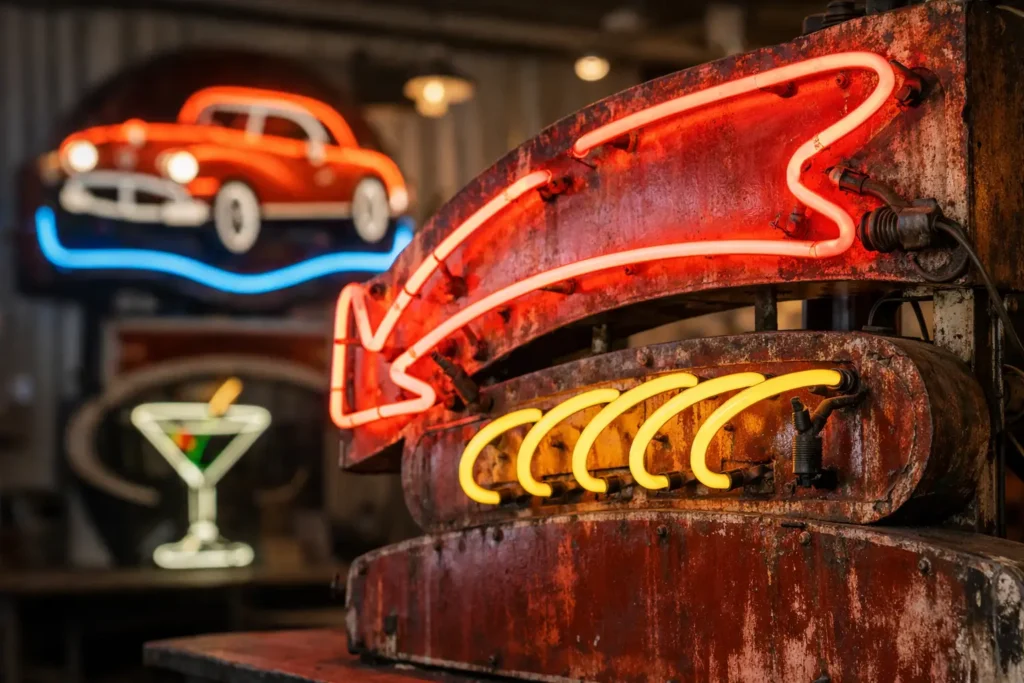
A real neon sign does something a flat sign never can. Even switched off, it has presence. Fired up, it changes the whole room. That is why antique neon signs sit in a different category from most advertising pieces. They are not just graphics or brand history. They are glass, gas, transformers, paint, metal, and craftsmanship working together, and when an original survives intact, collectors pay attention.
The problem is that neon has always been easy to fake badly and hard to preserve well. A lot of buyers love the look but do not always know what separates a period piece from a later shop-made fantasy sign. In this part of the market, originality matters more than hype. Age alone is not enough.
Why antique neon signs carry real collector weight
The best antique neon signs are tied to strong American brands, roadside culture, and a period when businesses competed for attention after dark. Gas and oil stations, dealerships, beer distributors, motels, diners, and soda bottlers all used neon because it worked. It pulled drivers off the road and into the building.
That history gives original neon broader appeal than many categories of advertising. A porcelain sign may bring sharper graphics and tougher durability, but neon adds movement, glow, and atmosphere. That makes it attractive to both advanced collectors and buyers building a serious display in a garage, showroom, restaurant, or private bar.
Rarity also plays a big part. Neon was fragile when new and has only gotten harder to keep complete over time. Tubes break. Housings rust. Transformers fail. Backings get repainted. Components are swapped. A sign that survives with strong original features, honest age, and the right look is simply harder to find than most people expect.
What makes an antique neon sign original
This is where buyers need to slow down. Originality in neon is not always all or nothing. A sign can have an original metal can and face but replacement tubing. It can have original glass patterning but a later transformer installed for safe operation. It can also be a complete fantasy piece made decades after the brand it advertises. Those are very different things, and they should not be priced the same.
An original period sign usually shows consistency. The metal housing, mounting method, paint, typography, tube layout, and wear should make sense together. You want the construction to fit the era and the brand. Factory-made advertising neon from major oil companies, soda brands, and automotive names tends to have a certain discipline in scale and design. Later decorative pieces often look too clean, too convenient, or just slightly off in proportion.
The glass itself can tell part of the story. Older tubing work often has a hand-bent character that is hard to fake convincingly. The backing and can should also show honest age rather than artificial distress. If a sign is claimed to be old but every surface looks newly finished except for a few staged scratches, that is a red flag.
Provenance helps when it exists, but many signs come out of old collections, closed businesses, barns, shops, and estate holdings without a paper trail. That is normal. In those cases, experience matters. You are buying the piece, not the story attached to it.
Condition matters, but it depends on what was changed
Collectors talk about condition constantly because in neon it affects both desirability and value in a big way. Still, condition is not just about whether the sign lights up.
A non-working original sign can be more desirable than a heavily restored one that burns bright. If the can, face, and tube pattern are original and untouched, many collectors will take that over a sign that has been rebuilt so completely that little period material remains. On the other hand, some buyers want a display-ready piece for a commercial interior and are perfectly happy with professional replacement transformers or repaired tubing if the look stays true to the original.
That is why restoration is a trade-off. Good restoration can stabilize a sign, make it presentable, and keep it usable. Bad restoration can erase age, alter colors, flatten the character, and push a rare sign into decorative territory. Repainted cans, incorrect neon colors, sloppy tube spacing, and modern materials used without regard for period appearance all hurt the piece.
Honest wear is usually better than over-restoration. Edge wear, oxidation, minor paint loss, and age in the metal are part of the appeal if the sign still reads well and has not been messed with. Collectors have no problem with age. They do have a problem with guessing what is original and what is not.
How value is really judged in the antique neon signs market
No serious collector prices a neon sign on one factor alone. Brand strength matters. A desirable gas and oil name, early automotive brand, soda piece, or dealership neon usually has a stronger market than a generic shop sign. Size matters too. Large signs have impact, but they are harder to store, ship, and install, so the buyer pool can narrow at the top end.
Design is huge. Some signs are rare but not especially attractive. Others have color, motion, shape, and strong letter style that make them stand out across the room. Those are the pieces decorators chase as hard as collectors. If a sign has visual authority, it tends to stay in demand.
Then there is survival rate. Certain categories just did not make it. Early station neon, dealership signs, and pieces with unusual figural elements can be extremely scarce in any condition. If you get rarity, strong brand recognition, and good eye appeal in the same sign, value goes up quickly.
Originality still sits at the center. A scarce sign with replaced guts may still be desirable, but a scarce sign with strong untouched features will generally outrun it. That is especially true with advanced collectors who know how few real survivors remain.
Red flags buyers should not ignore
The biggest problem in this category is wishful buying. Someone sees a famous logo in neon and wants it to be old, so they stop asking the right questions.
Be careful with signs that have no age where it should show, or age that appears only where someone tried to create it. Watch for tube layouts that feel decorative rather than commercial. Be cautious with pieces described as antique when the hardware, paint, or construction clearly suggest a later build. If the seller cannot explain what is original, what has been replaced, and why they believe the sign is period, move on.
Measurements matter too. Factory signs tend to follow practical production dimensions. Fantasy pieces are often made to fit a wall rather than a brand standard. Also pay attention to the back of the sign. Buyers focus on the front, but the rear can reveal a lot about age, use, repairs, and whether the construction belongs together.
If you are buying from photos, ask for close views of the tubing, can, mounting points, transformer area, and paint. A trustworthy seller should not dodge that.
Where antique neon signs fit in a serious collection
Neon is often the anchor piece, not the filler. A great porcelain sign may establish the brand story, but an original neon often becomes the visual center of the room. It gives height, light, and a period atmosphere that other categories cannot match.
That does not mean every collection needs one. Neon takes space, care, and a little tolerance for maintenance. It is less forgiving than tin or porcelain. But for buyers building a meaningful Americana display, it is hard to top.
It also crosses over well into design. Collectors may care most about rarity and originality, while decorators may care about color and impact. The best signs satisfy both. That crossover is one reason top-end original neon has held attention for years.
At Road Relics, the standard is simple: original means original. In a market crowded with remakes and shop-built pieces, that distinction is not sales talk. It is the whole game.
Buying with confidence means knowing what you can live with
Every buyer has a line. Some want untouched examples, even if they do not light. Some want professionally serviced signs they can hang and enjoy immediately. Neither approach is wrong. The mistake is paying untouched money for restored material, or original money for a reproduction.
The right antique neon signs are not just wall decor. They are survivors from American commercial history, built to sell gas, soda, tires, beer, rooms, and cars to a passing public. If you buy carefully, they still do that job. They stop people cold, start conversations, and hold their ground in a room full of good things.
If a sign has the right brand, the right look, and the right honesty, you usually know it the minute you see it.