
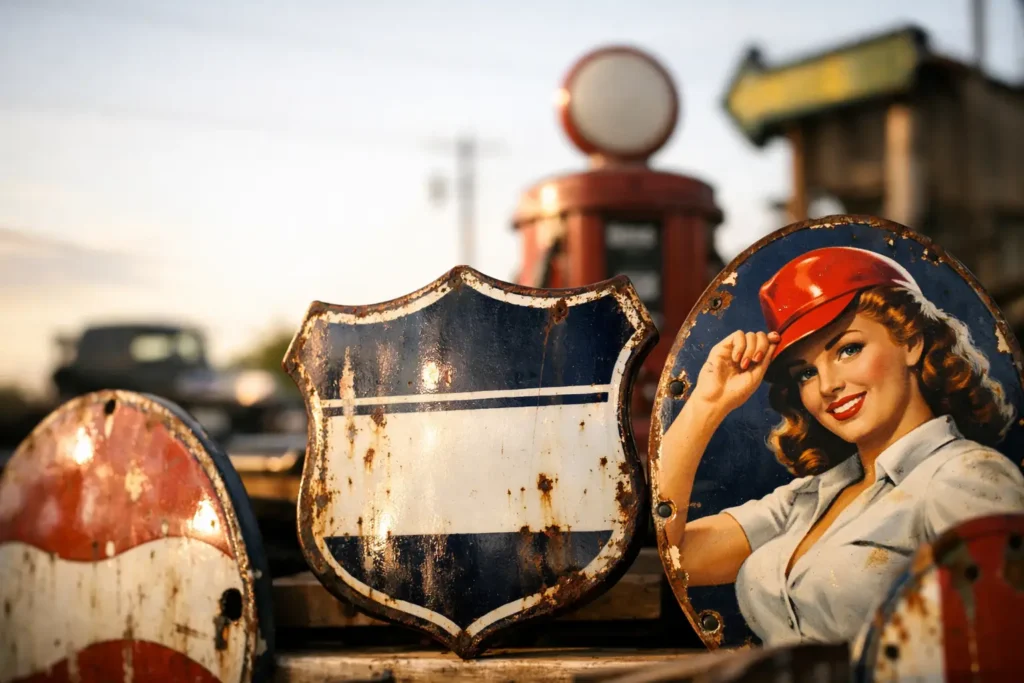
A real piece of roadside history does not need much help. Hang an original gas and oil sign with honest gloss, strong color, and a few battle scars on the wall, and the room changes fast. That is the pull of vintage porcelain signs – they were built to sell products hard, survive weather, and command attention from a distance, and they still do exactly that.
For serious collectors, decorators, and business owners, porcelain signs sit in a class of their own. They are not just old advertising. They are heavy, fired enamel on steel, made to last, and tied directly to American roads, service stations, dealerships, bottlers, and local commerce. When the sign is right, you can see the era in it. When the sign is wrong, you can usually feel that too.
What makes vintage porcelain signs different
Porcelain signs were made by fusing powdered glass to steel at high heat. That process gave them a hard, glossy surface with depth that paper, tin, and later plastic signage never really matched. Good originals have a kind of presence that is tough to fake. The color sits differently. The surface reflects light differently. Even wear has a different character.
That is one reason collectors keep coming back to them. Another is survival rate. These signs were used outdoors on gas stations, farm buildings, dealerships, highways, and storefronts. Many were shot up, rusted out, scrapped, or replaced. The ones that remain, especially examples with strong color and legible graphics, carry both decorative weight and real scarcity.
Single-sided pieces have their place, but many of the most desirable signs were made double-sided for pole or bracket mounting. Add in strong brand recognition – gasoline, soda, tires, automotive service, tractor, or transportation – and demand rises quickly. Size matters too. A small flange sign can be a great display piece. A large shield or dealership sign can anchor an entire room.
Why collectors chase original porcelain
A lot of buyers start with the look. Bright reds, deep blues, crisp whites, bold typography, and company logos from another era are hard to beat. But after a while, most collectors stop buying only with their eyes. They start buying originality, condition, rarity, and category strength.
Original porcelain carries authority that reproductions never will. It lived the life. It was actually mounted, exposed to weather, and used in trade. That matters, whether the sign came from a gas station canopy, a motor oil distributor, a bottling plant, or a dealership wall. Collectors are not just paying for graphics. They are paying for authenticity and the history attached to it.
The best pieces also cross over well. A top-grade porcelain sign appeals to seasoned advertising collectors, automotive enthusiasts, Americana buyers, and interior designers looking for a statement piece that is not manufactured to look old. That wider demand supports value, but it also means strong originals do not sit around long.
How to judge vintage porcelain signs like a collector
Condition in this category is rarely simple. A sign can be rough and still be highly desirable if the graphics are rare enough. Another can be cleaner but less important. There is no one rule that covers every piece.
Start with the basics. Look at gloss, color strength, chips, edge wear, rust bleed, touch-up, and whether the mounting holes look right for age and use. Porcelain loss around the outer edge is common. What matters is how much, where it is, and whether it distracts from the field and main lettering. Large chips in dead space may be easier to live with than smaller damage across a logo or central graphic.
Then look at construction. Gauge of steel, shape, factory grommets, hanging holes, and the way the porcelain lies on the metal can tell you a lot. Originals often show age in a natural pattern. Reproductions and fantasy pieces tend to miss that rhythm. They can be too clean in the wrong places, too artificially distressed, or simply wrong in size, color, wording, or layout.
Maker marks can help, but they are not a free pass. Companies such as Veribrite, Baltimore Enamel, and Ingram Richardson produced excellent period signs, and marks from known manufacturers are useful. Still, fake examples can borrow familiar details. A stamp alone does not make a sign right.
The problem with reproductions and fantasy pieces
This is where many buyers get burned. The market has been flooded for years with reproductions, repops, and signs for brands or formats that never existed in period. Some are sold honestly as decorative pieces. Others are not. That difference matters.
A reproduction can look good on a wall from across the room, but it does not belong in the same conversation as an original company-issued sign. It has no collector standing, no real historical weight, and no business being represented as authentic. If the price feels low for the brand, size, and condition, there is usually a reason.
Fantasy pieces are worse because they are designed to fool the buyer with a name or graphic that sounds plausible. The brand may be real, but the sign itself was never an original period issue. That is why experience counts. You want to buy from somebody who knows the difference between old stock, later reissue, reproduction, and made-up nonsense – and is willing to stand behind it.
Which categories hold the strongest interest
Gas and oil remains one of the deepest and most competitive areas in the hobby. Signs from Sinclair, Texaco, Gulf, Standard, Mobil, Phillips 66, and other major brands have broad recognition and strong display appeal. Automotive service and tire signs also stay in demand, especially pieces tied to garages, dealerships, batteries, spark plugs, and road service.
Coca-Cola and soda advertising remains a powerhouse because the graphics are iconic and the buyer pool is broad. Transportation, farm, and tractor signage have loyal followings as well. Local dealership or regional brand signs can be especially interesting because they are often tougher to replace than national issues. A sign does not have to be from the biggest name in America to be a serious piece. Sometimes the rare regional example is the one advanced collectors fight over.
Display value matters, but so does scale
A porcelain sign should fit the room and the wall, but it should also fit the buyer. Not everybody needs a massive curb sign or a huge double-sided station piece. Smaller signs, pump plates, and flange signs can deliver just as much period character without taking over the entire space.
For decorators and shop owners, color and readability often come first. For long-time collectors, rarity and originality usually lead the decision. Neither approach is wrong. It just means the right sign depends on whether you are building a room, a themed collection, or a serious investment-grade lineup.
Lighting changes everything too. Porcelain has life under natural light and a depth under warm indoor lighting that flat signs often do not. That is part of why originals work so well in garages, bars, showrooms, and retail spaces. They were made to grab attention, and decades later they still do it.
Buying vintage porcelain signs without making expensive mistakes
The safest buyers ask hard questions. Is it original? Is there any touch-up? Are both sides original on a double-sided piece? Has it been clear coated? What are the exact dimensions? Where is the damage? Does the seller guarantee authenticity?
Those questions are not nitpicking. They are how you protect yourself. A trustworthy seller should be direct about condition and quick to point out flaws. In this business, confidence comes from transparency, not polished language. At Road Relics, that collector-first standard is the whole point. If a sign is represented as original, it should be exactly that.
Photos matter, but they do not tell the entire story. Close-ups of chips, edges, mounting holes, and surface gloss help. So does a description that sounds like it came from someone who has actually handled thousands of signs, not someone flipping decor. Provenance can help when it exists, but deep category knowledge often matters more than a story.
The other mistake is buying too quickly because the name on the sign is famous. Brand recognition can cloud judgment. A weaker example of a popular sign is not always a better buy than a stronger, rarer sign from a less obvious category. Good collectors learn to balance appeal, condition, scarcity, and price.
Some signs are bought for investment, some for nostalgia, and some because they simply stop you in your tracks. The best originals can do all three. If you stick with authentic pieces, learn the tells, and buy from people who know the field, vintage porcelain signs reward patience in a way few advertising categories can. And if a sign still feels alive after all these years, that is usually the one worth making room for.