
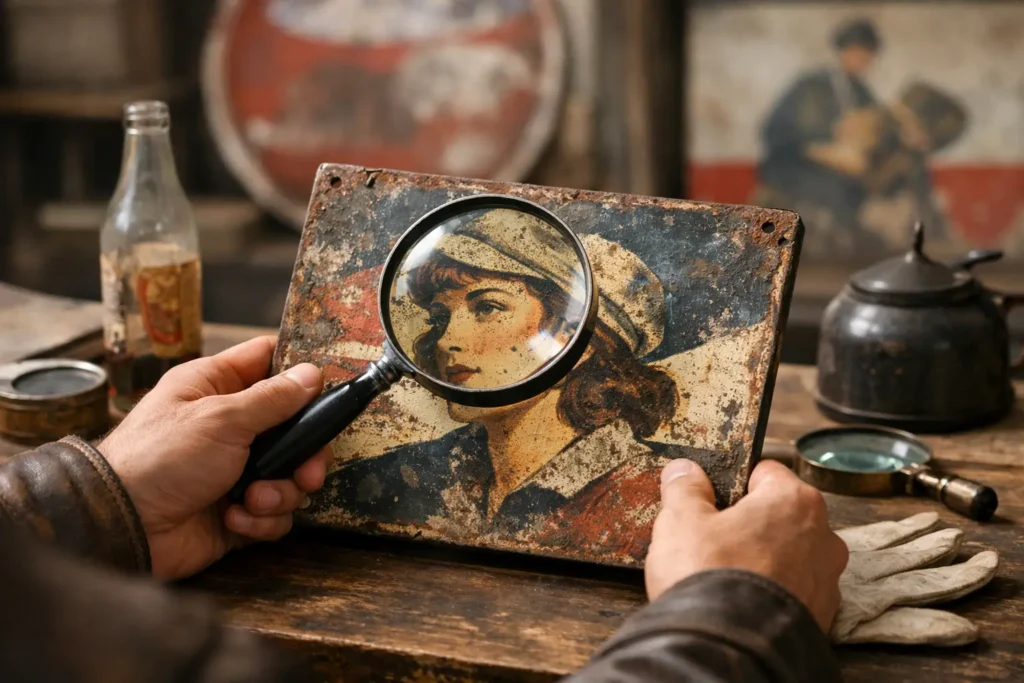
A sign can look old, feel heavy, and still be wrong. That is the hard truth of this business. If you want to know how to authenticate antique advertising, you have to get past surface age and start reading the piece the way a long-time collector does – construction, finish, wear, lettering, mounting, and story all have to line up.
The mistake most buyers make is trusting one clue. They see rust and assume age. They see chips and assume porcelain. They hear “barn fresh” and stop asking questions. Real antique advertising does not need a dramatic story to be good, but it does need to make sense. Originals usually tell a consistent story from the front, the back, the edges, and the hardware.
How to authenticate antique advertising without guessing
Authentication starts with the category. A porcelain gas and oil sign should not be judged the same way as a tin soda sign, a reverse-painted trade sign, or a neon piece with a later transformer. Different materials age in different ways, and the best fakes usually fool buyers who apply broad rules instead of category-specific ones.
Start by asking what the item was originally made to do. Was it a roadside sign built to survive weather, a point-of-sale display meant for a store interior, or a dealer clock designed for everyday commercial use? Original purpose affects thickness, mounting holes, finish, and expected wear. A large outdoor porcelain sign should show age differently than a small interior cardboard display. If the construction does not fit the function, that is your first warning.
Then study the manufacturing method. Porcelain signs were made by fusing enamel to steel. Tin signs were lithographed or painted on sheet metal. Advertising clocks were built from parts that can be dated by case style, movement, dial printing, and backs. Neon signs often have a mix of old and replaced components, which does not automatically kill authenticity, but it changes value and has to be disclosed honestly.
Read the wear, not just the look
Real wear has rhythm. It builds where a sign was hung, handled, washed, or exposed to weather. Reproduction wear is often too even, too dramatic, or placed where it photographs well. That is one of the oldest tricks in the hobby.
On porcelain, look closely at chips. Old chips usually have logic. They appear around mounting holes, outer edges, corners, or spots where the sign would have taken impact. The exposed steel may show oxidation, but it should not look like somebody attacked it with acid last week. Freshly forced damage often leaves bright, unnatural-looking edges or rust patterns that are too active for the surrounding surface.
On tin, pay attention to paint loss and oxidation. Original tin signs can show honest fade, edge wear, small bends, and rub marks from use. Reproductions often overdo the distressing. They may have fake scratches that cut through the image in a way that feels staged, or rust that sits on top of modern paint instead of growing naturally from vulnerable areas.
Patina is where many buyers get trapped. Good age is not just dirt or dullness. It is the accumulation of time, storage, handling, and environment. Sometimes a piece with less wear is the better piece because its condition is consistent. Sometimes a sign with strong wear is perfectly right because the wear matches how and where it lived. It depends on the object, not the romance.
Materials and construction tell the truth
If you are serious about how to authenticate antique advertising, get comfortable turning pieces over. The back can save you from an expensive mistake.
Porcelain signs should have a weight, steel body, and edge profile that fit the era and maker. Multi-piece porcelain can show different attachment methods depending on age and manufacturer. Mounting holes matter too. Clean, sharp, freshly drilled holes are a bad sign on an item that is supposed to be 80 or 100 years old. So are holes that do not fit the design or expected mounting pattern.
Tin signs should show proper gauge, folded or crimped edges when appropriate, and printing methods that match the period. If the graphics are too crisp in the wrong way, or the metal feels thin and modern, stop right there. Old signs can be vibrant, but they should not feel digitally clean.
With advertising clocks, originality gets more complicated. Cases, dials, glass, hands, motors or movements, backs, and cords all need to be considered together. A clock can be period-correct in appearance and still be assembled from mixed parts. That does not always make it worthless, but it does mean it is not fully original. In this category especially, honesty about what has been replaced is everything.
Neon is another category where all-or-nothing thinking causes trouble. Many original neon signs have had transformers, wiring, or tubing repaired over the years. The frame, can, face, or pattern may still be old and highly desirable. The key is knowing what is original to the sign and what has been professionally updated. Collectors pay for originality, but they also understand that electric signs lived hard commercial lives.
Study the graphics and typography
Most fantasy pieces fall apart in the artwork. The logo may be close but not quite right. The colors may be too loud. The slogan may not belong to the period. Letter spacing can be off in a way that a casual buyer misses but an experienced collector spots in seconds.
That is why brand history matters. Gas and oil, soda, automotive, farm, and dealership signs all followed company style standards that changed over time. If the script, shield, border, mascot, or wording does not match known examples from the claimed era, there is a problem. You do not need to memorize every variation, but you do need to compare the graphics to authentic period examples from trusted sources and long-held collections.
Size matters too. Reproductions often borrow a known design and print it in a size that was never originally issued. That happens constantly with porcelain. A sign can look convincing until you realize the dimensions are wrong for the company and use.
Marks, makers, and provenance
A maker’s mark can help, but it is not a free pass. Marks can be copied, added, or misread. Still, original manufacturer stamps, date codes, and production details are useful when they appear where they should and look right under close inspection.
Provenance is even better. If a sign came from an old service station, dealership, bottling plant, or long-time collection, that history adds confidence. So do old photos, receipts, estate records, and decades of collector ownership. Provenance does not replace inspection, but it strengthens the case when the physical evidence already points in the right direction.
This is where the seller matters. A knowledgeable seller should be able to explain why a piece is original, what condition issues exist, what has or has not been restored, and where the piece fits in the hobby. If the answer is vague, defensive, or built on hype, move on. In this market, confidence should come from details, not sales talk.
Restoration is not the same as reproduction
Collectors sometimes confuse restoration with fakery. They are not the same thing. A sign can be original and still have touch-up, a repaired flange, replacement neon tubing, or an updated clock motor. The issue is disclosure.
Restoration affects value, sometimes lightly and sometimes heavily, depending on rarity and quality. A scarce sign with professional restoration may still be a desirable collector piece. A common sign with heavy repaint may not be. The point is to know exactly what you are buying. Original paint, original porcelain, original can, original face, original clock body – those distinctions matter.
When a seller avoids that conversation, you should assume the answer will not favor the buyer.
The best protection is a trained eye and a trustworthy seller
No article can replace handling real pieces over time. The more originals you study, the harder it becomes for bad pieces to fool you. That is why seasoned collectors spend years looking at signs in person, comparing surfaces, learning known sizes, and remembering what authentic age actually looks like.
Until your eye gets there, buy slower. Ask for back photos, close-ups of holes and edges, dimensions, blacklight photos when useful, and a straight answer on originality. A money-back authenticity guarantee is not a small detail in this hobby. It is one of the clearest signals that a seller stands behind what they own.
There are still great original pieces out there – porcelain gas signs, dealership clocks, tin soda signs, trade signs, and rare Americana that carry real history in the metal, glass, and paint. The trick is not getting distracted by artificial age or a good story. Let the piece speak for itself, and if it does not hold up from every angle, leave it behind and wait for the right one.