
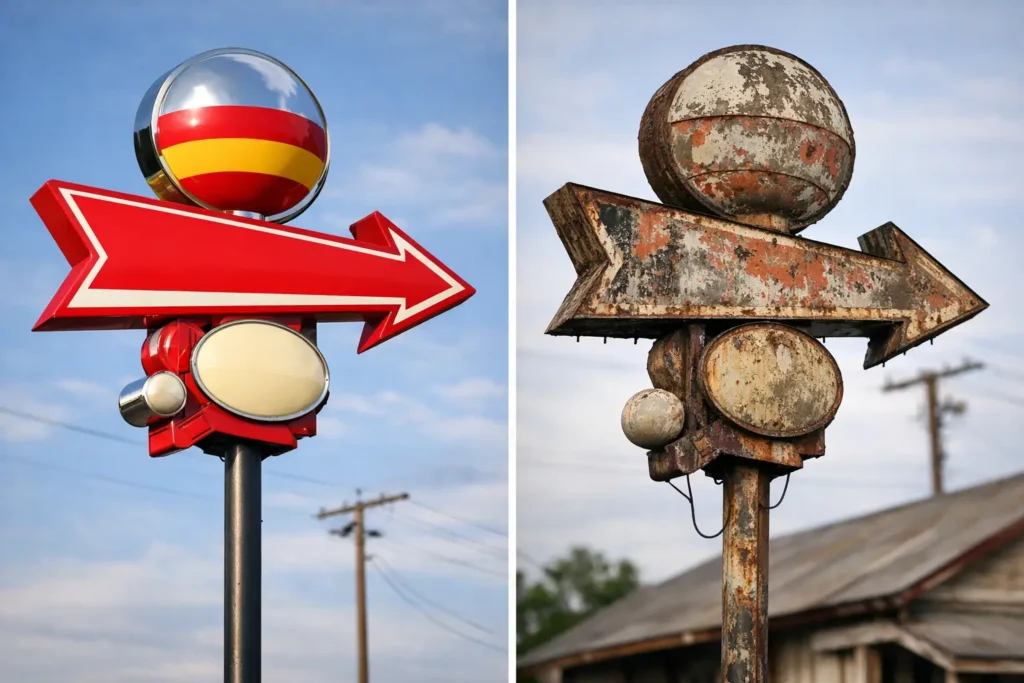
A glossy porcelain sign with perfect color and no chips can stop a room cold. So can a hard-used original with edge wear, fade, and twenty honest years hanging on a service station wall. That is why restored signs versus untouched originals is not a beginner’s question. It sits right at the center of how collectors judge authenticity, value, and what kind of history they actually want to own.
In this hobby, there is no single right answer. There is only the right answer for the piece, the buyer, and the level of honesty attached to it. If you have spent any real time around vintage advertising, you already know the problem. A sign can be beautifully restored and still lose collector appeal. Another can be rough as sandpaper and still bring stronger money because every inch of it is factory-made and untouched.
Why restored signs versus untouched originals matters
The difference starts with what collectors are buying in the first place. With an untouched original, you are buying surviving surface, original paint, factory porcelain, period mounting holes, age, wear, and all the evidence that the sign lived a real life. With a restored sign, you are buying a combination of old material and newer work. Sometimes that work is minor stabilization. Sometimes it is a complete cosmetic rebuild.
That distinction matters because originality is the foundation of value in antique advertising. Serious collectors do not just buy the image. They buy the object. They want the company-issued piece as it was made and as it survived, not a modern interpretation of how it should look.
That said, restoration is not automatically a dirty word. A rare sign with expert, disclosed restoration can still be desirable. In some categories, especially high-end porcelain and neon, restoration may be the reason a scarce example remains displayable at all. The problem is not restoration itself. The problem is hidden restoration, bad restoration, or restoration priced like untouched original condition.
Untouched originals carry the weight of proof
An untouched original tells its story plainly. The wear is where you expect it. The gloss breaks naturally. The backside often matches the age and use of the front. Mounting holes make sense. The rust, fade, scratches, and staining usually relate to how the sign was actually used, whether that was outdoors on a pole, inside a dealership, or nailed to a barn wall.
Collectors trust that kind of evidence because it is hard to fake well over an entire surface. Honest wear has rhythm to it. It does not look airbrushed. It does not stop abruptly. It does not create a suspiciously perfect sign with just enough damage left behind to seem old.
Untouched originals also hold stronger long-term appeal for advanced buyers. A sign with chips, fade, and patina may not be as flashy on day one, but it often has more credibility in the room. It looks right because it is right. In a serious collection, originality tends to win that argument.
There is also a market reality here. If two identical rare signs appear and one is all original with honest wear while the other has been restored, the untouched example usually gets the stronger interest. That is especially true when the original still has solid eye appeal. Collectors will forgive a lot if the surface is factory and the piece presents honestly.
When restoration helps and when it hurts
This is where restored signs versus untouched originals gets more nuanced. Restoration can help when the underlying sign is rare, structurally compromised, or so visually distracted by damage that the artwork is hard to read. An early porcelain gas and oil sign with significant chipping may still deserve professional work if the alternative is ongoing loss. A neon sign with fragile components may need careful restoration simply to exist as a display piece again.
But restoration hurts when it erases too much evidence, creates a false level of condition, or pushes the piece into something it never was. Over-restored signs often look loud in the wrong ways. Colors are too fresh. Lettering lacks the depth of period production. Artificial distressing gets added to mimic age. You end up with an object that photographs well from ten feet away and falls apart under real inspection.
The market usually punishes that. Even buyers who want a clean decorator piece do not like feeling fooled. A restored sign should be sold as restored, priced as restored, and described with plain language. Anything less is where trust starts to break down.
The value difference is real
In most cases, untouched originals outperform restored examples because originality carries scarcity. You can restore a damaged sign. You cannot recreate original factory surface once it is gone. That is why seasoned collectors often pay a premium for strong, honest survivors, even when they are not perfect.
The exact spread depends on rarity, category, and presentation. A common sign with heavy damage may benefit from quality restoration if the goal is display. A very rare sign may still bring substantial money even with significant restoration because there are so few chances to own one. On the other hand, a desirable untouched original with rich color and natural wear can sit in the sweet spot where both collectors and decorators want it.
This is also why blanket statements do not work. Some buyers chase untouched condition above everything else. Others want a dramatic wall piece and are comfortable with disclosed restoration if the sign is scarce and visually strong. The key is to know which market you are in before you buy.
How experienced buyers judge restored signs versus untouched originals
The first question is always whether the seller is being straight. If a sign is restored, where was the work done and how much of the surface was affected? Was it porcelain repair, repaint, metalwork, replacement neon tubing, or a total cosmetic overhaul? Good sellers answer that directly.
After that, buyers look at the sign itself. Front and back need to make sense together. Surface texture matters. Aging patterns matter. The edges and mounting holes often tell the truth fastest. On porcelain, collectors watch for gloss inconsistencies, filled chips, and color that does not match period standards. On tin, they look for repainted fields, artificial wear, and suspiciously clean transitions around lettering.
Provenance helps too, but it does not replace eyes-on judgment. A sign from an old collection is a plus. A sign with decades of ownership history is a plus. Neither one excuses undisclosed work. In this business, originality and honesty travel together.
For that reason, many serious buyers prefer specialists who deal in original material every day. At Road Relics, that standard is simple: original means original. That matters because the difference between a survivor and a dressed-up piece is often where the whole deal is won or lost.
Which is better for display
If the goal is pure visual impact in a garage, showroom, restaurant, or retail space, a restored sign may fit the room better. Clean color, readable graphics, and strong presence have obvious appeal. Not every buyer is building a condition-sensitive collection. Some are building atmosphere.
Still, untouched originals often have more character on the wall. Their wear gives them authority. They do not look manufactured for effect because they were not. In the right setting, the chips and fade are exactly what make the sign convincing and memorable.
That is why the best answer is usually tied to intention. If you want investment-grade originality, lean toward untouched examples. If you want a scarce image and can accept restored condition with full disclosure, buy the best piece you can afford and be honest about what it is.
Buy the sign, not the sales pitch
The biggest mistake in this hobby is buying a story instead of an object. Terms like old look, estate fresh, barn find, or professionally redone mean nothing by themselves. What matters is whether the sign is original, how much original surface remains, what work has been done, and whether the asking price reflects reality.
A good untouched original does not need excuses. A good restored sign does not need secrets. Both can have a place in a collection, but they are not interchangeable, and they should never be treated as equal just because the image is the same.
If you are spending real money, slow down and study the surface. Ask direct questions. Look for consistency, not perfection. In vintage advertising, the signs that hold respect over time are usually the ones that tell the truth the fastest.