
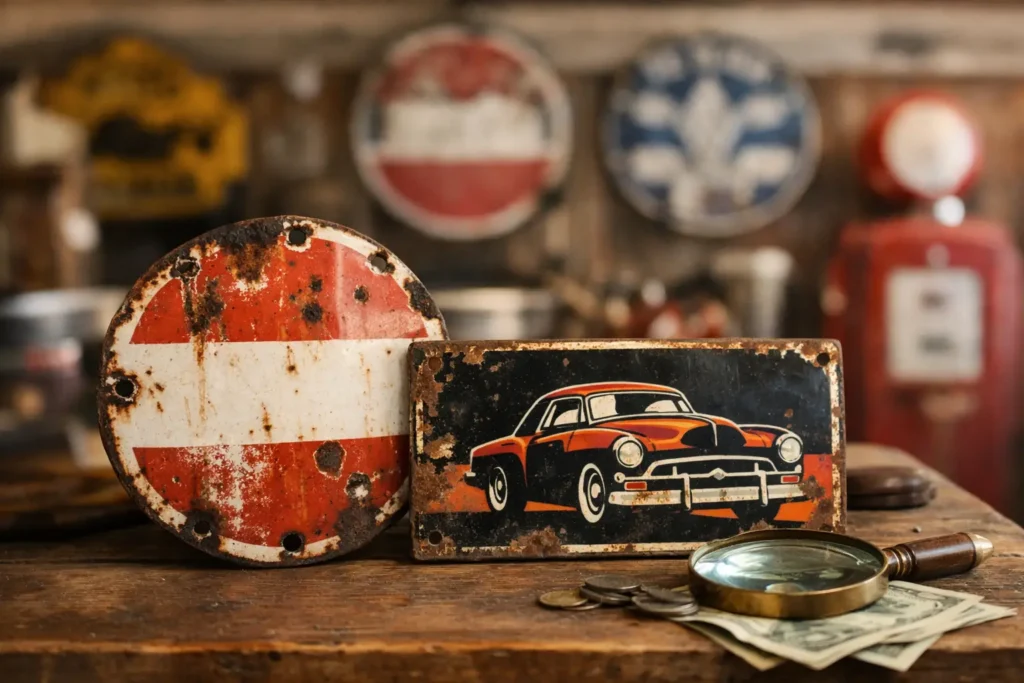
A beat-up gas station sign with edge chips and sun fade can still bring serious money. That surprises people until they spend time around original porcelain. So, are old porcelain signs valuable? Many are, but the honest answer is that value depends on originality, rarity, condition, subject matter, and whether collectors actually want that exact piece.
That last part matters. A sign is not valuable just because it is old. It becomes valuable when it is old, original, desirable, and hard to replace. In this category, the gap between a common piece and a top-shelf example can be enormous.
Are old porcelain signs valuable in today’s market?
Yes, plenty of old porcelain signs are valuable, and some are extremely valuable. Strong original examples from gas and oil, automotive, soda, farm, tire, tobacco, and transportation categories continue to sell well because they check several boxes at once. They have visual impact, they carry brand history, and they were made to survive outdoors, so they display beautifully decades later.
But this is not a market where every rusty sign is gold. A small, heavily damaged sign for a lesser-known regional business may have modest value. A rare double-sided porcelain sign from a major oil brand with strong gloss and color can sit in a completely different price bracket. The market rewards the right names, the right formats, and above all, originality.
Collectors have also become more educated. Twenty years ago, some buyers focused mostly on age and look. Today, experienced buyers want the full picture – whether the sign is period-correct, whether the mounting holes look right, whether the porcelain is original-fired, and whether the wear makes sense. Real value follows real confidence.
What makes old porcelain signs valuable?
The first driver is authenticity. An original company-issued porcelain sign will always command more respect than a reproduction, replica, or fantasy piece. In some cases, a reproduction may have decorative value, but it does not belong in the same conversation as a genuine period sign. If a buyer has doubts about authenticity, value falls fast.
Rarity comes next. Some signs were produced in huge numbers and survived in enough quantity that buyers can be selective. Others were made for a short time, in a specific region, or in formats that rarely lasted. A hard-to-find dealer sign, a scarce gas and oil brand, or a short-lived regional advertiser can bring strong money even with honest wear.
Condition matters, but not always in the way newcomers think. With porcelain, condition is not just about looking clean. Collectors study gloss, color, chips, touch-up, rust bleed, staining, edge wear, mounting hole damage, and whether both sides match the age if it is double-sided. An untouched sign with real patina often carries more credibility than one that has been cleaned up too aggressively or repaired poorly.
Size and format matter too. Larger pieces generally have more wall power and lower survival rates, which can help value. Double-sided signs, flange signs, dealer signs, and signs with strong graphics usually bring more interest than flat, text-only examples. A porcelain sign with bold imagery can appeal to both hardcore collectors and design buyers, which widens the market.
Then there is subject matter. Gas, oil, automotive, soda, and motorcycle signs remain dependable because they sit at the center of Americana collecting. The names people know – and the names advanced collectors chase – keep demand alive. Brand recognition is a real factor. A visually striking sign from a major company often outperforms a more obscure sign simply because more people want to own it.
Age helps, but age alone is not enough
One of the most common mistakes is assuming older automatically means more valuable. It does not. A porcelain sign from the 1910s or 1920s can be worth less than a stronger 1940s or 1950s example if the older sign has weak graphics, heavy damage, or limited demand.
What buyers really pay for is a combination of age, scarcity, eye appeal, and authenticity. A sign from the right era with great color and a desirable brand can outrun an earlier piece that lacks presence. That is why blanket pricing never works in this field.
Porcelain signs also occupy a special place because they were built to last. The fired enamel finish gives them a depth and gloss that modern reproductions rarely match. Even with chips and wear, original porcelain has a look that serious collectors recognize immediately. That visual quality helps support value over time.
Condition can raise or crush the price
Condition is where valuations spread apart fast. Two signs with the same graphics and same dimensions can sell at dramatically different levels depending on how they survived.
A high-grade example with strong color, deep gloss, clean fields, and only light edge wear is naturally going to command premium money. A sign with large areas of porcelain loss, severe rusting, extra holes, heavy bends, or amateur restoration can still have value, but it will not compete with a cleaner original.
That said, perfect is not always the goal. In this hobby, honest wear is accepted. In fact, some signs are so scarce that collectors will buy rough examples because they may not see another one for years. Scarcity can forgive damage. Common signs do not get that same forgiveness.
This is also where experience counts. A small chip is one thing. Repaint disguised as age is another. Touch-up around the border, fake staining, fresh drilling, or built-up repairs can change a sign from collectible to questionable in a hurry.
Why authenticity matters more than anything
If you want the short version of the market, here it is: original wins. An original porcelain sign with moderate wear usually has more real value than a reproduction in near-mint condition.
The reproduction problem is not minor. The sign market has been flooded for years with copies made to look old, along with fantasy pieces for brands or formats that never existed. Some are obvious. Some are dangerous because they are made just well enough to fool casual buyers.
That is why serious collectors look closely at the steel, the porcelain, the construction, the grommets or holes, the back side, and the overall aging pattern. They ask whether the sign makes sense for the maker, the era, and the brand. They want provenance when possible, or at least a seller who knows the category and stands behind the piece.
At Road Relics, that is the whole point of dealing in original stock. In this business, trust is part of the value.
Which porcelain signs tend to bring the strongest money?
Top-performing categories are usually the ones tied to established collector demand and strong visual identity. Gas and oil signs remain near the front because they connect directly to roadside America, service stations, petroleum branding, and automotive history. Dealer signs, pump plates, motor oil signs, and large station pieces all have an active buyer base.
Automotive signs also stay strong, especially those tied to major brands, parts makers, dealerships, tires, or transportation. Coca-Cola and other soda signs can be excellent as well, particularly early examples with attractive graphics. Farm and tractor advertising, motorcycle brands, tobacco, and regional transportation signs all have their own collector circles.
The strongest pieces often combine several traits at once. Think rare brand, great color, large size, double-sided format, early date, and unquestioned originality. That is the level where prices separate from the pack.
How to tell if your sign may be worth real money
Start with the basics. Is it porcelain enamel on steel, or just painted metal? Is it original, or something made later? Does the wear look natural? Is the brand desirable? Is the format common, or one you rarely see? Those questions will get you closer than guessing from age alone.
Look at the graphics too. Strong imagery sells. Bold logos, vivid colors, shield shapes, globes, arrows, service station themes, and figural designs often attract more interest than plain text signs. The sign has to work both as history and as display.
Then compare condition honestly. Collectors are used to chips and edge wear, but they discount major problems quickly. If you are unsure, get a knowledgeable opinion before cleaning it, repairing it, or trying to price it. A bad restoration can do more harm than good.
The smartest move is to treat every old porcelain sign as a case-by-case piece. Some are decorative. Some are collectible. A few are serious blue-chip objects.
If you have one in your hands, don’t ask only how old it is. Ask whether it is original, scarce, and desirable enough that another collector would have a hard time replacing it. That is where the real value starts.