
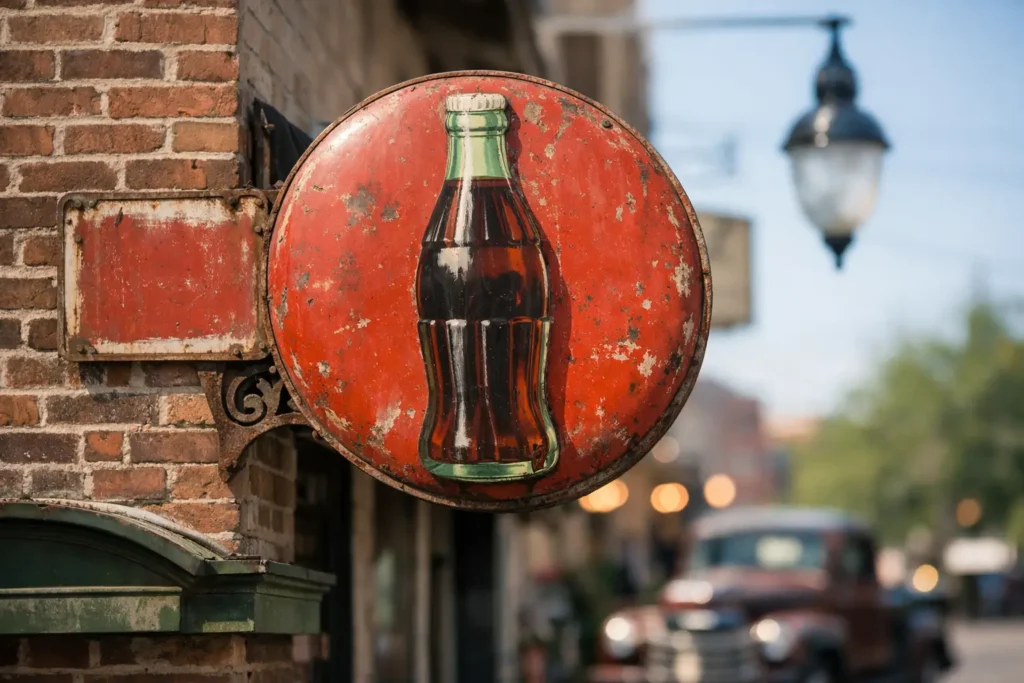
A real piece of original coca cola signage has a presence that reproductions never quite get right. The color sits differently. The wear makes sense. The graphics carry the look of a company that spent decades shaping American roadside culture, not a modern shop trying to imitate it. For collectors, decorators, and anyone serious about vintage advertising, that difference is the whole ballgame.
Coca-Cola signs have been chased for decades because they work on two levels at once. They are strong decorative pieces, and they are also one of the most collected categories in antique advertising. That popularity is exactly what makes them rewarding to own and dangerous to buy casually. The market is full of fantasy pieces, later copies, touched-up examples, and signs described as old when they are anything but.
Why original Coca Cola signage still commands attention
Coca-Cola did not become iconic by accident. The company invested heavily in signage across general stores, gas stations, diners, bottlers, pharmacies, and roadside locations. That broad distribution created an enormous visual legacy, but it also produced a wide range of sign types. Porcelain door pushes, tin litho signs, cardboard easel backs, metal fishtails, store displays, painted buttons, and neon all came out of that world.
Collectors respond to the brand because the imagery is instantly recognizable, but the better reason to buy is depth. There are real distinctions in era, maker, region, format, condition, and scarcity. An early festoon from the 1890s lives in a completely different league from a common later metal panel. A porcelain button with strong gloss and honest edge wear tells a very different story than a cleaned-up example with hidden restoration.
That range is what keeps the category interesting. You can buy for investment, for display, or for the history, but the serious value usually sits where originality, eye appeal, and condition meet.
What makes a Coca-Cola sign original
An original sign is a period-made advertising piece issued for actual use, not a later reproduction and not a modern fantasy item made in an old style. That sounds straightforward until you get into the details.
A sign can be old and still not be right. It may have been heavily restored. It may use original metal with repainted graphics. It may be assembled from parts. It may be a commemorative item that was never intended as period store advertising. In the Coca-Cola world, all of those distinctions matter because they directly affect collector value.
The first question is always whether the piece was company-issued and period correct. After that, you look at construction. Porcelain should show the right layering, gloss, and chipping patterns for its age. Tin signs should have the expected lithography, mounting holes, and edge wear. Neon should be judged not just by the frame, but by the can, transformer setup, tube style, backing, and whether the assembly makes sense for the era.
Then comes the hard part: condition versus originality. A sign with wear is not a problem. In many cases, it is exactly what you want to see. Honest scratches, fade, edge chips, and surface aging can support authenticity. Over-restoration usually does the opposite. Once a piece has been repainted, clear-coated, or aggressively cleaned, some of the character and much of the collector confidence can disappear.
The sign types collectors chase most
Porcelain Coca-Cola signs tend to lead the pack because they combine durability with strong color and broad display appeal. Buttons, directional signs, and door pushes are especially popular. Good porcelain has depth to the glaze and a look that modern copies struggle to mimic.
Tin signs have their own following, especially earlier lithographed examples with strong graphics. They are often more vulnerable to wear, which means surviving examples with nice color and clean surfaces can be hard to find. The same sign in average condition and premium condition can be worlds apart on value.
Cardboard and paper display pieces are fragile and often overlooked by newer buyers, but scarcity can be strong. Because so many were tossed out, period store displays and easel backs can be tougher than larger metal signs. They also bring a different kind of charm – more countertop, less highway.
Neon Coca-Cola signs pull in both serious collectors and design buyers. The visual impact is obvious, but neon needs careful scrutiny. Many pieces are built around old tins or old faces with later tube work and later housings. That does not automatically make them worthless, but it does change what they are and what they should bring.
Condition is everything, but not always in the same way
Collectors love to say condition is king, and generally that is true. Still, the right kind of wear is very different from damage that drags a sign down. Edge chips on porcelain can be acceptable, even attractive, when the main field displays well. Uniform fade on a tin sign may be tolerable if the graphics still read cleanly. Heavy touch-up, corrosion through the field, replaced sections, or restoration that covers the original surface is another matter.
The trade-off depends on the sign. A rare early piece with flaws can still be a major item because rarity carries weight. A more common sign has to compete on appearance, so condition matters even more. That is why buyers should not ask whether condition matters. They should ask how condition interacts with rarity, format, and demand.
One of the biggest mistakes in this category is paying premium money for a mediocre sign just because it says Coca-Cola. Brand power alone does not make every example desirable. Good collectors buy the piece, not just the name.
How to spot trouble in original Coca Cola signage
Reproductions have been around for a long time, and some are obvious. Others are made well enough to catch buyers who rely only on a quick visual impression. The danger increases when a seller is vague, avoids close-up photos, or leans too hard on words like vintage without backing it up.
Look at the back as hard as the front. Construction tells the truth more often than graphics do. Check mounting holes, edges, porcelain drips, metal gauge, fasteners, and the consistency of wear. Real age tends to make sense across the whole piece. Artificial aging usually shows up as random scuffs, forced rust, or wear that has no relationship to how the sign would have actually hung.
Typography and layout matter too. Coca-Cola changed slogans, logos, and design language across decades. A sign that mixes the wrong script, border style, and subject matter can be a fantasy piece even if it looks old at first glance.
Size can also be a clue. Many reproductions are made in convenient decorator sizes that do not match known period production. That does not prove anything by itself, but unusual dimensions should prompt more questions.
The best protection is seller knowledge. A specialist should be able to explain why a sign is right, what era it belongs to, what condition issues it has, and whether any restoration is present. If the answer is fuzzy, the risk usually is not worth it.
Buying for display versus buying for long-term value
Not every buyer needs the same thing. A restaurant owner may want a strong original piece that reads well across the room. A garage collector may prefer a sign with honest wear that fits the space and budget. A long-term collector may hold out for a harder example with excellent gloss, clean color, and no apology condition.
There is nothing wrong with buying for display first, as long as you understand what you are buying. The problem comes when decorative value gets confused with top-tier collector value. A touched-up sign can still look terrific on a wall, but it should not be priced like a fresh-to-market original surface example.
That is where experience counts. At Road Relics, the whole point is separating real period pieces from the noise and describing them straight. In this market, trust is not a bonus. It is part of the item.
Why these signs hold up beyond nostalgia
Original Coca-Cola signs are not just souvenirs of a famous brand. They are pieces of commercial American history. They come out of bottling networks, roadside expansion, local retail, and the rise of branded visual culture. That is why the best examples still feel alive. They were made to stop people in their tracks.
Good signage still does that. Put a real porcelain button in the right room and it anchors the wall. Hang a period tin sign in a showroom or bar and people notice it immediately. Beyond the décor value, there is satisfaction in owning the real thing – an object that did its job decades ago and still does it now.
If you are buying in this category, patience pays. Wait for strong color, honest condition, correct construction, and a seller who stands behind originality without hedging. There are plenty of Coca-Cola signs out there. True originals worth keeping are another story.