
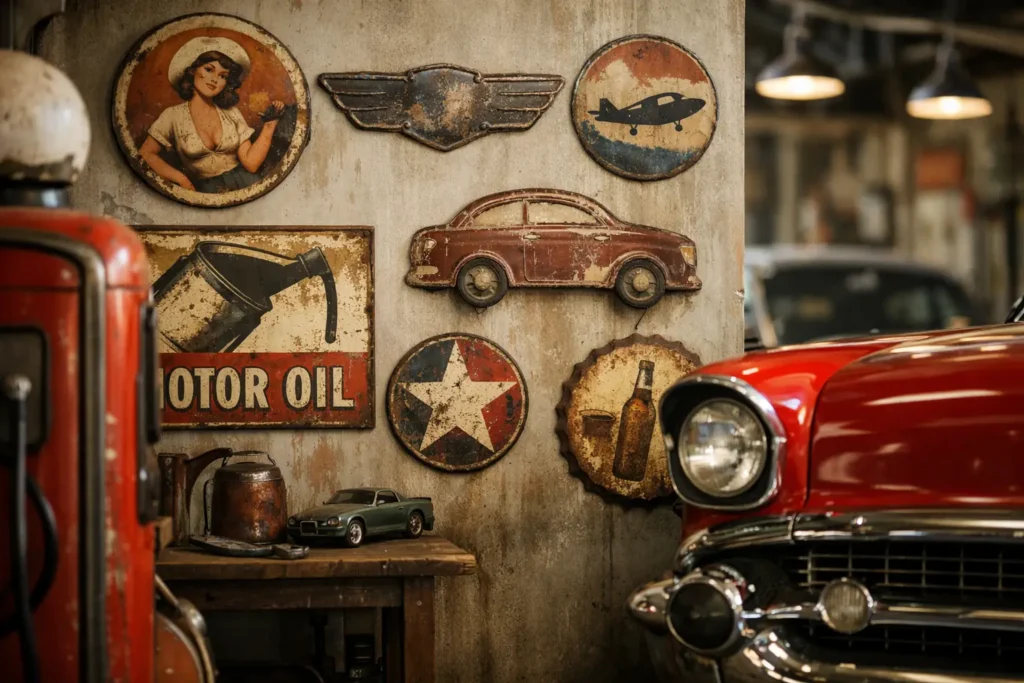
A garage with bare walls feels unfinished. Put the right original sign on one wall – a real gas and oil porcelain, an old dealership panel, a period neon piece – and the whole space starts to read differently. The best vintage signs for garages do more than decorate. They bring in history, color, brand recognition, and that hard-to-fake feeling that comes from original American advertising.
That said, there is no single best sign for every garage. A serious collector building a period-correct automotive space is shopping with a different eye than a homeowner who wants one strong centerpiece over a workbench. Size, lighting, subject matter, condition, and originality all matter. If you want a garage that looks right instead of staged, it pays to know which categories actually work and why.
What makes the best vintage signs for garages?
Garage walls favor signs with visual punch. That usually means bold graphics, strong lettering, familiar automotive brands, and enough scale to hold a wall without getting lost next to tool chests, lift posts, shelving, or a parked car. Porcelain signs do this especially well because the gloss, color saturation, and weight give them presence even when the design is simple.
The other factor is subject matter. Automotive, petroleum, tire, battery, and dealership signs feel natural in a garage because they belong to the environment. A great Coca-Cola sign can still look fantastic in the right setup, especially in a lounge corner or attached bar area, but a garage built around cars usually benefits from signs that speak the same language as the room.
Authenticity is the dividing line. Reproductions are everywhere, and some are made just well enough to fool casual buyers from ten feet away. But once you know what real age, wear, construction, and gloss look like, the difference is obvious. Original signs carry the scars, the character, and the value. They also age better in a collection because they were never pretending to be something else.
Porcelain gas and oil signs still lead the field
If you asked seasoned collectors to name the safest category for a high-impact garage display, porcelain gas and oil would be near the top every time. Brands like Texaco, Gulf, Mobil, Sinclair, Phillips 66, Pure, and Shell have the right mix of graphic strength and automotive relevance. They were made to catch attention from a distance, and they still do.
Single-sided porcelain pump plates and larger service station signs both work well, but the right choice depends on the garage itself. A smaller two-color pump plate can be perfect in a tighter space where too much sign looks crowded. A larger round or shield-form station sign can anchor an entire wall in a more open building. There is no virtue in buying bigger if the sign overwhelms the room.
Condition matters, but not in a simplistic way. Collectors will always pay up for strong gloss and clean fields, yet an honest sign with edge wear and scattered chips can still present beautifully in a garage. In fact, a little age often helps. A spotless example in a heavily used workshop can look disconnected, while a well-worn original often feels exactly right.
Dealership signs give a garage a more personal feel
Old dealership signs have a different energy from gas and oil material. They are tied to the selling side of the car business, and that gives them a local, human quality. Ford, Chevrolet, Dodge, Pontiac, Buick, Cadillac, and farm or truck dealership pieces can all work, especially if the vehicles in the garage match the sign.
This is where a collection can become more than decoration. A porcelain Ford dealership sign above a restored pickup is one thing. A period Chevrolet dealer panel hanging over a row of mid-century bowtie cars tells a story. That connection between object and machine is what separates a thoughtfully built garage from one that just has old stuff on the wall.
Tin dealership signs can be excellent buys if you know what you are looking at. They usually cost less than top-tier porcelain, but the best originals have strong graphics and real period character. You do have to be more careful with condition. Tin often bends, fades, and rusts in ways that affect presentation more dramatically than porcelain damage does.
Tire and service signs are underrated
Some of the best garage signs are the ones buyers overlook while chasing the usual gas brands. Goodyear, Firestone, Goodrich, Fisk, and service-related advertising can be every bit as strong visually, and often they fit a working garage better than more decorative categories.
These signs tend to have bold lettering, winged logos, mascot imagery, and practical shop appeal. If your garage includes lifts, service equipment, old air meters, cabinets, or tire racks, they make immediate sense. They also give the room a shop-floor edge instead of a general Americana look.
The trade-off is that some tire and service signs are harder to find in premium condition because they saw real use. That is not necessarily a negative. A harder-used original with surviving color and good eye appeal can be a better garage sign than a cleaner piece that lacks character.
Neon signs change the room after dark
A garage that gets used at night benefits from one good original neon sign more than from three ordinary wall pieces. Real neon has movement, glow, and atmosphere. It turns a storage space into a destination. Automotive neon, gas station neon, and dealership neon are especially strong when they retain original housings, backing, or transformers.
This is also a category where originality and restoration need to be discussed honestly. Many old neon signs have had repair work, replacement tubing, or electrical updates. That does not automatically make them bad buys. It depends on how much is original, how well the work was done, and whether the sign still presents as a period piece rather than a modern rebuild.
For a collector-led garage, a partially restored original neon can still be a serious display item. For a buyer who wants investment-grade untouched examples, standards will be stricter. That is why blanket advice does not help much here.
The 10 best vintage signs for garages
If you want strong categories that repeatedly perform well in garage spaces, these are the ones worth hunting:
- Porcelain gas station signs
- Oil company pump plates
- Automotive dealership porcelain signs
- Vintage tire brand signs
- Service station and repair shop signs
- Original neon automotive signs
- Battery and spark plug advertising signs
- Motor oil tin signs
- Transportation and truck line signs
- Gas and oil advertising clocks
Not all ten fit every garage. A clean collector showroom may want two or three major porcelain pieces and one neon. A rougher workshop may look better with mixed tin, a clock, and one honest gas sign with real wear.
How to choose the best vintage signs for garages you actually use
Start with the wall, not the sign. Measure the space, note the ceiling height, and think about what the sign has to compete with. A sign over a workbench reads differently than a sign on a long uninterrupted block wall. If cars are parked in front of it most of the time, you may need more scale and stronger contrast than you think.
Then match the sign to the kind of garage you have. If it is a muscle car garage, mid-century dealership, tire, and performance-related signs often feel right. If the space leans prewar or early postwar, older petroleum, service station, and transportation pieces may suit the room better. If the garage is really a hangout space with polished floors and bar seating, a neon sign or advertising clock might earn its place faster than another flat wall sign.
Do not chase rarity at the expense of fit. A rare sign that does not belong in the room will never look as good as a more common original with the right graphics, size, and color. Collectors know this, but plenty of buyers still get distracted by scarcity alone.
Originality is where buyers get burned
The market is full of reproduction signs, fantasy pieces, and altered originals. Some are obviously wrong. Others are dangerous because they borrow old graphics, copy known brands, and add fake wear to suggest age. Garages are one of the biggest markets for this material because many buyers want the look without learning the difference.
A real sign should be judged by construction, porcelain quality, mounting holes, gloss, edge wear, typography, color, and known patterns from the period. Provenance helps. So does buying from someone who knows the category well enough to stand behind the piece. That matters more than a clever sales pitch.
At Road Relics, that collector-first standard is the whole point. Original means original. If a seller gets vague when you ask direct questions about authenticity, age, or restoration, keep your money in your pocket.
Build the wall slowly and buy better
Most great garage walls are not assembled in a weekend. They are built piece by piece, with attention to color, spacing, era, and subject. One excellent porcelain sign can carry a wall better than a pile of mediocre pieces. The same goes for neon, clocks, and dealership material.
If your budget is substantial, buy quality first. If your budget is tighter, buy smaller originals instead of larger reproductions. A real pump plate, a period service tin, or a good advertising clock will always have more integrity than a fake oversized sign made to imitate age.
The garage is one of the few places where old advertising still feels completely at home. Choose signs with real history, honest condition, and enough presence to hold the room, and the space will start speaking for itself.