
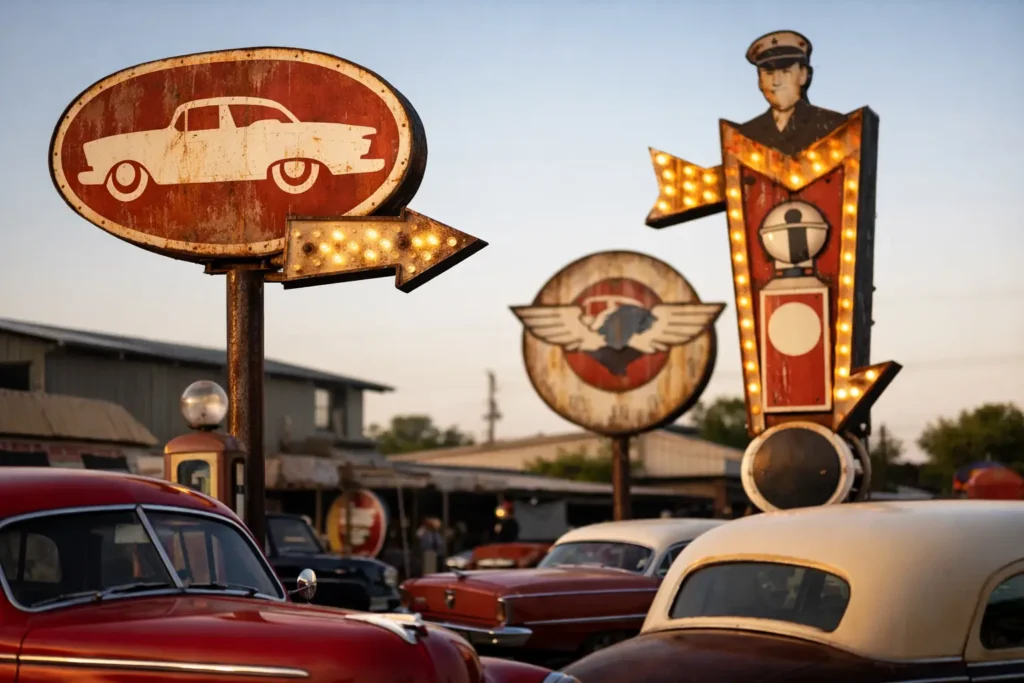
A real Packard, Ford, Chevrolet, or Cadillac dealer sign does not read like generic wall decor. It carries the look of a business that once sold new cars, serviced local owners, and stood out on a main street or highway before dealership branding became standardized and disposable. That is exactly why antique auto dealership signs still pull strong money and serious interest – they are not just automotive advertising, they are surviving pieces of retail history.
For collectors, decorators, and buyers outfitting garages, showrooms, bars, and commercial spaces, the appeal is obvious. The best examples bring together brand recognition, period graphics, heavy construction, and true scarcity. More importantly, original dealership signs sit in a narrower lane than common gas and oil advertising. You do not see them every day, and when the right one turns up, condition and authenticity matter fast.
Why antique auto dealership signs stand out
A dealership sign was built to identify a selling point, not just to advertise a product. That difference matters. Oil signs were produced in large numbers and distributed widely. Dealer signs were often made for a specific storefront, territory, franchise holder, or regional sales network. Some were porcelain panels mounted outside. Others were embossed tin, painted metal, neon, or double-sided hanging examples meant to catch traffic from both directions.
That smaller production base is a big part of the draw. Once a dealership remodeled, changed franchise lines, moved locations, or closed, the old sign was usually discarded. Many did not survive because they were exposed to weather, repainted, or simply scrapped for metal. What remains today tends to be tougher, more character-rich material with real use behind it.
There is also a strong visual difference between dealership pieces and standard brand advertising. Dealer signs often feel more local and more personal. You may find a manufacturer name paired with a dealer identifier, a service department panel, a body shop sign, or a franchise sign from an era when automobile retail still had regional quirks. That gives the category a little more depth than buyers expect at first glance.
What collectors look for in antique auto dealership signs
The first thing is still the same as any serious advertising category – originality. If the piece is not period, nothing else matters much. A rare name on a fresh fantasy sign is still a bad buy. In this category, reproductions can fool casual buyers because dealership graphics were often simpler than national advertising pieces. Plain lettering, a strong automaker name, and old-looking wear can trick the eye.
Original construction usually tells the truth. Porcelain should show age in the steel base, honest chipping at impact points, and proper gloss where the surface has survived. Tin should have believable paint loss, oxidation, and edge wear that fit the piece. Neon should make sense in its housing, transformer era, and tubing style. Mounting holes, flange design, reverse side finish, and size all need to line up with how the sign would have actually been used.
Collectors also watch for signs that have been dressed up. Added holes, fake distressing, clear-coated rust, modern hardware, new backs on old faces, and heavy restoration all affect value. Restoration is not always a deal-breaker, but it changes the lane. A scarce sign with professional restoration may still have strong display value. It just should not be priced or represented like an untouched survivor.
Brand matters too, but not in a flat way. Chevrolet and Ford have broad demand because the collector base is huge. Cadillac, Buick, Packard, Pontiac, Chrysler, Oldsmobile, Dodge, and Studebaker can be just as compelling depending on the sign, era, and graphics. Defunct makes often bring stronger interest from seasoned buyers because survival rates are lower and the historical pull is stronger.
Rarity is not the same as desirability
This is where a lot of buyers get sideways. A sign can be rare and still not bring top-end money if the design is weak, the condition is rough, or the brand has limited demand. On the other hand, a visually strong sign from a major make with bold colors and good presence can outrun a technically rarer piece.
Size plays into that. Large dealership signs, especially double-sided porcelain or neon examples, have serious room presence. They are harder to place, but when a buyer has the wall or ceiling space, big pieces tend to dominate a collection. Smaller dealer emblems, service signs, and countertop identifiers are easier to live with and often easier to sell, but they do not always have the same visual authority.
Condition is another trade-off. In original advertising, perfect is not always the goal. Honest weathering can be a plus. A porcelain dealer sign with edge chips, gloss, and strong color may be more attractive than one that was over-cleaned or heavily restored. The right wear proves age and use. Too much damage, though, can flatten value quickly, especially if the central graphic or brand name is compromised.
The signs that tend to carry the most weight
Porcelain dealership signs remain at the top of many want lists because of durability, color, and period feel. A strong single-sided porcelain panel with clean lettering and a known automobile brand checks a lot of boxes. Double-sided porcelain examples can move into another tier, especially if they still retain mounting hardware or a bracket tied to dealership use.
Neon dealership signs are a different animal. They are harder to find intact, more expensive to move, and more vulnerable to restoration issues. But a correct period neon sign from an automobile dealer, service department, or showroom can be a knockout piece. Collectors need to separate old housings with replacement neon from genuinely period components. Again, originality and honest disclosure matter more than hype.
Embossed tin and painted metal dealership signs should not be overlooked. They can offer better value relative to porcelain and still bring excellent graphics. In some cases, a rare embossed dealer sign with the right typography and patina has more personality than a cleaner, more standardized later porcelain example.
Signs tied to service departments, used car lots, body shops, and dealer-installed accessories can also be sleepers. They tend to be more specialized, and that narrower lane sometimes keeps prices more reasonable. For a buyer who wants originality and story rather than just a familiar badge, those pieces can be smart pickups.
How to buy without getting burned
The safest approach is simple. Buy the sign, not the story. If a seller leans hard on family history, barn-find romance, or “one of one” language but cannot explain construction, age, condition, and known issues, slow down. Real pieces do not need dramatic sales copy to stand up.
Ask direct questions. Is it original as made? Has it been restored, clear-coated, touched up, or rebuilt? Are the porcelain chips old? Is the neon old or replaced? Are both sides original? Has the frame been fabricated? A trustworthy seller should answer plainly.
Study the details before you buy. Fonts, logos, colors, mounting style, and manufacturing traits should fit the brand and era. If something feels off, it usually is. That is one reason experienced collectors stay close to specialist dealers who handle original stock every day. At Road Relics, that collector-first standard is the whole point – original material, described honestly, with no confusion between authentic signs and decorative copies.
Display value and collector value often meet here
One reason antique auto dealership signs keep broad appeal is that they work on two levels at once. A serious collector may want them for rarity, make, and period correctness. A design-focused buyer may want one because nothing else gives a garage, loft, showroom, or restaurant the same authority on the wall.
That crossover helps support the market. The sign does not need to appeal only to auto historians. It can also sell on color, scale, typography, and Americana presence. Still, the strongest prices usually come when both sides line up – real originality and strong visual impact.
If you are buying for long-term value, be selective. Hold out for the best brand, best surface, best size, and best honesty you can afford. If you are buying for display, do not ignore condition, but buy the piece that still stops you in your tracks from across the room. The right antique auto dealership sign does that every time, and that is usually the one worth bringing home.