
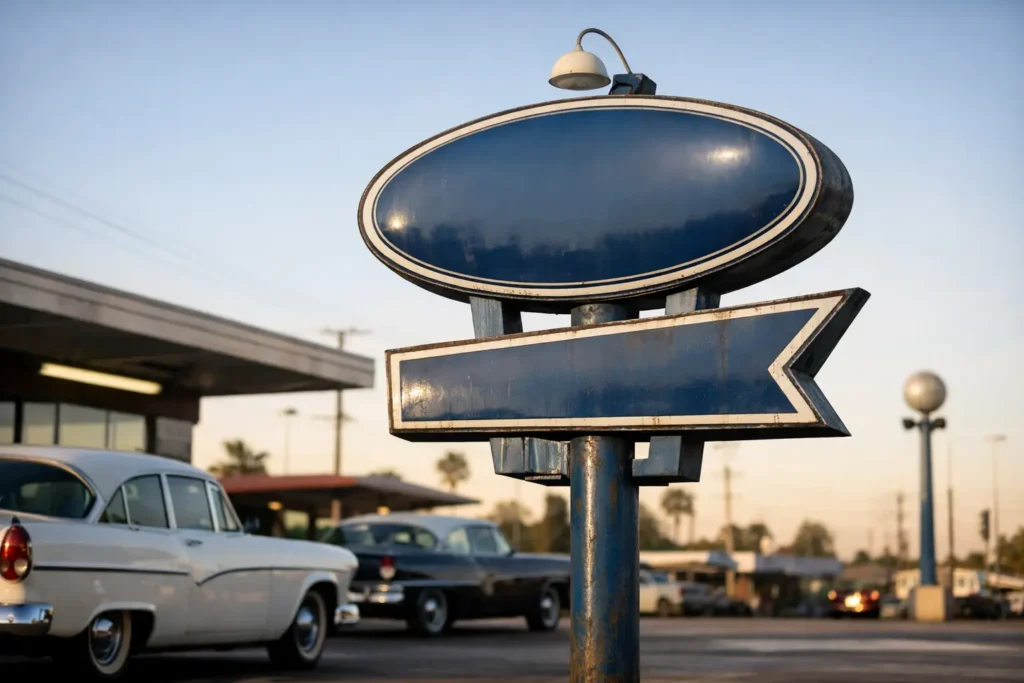
A real vintage Ford dealership sign has a look that reproductions never quite get right. The color has age to it. The porcelain has depth. The wear sits where it should, around the mounting holes, on the outer edge, across the face if it spent years on a service station, showroom wall, or roadside pole. For collectors and decorators alike, these signs hit a sweet spot – strong brand recognition, real American road history, and serious visual presence.
Why a vintage Ford dealership sign still draws attention
Ford dealership signs sit in a strong part of the advertising market because they connect with more than one buyer. Auto advertising collectors want them for the brand. Americana buyers want them for the roadside story. Interior designers and shop owners want them because even a single original Ford sign can anchor an entire room.
That broad appeal matters. A sign tied to a major American automaker carries instant recognition, even with people who do not collect. The blue oval is one of the most familiar dealer marks ever used, and earlier dealership pieces often have even more character – stamped metal, porcelain enamel, lighted cabinet faces, and service department signs with hard-working graphics rather than polished modern branding.
There is also the dealership angle itself. Factory-issued signs made for dealers have a different kind of interest than general advertising. They were built for use, not for gift shops or nostalgia buyers. That gives them a commercial honesty collectors respect. When you find an original piece that came off a dealership building or out of a long-closed service department, you are buying a piece of actual automotive retail history.
What makes an original vintage Ford dealership sign desirable
Not every old Ford sign carries the same weight. The best pieces tend to check several boxes at once – originality, strong graphics, useful size, and the right kind of age.
Original construction matters
Porcelain enamel on steel is usually at the top of the market when condition is strong and the sign is unquestionably authentic. These signs were expensive to produce and built to last, which is why they still command attention now. The gloss, the layered enamel, and the way honest chips expose the steel underneath all separate original porcelain from later copies.
Tin and steel dealership signs also have a loyal following, especially if the design is right. A scarce painted or embossed dealer sign can be a better collector piece than a more common porcelain example if it has the right form and survives in honest condition. Lighted dealership signs and cabinet signs can be especially strong because they bridge automotive advertising and architectural salvage.
Era affects both value and look
Early Ford dealership signs from the prewar and immediate postwar periods usually carry the most collector interest because they are scarcer and visually tougher. Mid-century examples are also strong, especially from the 1950s and 1960s, when dealership branding had a clean, bold commercial look that works well in garages, showrooms, and retail spaces.
Later signs can still be worthwhile, but the market gets more selective. Some buyers want the simple blue oval. Others want script logos, service messaging, or signs tied to trucks, tractors, or specific dealership departments. It depends on the collector and the setting.
Size and display power count
A small original Ford service sign can be easier to place and easier to sell. A large porcelain dealership sign or neon piece has more visual authority, but it also needs the right wall and the right buyer. Big signs are often where serious scarcity shows up, though. If an oversized original survives with good gloss and minimal damage, collectors notice.
How to judge condition without fooling yourself
Condition drives value, but with old dealership signs, perfect is not always the goal. Honest use is expected. The trick is knowing the difference between normal age and damage that kills desirability.
Edge chips, light surface wear, factory grommets, and weathering around mounting points are common and often acceptable. Heavy porcelain loss across the main graphic, major touch-up, extra holes, bent metal, or modern restoration can change the value fast. Some restored signs display well, but they do not trade like untouched originals.
This is where experience matters. Collectors who have handled real stock for years can usually spot the right surface immediately. Gloss should make sense. Wear should make sense. Backside aging should make sense. If the front looks 70 years old and the back looks five, that is a problem.
A lot of buyers get too focused on getting the cleanest example possible. That can be a mistake. A sign with a few edge chips and a strong face often has more character than one that has been over-cleaned or restored to death. On the other hand, severe damage is still severe damage. There is no rule that old wear automatically adds charm.
The biggest issue in the market – fakes and fantasy pieces
The vintage Ford dealership sign market has the same problem as the rest of antique advertising: reproductions, repaints, and fantasy signs that were never made in the period at all.
Some are obvious. Some are not. Reproduction porcelain signs often have the basic design right but miss the construction details. The steel may be too thin. The porcelain may look flat or artificially aged. The colors can be slightly off. Mounting holes can be wrong. The back can look too clean, too uniform, or deliberately distressed.
Fantasy pieces are worse because they are made to look rare. They may combine a Ford logo with wording or layouts that appeal to collectors, but no original manufacturer ever produced them. Buyers who are new to automotive signs often get pulled in by dramatic graphics and fresh surfaces. That is exactly the trap.
The best protection is simple. Buy from people who know the category, stand behind originality, and can explain why a sign is right. Provenance helps, but expertise matters just as much. A trustworthy seller should be able to talk plainly about era, construction, condition, and whether a piece is factory-issued. At Road Relics, that standard is straightforward – original means original, not replica, not reproduction, not made-up nostalgia.
Where these signs work best today
A vintage Ford dealership sign is not just for a hardcore collector with a warehouse wall. These pieces work in residential garages, auto-themed basements, bars, lofts, retail shops, and commercial showrooms. The best examples do not need much around them. One strong sign can carry the room.
That said, placement matters. Large porcelain and cabinet signs need space and decent sightlines. Smaller service signs, directional signs, and counter pieces can be layered into a display with gas and oil advertising, dealership clocks, and transport memorabilia. If the goal is a clean high-end interior rather than a packed collector wall, one original sign in the right scale usually beats five lesser pieces.
Design buyers sometimes chase color first and history second. Collectors usually do the opposite. Neither approach is wrong, but if you can get both in one piece – strong Ford branding and real age – that is where the long-term satisfaction tends to be.
Buying one right is better than buying one fast
A lot of regret in this category comes from speed. Buyers see the Ford name, get excited, and stop asking questions. That is how they end up with a repop, a heavily restored piece, or a common sign priced like a rarity.
Slow down and study the sign itself. What was it made from? Does the wear fit the age? Is the size standard for dealership use? Does the design line up with known period branding? Has the surface been altered? Are you paying for rarity, or just for the name?
There is also a practical side. Original dealership signs are not all equal investments. A rare porcelain example with excellent gloss and strong color may hold collector demand better than a later, more common panel sign. But a less expensive original can still be the right buy if it has authentic age, clean display value, and honest condition. Buying smart is not always about buying the most expensive piece in the room.
The right vintage Ford dealership sign gives you more than decoration. It gives you a real object from America’s dealer era, built to sell cars, mark a storefront, and stand out on the roadside. If you buy with your eyes open and stick to original material, you end up with a piece that still does that job every time someone walks in and looks up.