
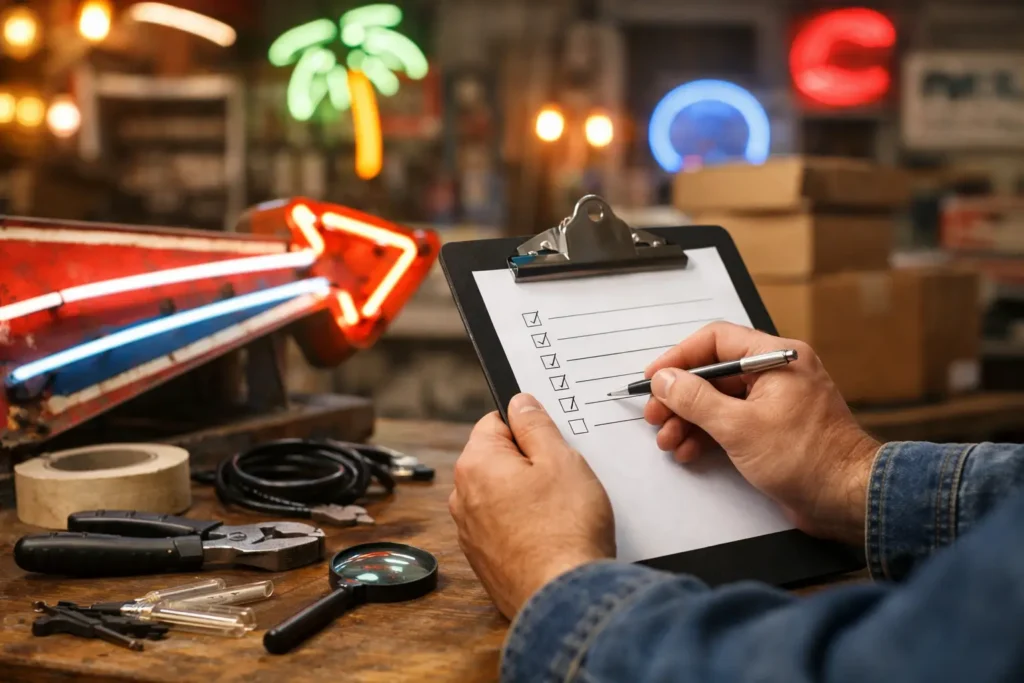
A real vintage neon sign can fool you from across the room for all the right reasons. The glass has age. The can has honest wear. The transformer setup makes sense for the era. Then you get closer, ask the seller a few direct questions, and the whole story either tightens up or falls apart. That is where an authentic neon sign seller checklist matters. If you are spending real money on original advertising, the seller is every bit as important as the sign.
Too many buyers still focus on the photo, the glow, and the logo. Those things matter, but they do not tell you whether the piece is original, rebuilt, partly married together, or a flat-out fantasy sign made to look old. A good seller helps you separate age from fakery. A bad one hides behind vague wording and dramatic pictures.
Why an authentic neon sign seller checklist matters
Vintage neon is one of the easiest categories to get wrong because it is built from replaceable parts. Glass can be remade. Transformers can be swapped. Cabinets get repainted. Back panels disappear. Components from two different signs get combined into one display piece and suddenly it is being sold as all original. Some restoration is expected in this hobby. Misrepresentation is not.
That is why the first question should not be, “Is this sign nice?” It should be, “Does this seller know exactly what they have, and are they willing to say it plainly?” Serious collectors and smart decorators both need the same thing – straight answers about originality, age, condition, and what has been changed.
Start with how the seller describes originality
A trustworthy seller does not play word games. If a sign is original, they should say original. If the glass is old but the can has been repainted, they should say that too. If the sign has replacement neon, modern wiring, or a later transformer, that needs to be on the table before money changes hands.
Watch for soft language like “vintage style,” “old look,” “from an old collection,” or “believed to be authentic.” Those phrases usually create room for retreat later. In this market, certainty has value. A seller with real experience knows the difference between an original company-issued sign and something made to imitate one.
The best descriptions are not flashy. They are specific. Era, maker if known, dimensions, condition, working status, and what is original versus replaced. That kind of listing usually comes from somebody who has handled enough real material to know what matters.
The seller should understand parts, not just brands
Anybody can recognize a desirable name. Far fewer people can speak intelligently about housing construction, mounting methods, electrode wear, tube diameter, paint age, access panels, or whether the transformer arrangement fits the period. That is where expertise shows.
If you ask about a neon sign and the seller can only talk about how great it looks lit, keep your guard up. Original neon deserves more than showroom language. A real specialist can explain whether the porcelain face is original to the piece, whether the can has been opened up, whether the glass pattern follows known examples, and whether any restoration was done for safe display.
This is especially important with high-demand categories like gas and oil, automotive, soda, and dealership neon. Those have been copied, rebuilt, and fantasized for years because the values support it.
Photos tell you a lot about the seller
Good sellers do not hide behind one glamour shot. They show the front unlit, front lit, sides, back, close-ups of the tubing, attachment points, can construction, transformer area, and any damage or repair. If there is rust, touch-up, replaced glass, or old wiring, you should be able to see it.
When a seller only shows the sign lit in a dark room, that is not enough. Neon can look impressive even when half the originality is gone. The unlit view is where condition and honesty live. Old paint, edge wear, staining, and construction details usually tell a truer story than the glow does.
You also want consistency. If the listing says “all original” but the photos avoid the back and electrical setup, ask why. A seller confident in authenticity has no reason to crop out the evidence.
Ask direct questions and judge the answers
A seller worth dealing with should welcome clear questions. Was this sign company-issued? Is the glass original? Has the can been repainted? Are the transformers old or replaced? Does it currently work? Has it been rewired for modern use? Are there any areas of restoration, fabrication, or married parts?
What matters is not just the answer but the way it is answered. Straight, detailed responses usually come from somebody who knows the piece. Evasive replies, delayed clarification, or irritation at basic authenticity questions are all warning signs. In this trade, serious buyers ask serious questions.
There is also a difference between “I do not know” and “I will tell you whatever gets the deal done.” Honest uncertainty can be acceptable if the seller clearly states what is known and prices the sign accordingly. False certainty is worse.
A real specialist respects restoration boundaries
Most original neon that survived decades will have some issues. Tubing gets broken. Wiring ages out. Transformers fail. So restoration itself is not the problem. The problem is when restoration is used to inflate originality.
A dependable seller explains the line between preservation and reconstruction. Replacement transformers for safe operation can make sense. Period-correct repairs to keep an original sign displayable can make sense too. But newly made glass on a fabricated can, sold as a complete original sign, is a different animal entirely.
This is where seasoned dealers separate themselves from sellers chasing décor dollars. They know collectors will pay for original condition, honest wear, and documented restoration. They also know a rebuilt piece should be represented as rebuilt, not romanticized into something it never was.
Guarantees matter because mistakes happen
Even strong sellers can make mistakes. Neon is complicated, and old signs surface with incomplete history all the time. That is why the return policy matters so much. If a seller stands behind originality, there should be a clear guarantee attached to that claim.
Look for language that protects the buyer if the sign proves to be reproduction, fantasy, or materially misdescribed. A real authenticity guarantee is a statement of confidence. Better still if it includes shipping, because heavy neon is expensive to move and weak guarantees often fall apart right there.
If the seller has no meaningful return protection on a high-dollar neon sign, you are taking on more risk than you should.
Reputation is built over time, not in one listing
An authentic neon sign seller checklist should include track record. How long has the seller been in vintage advertising? Do they regularly handle original porcelain, neon, clocks, and trade signs, or did they appear yesterday with a batch of suspiciously clean rarities? Experience in adjacent categories matters because knowledge carries across materials, makers, aging patterns, and market history.
A seller with long-term credibility usually has a recognizable style of inventory. The pieces make sense together. The descriptions sound informed. The condition grading is realistic. You get the sense you are dealing with somebody who has owned, bought, traded, and studied the material for years.
That is one reason collectors work with specialist dealers like Road Relics. The value is not just access to inventory. It is the judgment built from handling authentic pieces over decades and knowing when a sign is right, wrong, or somewhere in between.
Price can be a clue, but not always the clue
Everybody loves to say, “If the price is too good to be true, it probably is.” That is often correct, but not always. Sometimes a seller underprices a sign because they do not understand what they have. More often, though, unrealistically cheap vintage neon points to reproduction, fantasy construction, hidden condition issues, or major replaced components.
The flip side matters too. High price does not prove originality. Plenty of dressed-up signs carry premium asking prices because they look dramatic in a restaurant or garage. Decoration value and collector value are not always the same thing. A knowledgeable seller understands the difference and prices accordingly.
The checklist comes down to trust you can verify
At the end of the day, an authentic neon sign seller checklist is not about finding somebody charming. It is about finding somebody exact. You want a seller who states what is original, shows what matters, answers questions without dancing around them, understands restoration limits, and stands behind the sale if the authenticity claim fails.
The best vintage neon still carries the old roadside magic. It can stop a room cold. But collector-grade pieces are not bought on atmosphere alone. They are bought on construction, history, condition, and the credibility of the person selling them. If the seller checks out, the sign has a much better chance of being what it claims to be. That is how you buy with confidence and still enjoy the chase.