
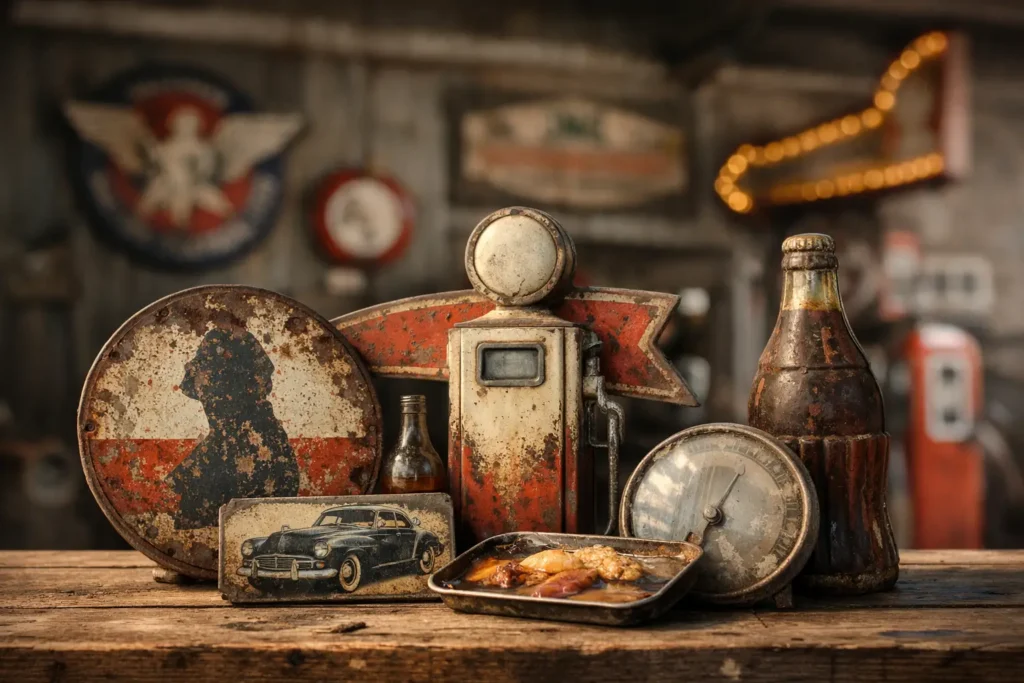
A real 1930s porcelain gas sign with strong color, honest age, and no apology attached to it does not sit in the market the same way a decorative reproduction does. That is the starting point for why do antique signs appreciate. The best original signs are finite, harder to replace every year, and tied to the kind of American history people want to own, display, and hold onto.
This is not true of every old sign. Some pieces stay flat for years. Some were overbought. Some suffer from poor condition, weak graphics, or questionable authenticity. But when collectors ask why one sign climbs steadily while another gets passed around at the same number, the answer usually comes down to a handful of hard factors: originality, rarity, condition, subject matter, and the strength of the buyer base behind it.
Why do antique signs appreciate over time?
The short answer is simple. Supply is limited, and demand for the right originals keeps expanding.
No factory is making authentic 1940s dealership porcelain signs today. No one is issuing untouched 1920s soda signs for the first time. Once a sign was used, discarded, damaged, or lost, that was it. The surviving examples are the market. Every time a strong piece goes into a serious collection and stays there for ten or twenty years, the available supply gets tighter.
At the same time, the buyer pool is broader than it used to be. Antique signs are not only bought by hardcore collectors anymore. They are bought by car guys outfitting garages, restaurant owners building atmosphere, designers creating statement walls, and business owners who want something real instead of mass-produced decor. That wider demand helps support prices, especially for signs with bold graphics and recognized brands.
There is also a practical point collectors understand quickly. A great sign checks multiple boxes at once. It is a historical object, a display piece, a conversation starter, and in many cases a store of value. That combination gives original advertising a staying power that purely decorative items often lack.
The biggest drivers behind appreciation
Originality is everything
If a sign is not original, its ceiling is low from the start. Reproductions, fantasy pieces, and cleaned-up later copies may look good from across the room, but they do not compete with authentic period pieces when real money is on the table.
Collectors pay up for company-issued originals because authenticity is the foundation of the category. A real porcelain sign from an oil company, auto brand, or bottler carries the actual manufacturing methods, wear patterns, mounting holes, gloss, and construction of its era. That matters. The market consistently rewards what is genuine and punishes what is not.
This is one reason seasoned buyers work with specialists and ask hard questions. A sign with solid provenance or long-term collection history tends to inspire confidence. Confidence supports stronger prices.
Rarity is not just about age
Older does not automatically mean more valuable. Plenty of old signs survive in decent numbers. Some later signs are far rarer because they were produced in lower quantities, used hard, or simply not saved.
Real rarity comes from surviving population, not just date. A 1950s single-sided porcelain dealership sign may outperform an earlier but more common tin sign if fewer examples remain and the brand has a stronger following. Size matters too. Large-format signs were often more expensive to make, harder to preserve, and more likely to be destroyed.
The market also values unusual variants. Different colorways, dealer names, regional issues, and graphics with standout design can create a premium over standard examples.
Condition moves the needle
Condition is where values can separate fast. Two authentic signs from the same maker and era can end up miles apart in price if one has strong gloss, clean color, minimal edge wear, and a good face, while the other is heavily hit with rust, fade, or restoration.
That said, condition is not always simple. In this field, honest wear can be a plus. Collectors often prefer original surface with age over over-restoration that strips the sign of character. A scarce sign with moderate wear may bring more than a common sign in cleaner condition. It depends on what the piece is and how often you see another.
Porcelain signs in particular tend to hold attention because good porcelain has durability, depth, and visual punch. Strong color and shine on original porcelain remain highly desirable, especially in gas and oil, automotive, and soda advertising.
Brand recognition and graphic power
Not every sign has the same audience. Broadly speaking, signs tied to iconic American brands tend to appreciate more consistently because the collector base is deeper.
Gas and oil names, automotive brands, Coca-Cola, transportation, farm equipment, and dealership advertising have long histories of demand. They appeal to collectors who care about the company, the era, the design, or all three. A sign does not need to be from the 1920s to be desirable, but it usually needs one thing the room cannot ignore: presence.
That is where graphics come in. Strong typography, memorable logos, vivid colors, and instantly recognizable imagery all help. Some signs appreciate because they are rare. Others appreciate because every serious buyer wants them when they show up.
Americana still has pull
A lot of antique signs are valued not just as advertising, but as surviving pieces of roadside America. Old service stations, motor courts, soda bottlers, tractor dealers, and hardware stores all left behind visual history. Buyers respond to that.
When people hang an original sign in a garage, showroom, bar, or collection room, they are not just filling wall space. They are buying a piece of a time and place. That emotional connection is real, and it feeds demand in a way spreadsheets alone cannot explain.
Why the best signs outperform average ones
The upper end of the market tends to reward quality, not just category. A scarce, untouched, visually strong sign from a top brand will usually appreciate better than an average example with weak graphics or compromised condition.
This is where experienced collecting matters. It is better to own one good sign than three mediocre ones if long-term value is the goal. The top pieces are the ones advanced collectors wait for. They are also the hardest to replace after they sell.
At Road Relics, that is the part of the business that matters most – original stock, real scarcity, and the kind of pieces collectors do not have to explain away.
What can slow appreciation?
Not every antique sign is a guaranteed winner. That needs to be said plainly.
Heavy restoration can hurt value if the work is obvious or if too much original material is lost. Repaired neon can still be desirable, but value depends on how much remains period-correct. Lesser brands may have a thinner buyer base. Some categories run hot for a while and cool off. And if you overpay for a mediocre piece during an aggressive market cycle, appreciation may take time to catch up.
There is also the fake problem. As values rise, so does the incentive to make reproductions and fantasy pieces look convincing. Buyers who get burned on bad material either leave the market or become much more selective. That is another reason authenticity and seller credibility matter so much.
Why do antique signs appreciate more than other old advertising?
Signs have one major advantage over many other forms of advertising: they display well. A sign can dominate a wall, set the mood in a room, and still read clearly from across the space. It does a job few paper items can do at the same scale.
That makes antique signs attractive to both collectors and decorators. A rare calendar or salesman sample may have strong collector value, but a porcelain sign or original neon piece can stop people in their tracks. The crossover appeal is wider, and wider appeal usually supports a stronger market over time.
There is also durability. Metal signs, especially porcelain, survived where many other advertising materials did not. Survivors with eye appeal naturally become the focus of collecting categories.
Buying with appreciation in mind
If appreciation matters to you, buy the best originality you can afford. Then buy rarity, graphic strength, and condition in that order, adjusting for category. Stick with subjects that have a real collector base. Ask direct questions about age, construction, restoration, and provenance. If the answers feel slippery, move on.
Most of all, buy pieces you would still want to own if the market went quiet for a while. The strongest antique signs tend to reward patience, but the real pleasure is living with something authentic that still carries its original impact decades after it was made.
That is usually where lasting value starts – with a sign good enough that once it lands on the wall, nobody wants to let it go.