
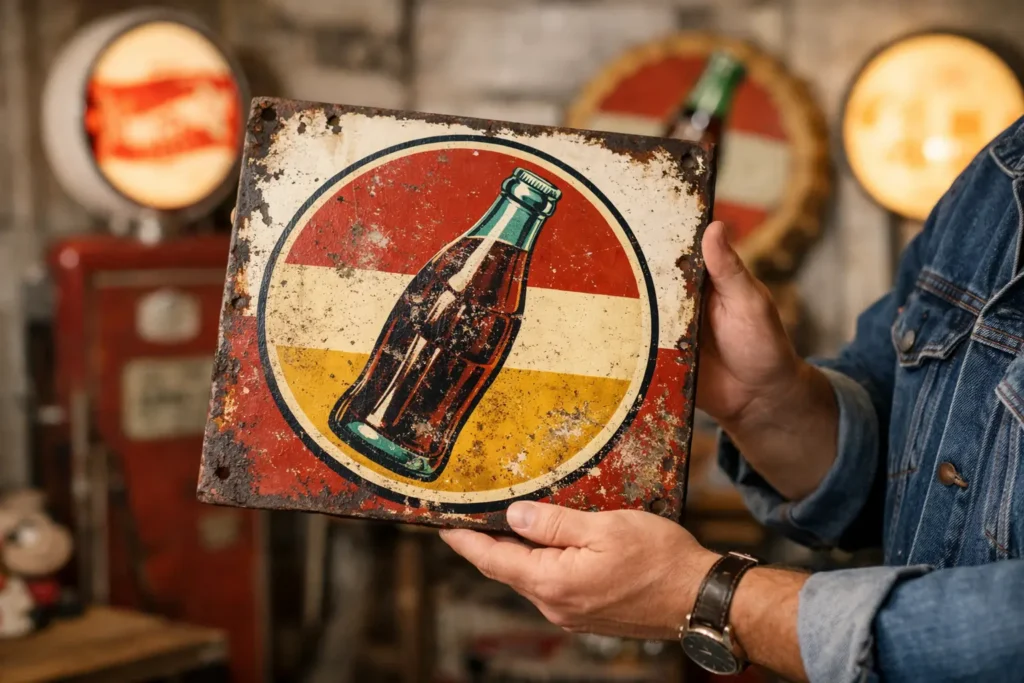
A lot of people say they want to buy original advertising signs, but what they really mean is they want the look without the risk. That is where buyers get burned. In this market, the difference between an authentic period sign and a dressed-up reproduction can be thousands of dollars, not to mention the disappointment of finding out your “rare” piece was made to fool you.
If you are spending real money on vintage advertising, authenticity has to come first. Good color, strong graphics, and wall appeal matter. So does rarity. But none of that means much if the sign is not right. Original stock has a different feel, different wear, and a different place in the history of American advertising. That is what serious collectors pay for, and it is what smart decorators and business owners should demand too.
Why buy original advertising signs instead of reproductions?
Reproductions have their place if all you want is decorative filler. There is nothing wrong with that, as long as it is sold honestly. But an original sign is a historical object. It was made for actual commercial use, issued by the company it advertises, and built to survive weather, travel, and years of display. That is a different category of item entirely.
Original porcelain signs show age in a way modern copies cannot fake well for long. Real neon has construction details, transformer age, tubing style, and mounting characteristics that tell a story. Tin signs, dealership pieces, and advertising clocks all carry period-specific manufacturing traits. When you own one, you are not buying a theme. You are buying a surviving piece of roadside America.
That matters for value, but it also matters for presence. A real gas and oil sign has weight. A true Coca-Cola button has scale and surface depth. An old dealership sign was built to catch eyes from the street, not blend into a gift shop wall. Even people who are not collectors usually recognize the difference once they see an original in person.
What separates a real sign from a fake?
This is where experience counts. Fakes are not always obvious, and the better ones are made to exploit enthusiasm. A buyer sees gloss, chips, rust, or artificial patina and assumes age. That is exactly what counterfeiters want.
The first thing to look at is construction. Porcelain signs should show the right steel base, proper layering, and honest edge wear. A sign that looks uniformly distressed across every inch can be a red flag. Natural aging tends to be uneven. Weather hits one side harder. Mounting holes wear in believable ways. Chips happen where signs were hung, moved, or struck, not in a neat pattern made for effect.
Graphics matter too. Original company-issued signs were produced to specific standards. Lettering, spacing, logos, border widths, and colors should line up with known period examples. If something looks just a little off, it usually is. That does not mean every variation is fake, because authentic production differences exist. It means you need to know the brand, the era, and the form of the sign before calling it right.
Then there is the metal itself. On old tin and steel signs, the back often tells you as much as the front. So do grommets, mounting holes, framing methods, and remnants of old hardware. With neon, you want to look at the cabinet, tube work, backing, and electrical components, not just whether it lights.
Condition can also mislead buyers. A sign does not have to be mint to be good. In fact, some of the best pieces have wear exactly where they should. Honest condition often brings more confidence than suspiciously perfect surfaces on supposedly old signs.
Where buyers make the biggest mistakes
The biggest mistake is buying the story instead of the sign. Sellers use words like old, vintage-style, barn fresh, or estate found because they know those terms create emotion without proving anything. If authenticity is not stated clearly and backed with confidence, slow down.
Another common mistake is focusing only on price. Cheap originals exist, but they are not common in desirable categories. If a scarce porcelain gas sign or an early dealership neon is priced far below the market, there is usually a reason. Sometimes the reason is heavy restoration. Sometimes it is damage. Sometimes it is that the piece is wrong.
Photos can be another trap. Front-facing glamour shots hide edge chips, touch-up, extra holes, replacement parts, and repaired cracks. Good sellers show the front, back, edges, mounting points, and close details of wear. They do not get vague when you ask direct questions.
Buyers also get in trouble by assuming all old signs are equal. They are not. Rarity, category, graphics, condition, size, and demand all move value. A common piece with nice color may still be a common piece. A tougher sign with strong company branding and real eye appeal can be a different level of collectible altogether.
How to buy original advertising signs the smart way
Start with the categories that have a long collector base. Gas and oil, soda, automotive, farm, transportation, and dealership advertising continue to attract strong demand because they connect directly to American industry and car culture. These are not passing decor trends. They have a real collecting history behind them.
After that, buy what you actually want to live with. Some people chase investment-grade rarity. Others want one great porcelain sign over a bar, a trade sign in a showroom, or an old neon piece for a garage that already has the right cars in it. There is no single right reason to buy. The key is making sure the object is original and the asking price reflects what it is.
Ask direct questions. Is it original company-issued stock? Has it been restored? Is there touch-up? Are the mounting holes original? Is the neon old tubing or later work? Has the clock movement been replaced? A real dealer who knows the material will not dance around those questions.
Guarantees matter more than sales talk. If a seller is certain a sign is original, that confidence should show up in the terms. A full authenticity guarantee says far more than a long description full of buzzwords. When real money is involved, that kind of backing is not optional.
What makes one original sign better than another?
Not every authentic sign is a top-tier sign. Some are desirable because they are rare. Others because the graphics are strong. Some have impressive size. Some carry regional importance or tie into a major brand with a deep collector following.
Porcelain signs usually get attention for gloss, color, and chip pattern. Neon gets judged on design, scarcity, completeness, and whether the piece still has period character. Tin signs can be sleepers when they have great graphics, hard-to-find subject matter, or exceptional condition. Folk art and trade signs often appeal to buyers who want one-of-a-kind display with real age and personality.
Provenance can help, but it is not everything. A sign fresh out of an old garage sounds great, but if the sign itself is wrong, the story does not save it. On the other hand, a sign with no dramatic backstory can still be a first-rate piece if the object checks out on originality, condition, and desirability.
This is where a specialist dealer earns his keep. A seasoned eye can tell the difference between honest wear and manufactured wear, between scarce and merely uncommon, between a sign that has collector upside and one that is just expensive wall decor. That kind of judgment usually comes from decades in the hobby, not from reading a few listings online.
Who should buy original advertising signs?
Collectors already know the answer. If you care about authenticity, history, and long-term value, originals are the only serious lane. But plenty of buyers outside the collecting world should be looking at them too.
Interior designers use original signs because they give a space authority. A real porcelain sign changes the room. Restaurant and bar owners buy them because customers respond to authentic visual history, not staged nostalgia. Car collectors and showroom owners use them because a genuine service station or dealership piece belongs with real machines. Even homeowners with one great garage or game room often decide they would rather own one original than five copies.
That is a better way to buy in general. Fewer pieces, better pieces, and no guessing about what you own. At Road Relics, that collector-first approach is the whole point.
If you are going to bring vintage advertising into your space, buy the piece you will still respect ten years from now – the one that is original, honestly represented, and worth turning the light on for every time you walk past it.