
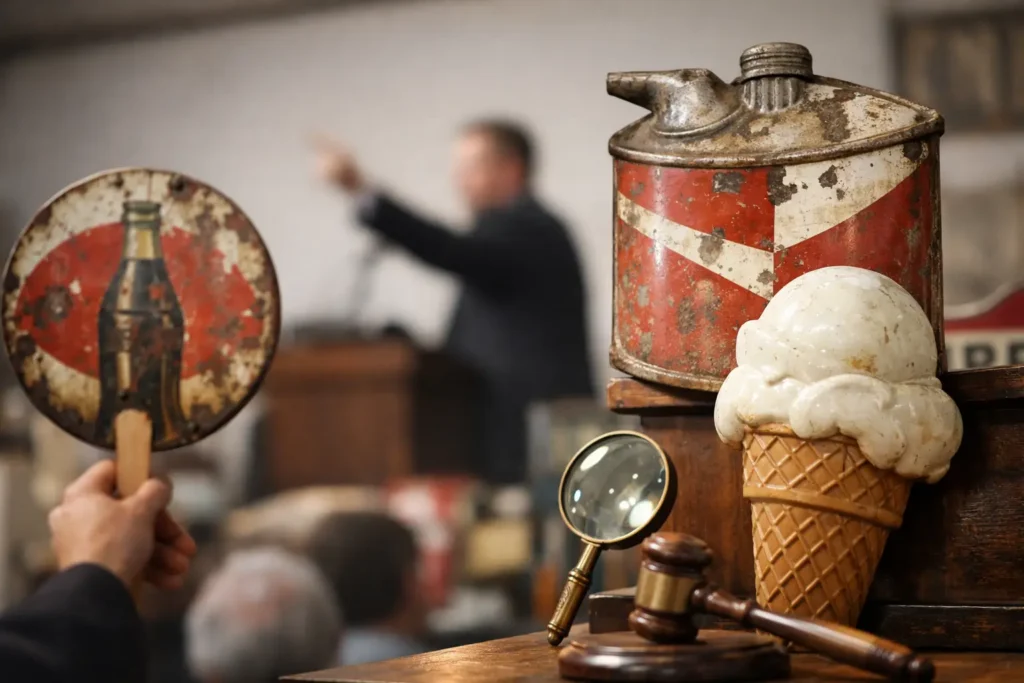
The lot looks right from across the room. Good color, honest wear, strong graphics, maybe a name you have been chasing for years. Then the bidding starts, adrenaline takes over, and common sense can leave the building fast. That is why buying antique signs at auction is not just about having money ready. It is about knowing exactly what you are looking at before the auctioneer starts calling numbers.
If you collect original advertising, auctions can be one of the best places to find real material. They can also be one of the easiest places to overpay for touched-up porcelain, fantasy pieces, married frames, or signs with condition issues that were easy to miss in the catalog photos. The difference usually comes down to preparation, not luck.
Why buying antique signs at auction gets expensive fast
Good signs bring strong money because the best examples are getting harder to find. Original porcelain gas and oil signs, early soda advertising, dealership pieces, and clean trade signs all have a deep buyer pool now. You are not just bidding against seasoned collectors anymore. You are up against decorators, commercial designers, restaurant owners, and buyers who simply want a statement piece on the wall.
That wider demand changes the auction landscape. A rare sign with strong gloss, good color, and no serious restoration can climb quickly. A common sign in excellent condition can sometimes outsell a scarcer piece with edge hits, fade, or replaced grommets. Auction prices are not driven by rarity alone. Eye appeal, authenticity, and how many bidders understand what they are seeing all matter.
Start with one question: is it original?
This is where most mistakes begin. A bidder gets focused on age, size, or brand name and forgets the first rule. If the sign is not period-original, the rest of the conversation changes.
Originality is not always obvious from a catalog description. Terms like old, vintage style, or from an estate do not mean authentic. Even honest auction houses can get signs wrong, especially outside their specialty. Reproductions have gotten better, and fantasy pieces continue to fool buyers who have not handled enough real examples.
With porcelain, pay attention to the construction. Look at the layering, the thickness of the steel, the character of the gloss, and how the chips break. Real wear has a different look than artificial distress. On tin signs, study the lithography, the edges, the mounting holes, and whether the paint and oxidation make sense together. On neon, originality gets more complicated because transformers, housings, and glass are often replaced over time. That does not automatically kill value, but it affects how you price the piece.
If you cannot get comfortable with originality, do not bid just because the estimate looks tempting.
Condition is not a side note
Collectors talk about condition because condition drives value. A lot of buyers say they do not mind wear, and sometimes that is true. Honest wear can make a sign more attractive. But there is a big difference between attractive age and expensive damage.
Porcelain signs deserve especially close inspection. Check for added holes, heavy border chips, fade, touch-up, clear coat, restoration, and any evidence that a single-sided sign may have been built up to look better than it is. Look at the mounting areas. Stress cracks around holes can be easy to miss in photos and can matter a lot once the sign is on your wall.
For embossed tin and painted metal signs, watch for overcleaning and repaint. A sign can still be original and still have enough work done to hurt collector value. On clocks and lighted pieces, condition extends beyond the face. You need to know whether the mechanism, can, glass, and internal components are period-correct or later replacements.
There is no universal rule on what condition level to buy. It depends on your budget, your goals, and how often the piece comes up. A rough rare sign can still be a smart buy. A common sign with serious issues usually is not.
Provenance helps, but it is not a free pass
Good provenance can add confidence and sometimes real value. If a sign came from a known collection, an old route find, a dealership dispersal, or a long-held estate, that matters. It gives the piece context and can support authenticity.
But provenance should support the sign, not replace inspection. Stories travel well in this hobby, and not all of them are accurate by the time a lot reaches the block. If the sign itself does not look right, a good story will not save it.
Catalog photos are never enough
This is one of the biggest lessons in buying antique signs at auction. Photos can help you narrow the field, but they are not a substitute for previewing the lot in person when possible. Lighting hides fade. Angles hide warping. Tight shots skip over edge damage. Sometimes a sign that looks sharp online turns flat and lifeless in person. Other times a piece with average photos has far better eye appeal than expected.
If you cannot attend preview, ask direct questions. Has the sign been restored? Are there extra holes? Is the gloss original? Are there repairs to the flange? Are the can and face original to each other? A serious buyer should ask serious questions.
You also need dimensions, not guesses. Two signs can look similar in photos and live in completely different value brackets because one is a harder-to-find large format.
Know where the money is in the piece
Not every old sign is a great auction buy. Some categories are broad and uneven. Brand matters, but format matters too. A standard dealer sign does not play the same way as a scarce die-cut. A small porcelain pump plate is not the same market as a large curved porcelain gas station sign. Neon can be spectacular, but size, completeness, and originality swing value fast.
This is where experience pays off. Strong colors, iconic graphics, desirable brands, and rare formats usually bring attention. Signs tied to gas and oil, soda, automobilia, transportation, and early roadside commerce continue to perform well because they appeal to both collectors and display buyers.
The best bidders understand what makes one example special within its category. That edge keeps you from paying top-tier money for a second-tier piece.
Set your number before the bidding starts
Auction fever is real. A sign you planned to leave alone can suddenly look like the missing piece in your garage, showroom, or collection wall. That is how buyers blow past market value.
Set your number early and build in all costs. Buyer’s premium, tax, shipping, crating, and possible electrical work on lighted signs all count. A piece that seems fair at the hammer can end up expensive by the time it lands at your door.
You also need to decide whether you are buying for investment, display, or pure enjoyment. Those goals overlap, but not perfectly. If a sign has outstanding eye appeal and you plan to live with it for years, you may choose to stretch. If you are buying strictly on collector value, discipline matters more.
When to pass on a lot
Passing is part of collecting well. If the sign has questionable originality, weak photos, vague condition language, or pricing that makes no sense for the piece, let it go. Another example will surface eventually, even if it is not next month.
The same goes for lots that have been bid up by two buyers who need to win. You do not need to be one of them. There is no prize for paying retail plus risk at auction.
A lot of advanced collectors look conservative in the room because they know where mistakes get made. They wait, they study, and when the right sign appears, they move with confidence.
The best auction buys are rarely impulse buys
The strongest pieces in a collection usually come from patient buying. You learn the category, handle real examples, compare gloss, steel, paint, wear, and graphics, and slowly build an eye for what belongs and what does not. That is how good buyers separate original from reproduction and fresh paint from honest age.
At Road Relics, that collector-first approach is the whole point. The market has plenty of signs. Truly original signs with the right look, correct construction, and real shelf life are a different story.
Auction houses will always be part of the hunt, and they should be. They can still turn up real sleepers, fresh material, and major pieces. Just do not confuse availability with quality. The best move is often the least dramatic one – study hard, bid carefully, and only chase the sign if you would still want it after the excitement is gone.
That last test usually tells you more than the catalog ever will.