
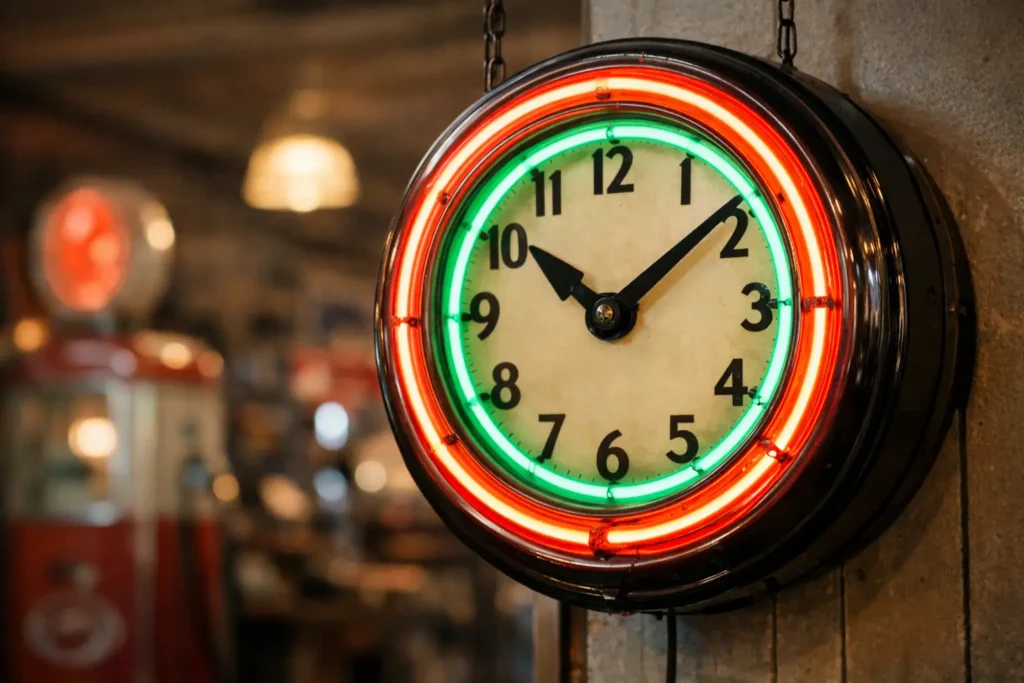
A real vintage neon clock for sale can stop a room cold. Not because it is loud or oversized, but because the right clock carries everything collectors want in one piece – glass, light, graphics, utility, and a direct tie to American advertising history. The problem is that clocks get faked, rebuilt, over-restored, and misrepresented more than many buyers realize. If you are spending serious money, you need to know exactly what you are looking at.
That matters whether the clock is headed into a dedicated sign collection, a showroom, a garage, a bar, or the wall of a business that wants authentic period character instead of modern imitation. Neon clocks have strong display power, but collector value always comes back to originality, condition, and how much of the piece still belongs to its own era.
What makes a vintage neon clock for sale worth buying
The best original clocks do more than light up. They tell a story about the brand that issued them, the distributor network that used them, and the era that produced them. Gas and oil brands, soda companies, auto-related businesses, and service industries all used advertising clocks as working display pieces. When neon was added, the result had far more visual punch than a standard lighted clock face.
That is why strong originals draw both seasoned collectors and design buyers. A true period neon clock can hold its own against porcelain signs and standalone neon because it combines mechanical appeal with advertising presence. It also tends to display well in tighter spaces where a large sign may not fit.
Still, not every old clock deserves premium money. Age alone does not make a piece scarce, and bright neon alone does not make it right. A buyer who chases glow without looking deeper usually pays too much for a compromised piece.
Originality is everything
If you are evaluating a vintage neon clock for sale, the first question is not whether it works. The first question is whether it is actually original. In this category, originality can mean a few different things, and the differences affect value in a big way.
An all-original clock with its original face, case, can, movement, wiring layout, and neon components sits at the top when condition supports it. Those do exist, but they are not common, especially in clean collector-grade condition. More often, buyers will encounter clocks with replacement motors, repaired transformers, reworked wiring, or later neon. Some of those are still honest period pieces. Some have been heavily reconstructed from parts. Some are outright fantasy items built to look old.
A replacement movement does not automatically kill a clock. Many original advertising clocks had their motors serviced or swapped over the decades because they were used hard. That is normal. But once the dial is repainted, the neon ring is newly fabricated, the housing is refinished beyond recognition, and the internals are largely modern, you are no longer paying for an untouched survivor. You are paying for a restored display piece. That may still be desirable, but it should be priced accordingly.
The hard truth is simple. In this market, originality beats perfection. Collectors will usually take honest age and wear over a polished-up piece that has lost its character.
Signs of a real period clock
The details tell the story. On an authentic clock, the face graphics usually show period-correct typography, brand layout, and manufacturing style. The case should fit the age of the piece, with proper metal construction, finish, and proportions. Neon supports, backing, mounting hardware, and access points should all make sense together.
Look closely at the reverse. The back of a clock often tells you more than the front. Original housings show age in a natural way. You may see oxidation, old labels, service marks, dust patterns, and wear around screws or access panels. New hardware scattered across an otherwise old case should make you pause. So should a back that looks freshly built while the front is being sold as mid-century original.
Transformers and wiring deserve the same scrutiny. Old wiring can be brittle and may have been updated for safety, which is understandable. But a claimed 1940s or 1950s clock with entirely fresh internals and no explanation needs more questions. Honest sellers explain what has been changed. Vague sellers usually have a reason for being vague.
Condition matters, but it depends on the piece
Condition in vintage neon clocks is never one-size-fits-all. A rare and desirable brand can carry significant value even with wear, touch-up, or non-working neon. A more common clock needs stronger overall condition to stand out.
The face is one of the biggest value drivers. Heavy flaking, moisture staining, repainting, or major fading can drag a clock down fast. Minor age wear is different. Light patina, small edge wear, and a surface that still reads cleanly are often exactly what collectors want. It shows the piece has lived an honest life.
Neon condition is its own issue. Original glass is a major plus, but it is fragile and often lost. If the tube has been replaced long ago in a proper style, that may still be acceptable. If the neon is bright, but the shape, color, or mounting looks wrong for the clock, value can suffer. Poor restoration work is common in this category because many buyers focus on whether it lights rather than whether it looks right.
Then there is the case. Dents, extra holes, rust-through, and heavy repainting hurt. Mild wear, small scratches, and age-consistent finish loss usually do not. Again, it depends on rarity. A scarce double-neon dealership clock may still be a strong piece with faults that would sink a more common example.
Why reproductions and fantasy pieces keep catching buyers
Neon sells the dream fast. That has always made the category vulnerable to reproduction. Some clocks are obvious once you know the signs. Others are built from old parts and newer graphics, then represented as original advertising pieces. That is where inexperienced buyers get trapped.
A fake often gives itself away through graphics that feel too sharp, colors that are slightly off, or branding combinations that never existed in period. Sometimes the clock is aged on purpose to create false credibility. Sometimes the seller leans on phrases like “old-style,” “vintage look,” or “from an estate” without ever clearly stating whether the piece is original. If the wording dances around authenticity, pay attention.
This is why specialist knowledge matters. In the authentic advertising market, you are not just buying an object. You are buying trust in what that object is. A real guarantee means something. So does dealing with someone who can tell you what is original, what has been repaired, and where the value really sits.
How value is really judged
Brand matters. A desirable oil company, soda brand, automotive name, or dealership-related clock will usually bring stronger money than a generic advertising example. Size matters too, especially when the scale gives the clock true display presence. Color, dial design, and visual impact all affect demand.
But rarity is where things get serious. Some clocks survive in decent numbers. Others almost never show up in untouched condition. A scarce original from a major brand can be worth real money even before you get into exceptional condition.
Provenance can help, though it is not always available. If a clock comes out of a known long-term collection, an old service station, or a well-documented group of original advertising pieces, that adds confidence. It does not replace physical inspection, but it strengthens the story when the clock itself supports it.
Buying a vintage neon clock for sale without making an expensive mistake
Ask direct questions and expect direct answers. Is it original? What has been replaced? Is the face original? Is the neon original, period replacement, or recent? Has the case been repainted? Does the movement run? Has the wiring been updated? A seller who knows the category should be able to answer that without hedging.
Photos matter, but not just glamour shots. You want the front lit and unlit, close views of the dial, side profile, back, wiring, transformer area, and mounting points. If those views are missing, ask why. In a high-value category, lack of detail is its own red flag.
This is also one area where the cheapest buy is often the most expensive. A bargain-priced clock with bad restoration, fantasy graphics, or major hidden issues can be nearly impossible to resell at honest market value. A stronger original bought right will usually hold attention better and stand up in a collection.
At Road Relics, the whole point is original stock and straight answers, because that is what serious buyers should demand in the first place. In a market full of glow and hype, the smart money still goes to authenticity.
If a clock speaks to you, that part is easy. The harder part is making sure the history, parts, and condition are real enough to deserve the wall space.