
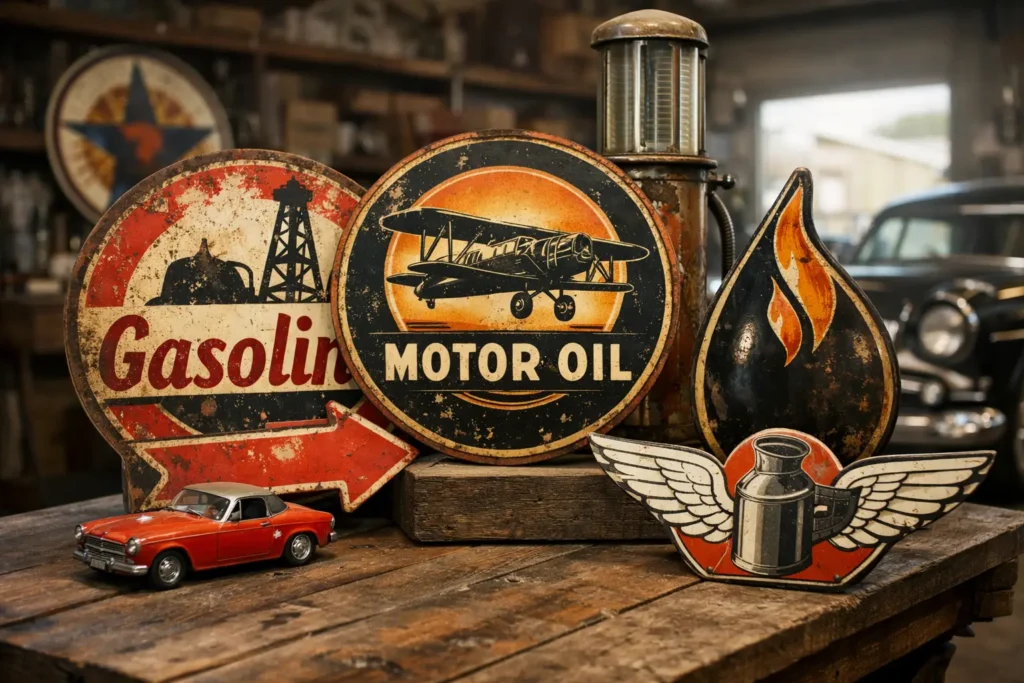
The difference between a real old Sinclair, Texaco, or Phillips 66 sign and a fresh-made fake usually shows up fast – if you know where to look. That is the real issue behind most searches for gas and oil signs for sale. Buyers are not just looking for wall decor. They are trying to find original American advertising with honest age, strong display value, and none of the nonsense that comes with reproductions dressed up as period pieces.
That matters because gas and oil signs sit in one of the most copied corners of the vintage advertising market. The best originals have everything collectors want: bold graphics, company history, automotive crossover appeal, and instant presence on a wall. They also bring enough money to attract fantasy pieces, altered signs, and outright counterfeits. If you are buying for a collection, a garage, a showroom, or a commercial interior, authenticity has to come first.
What makes gas and oil signs worth buying
Original gas and oil advertising has a grip on collectors for a reason. These signs came out of filling stations, bulk plants, repair shops, dealerships, and roadside businesses that helped build American car culture. A true period sign is not just branded metal. It is a surviving piece of that world.
Porcelain signs tend to lead the category because they were built to last and still carry color in a way paper and cardboard never could. Neon has its own pull, especially when the housing, glass, and transformer setup still match the sign’s age. Tin signs can be excellent too, particularly when the graphics are right and the scarcity is there. The company name matters, of course, but so do subject, size, regional appeal, and how well the sign presents from across the room.
A common mistake is assuming the biggest brand always makes the best buy. Sometimes it does. A strong Shell, Mobilgas, or Gulf piece will always have broad interest. But harder-to-find regional brands or obscure motor oil advertising can be tougher to replace and more appealing to seasoned collectors. Rarity and eye appeal usually carry more weight than hype.
How to judge gas and oil signs for sale
If you are looking at gas and oil signs for sale, start with one question: is it original company-issued advertising, or is it not? Everything else comes after that.
Originality should show in the construction. On porcelain signs, look at the steel base, the thickness of the porcelain, the grommet or mounting holes, and the way age appears around the edges. Honest wear is usually uneven. It shows where a sign hung, where it was handled, and where weather reached it first. Fakes often get this wrong. They try too hard, or they age the wrong areas in a way that looks forced.
Graphics are another clue. Lettering, logo shape, and layout need to match known period examples. Reproductions often miss small things – the font is slightly off, the border is too clean, the colors are too loud, or the proportions feel wrong. Experienced collectors notice those details right away. New buyers usually feel that something is off, even if they cannot name it yet.
Then there is the back side. A lot of buyers focus only on the front because that is what displays. That can be expensive. The back often tells the truth. You may see proper oxidation, old mounting wear, manufacturer marks, or the right style of construction. Or you may see modern fabrication that kills the piece immediately.
Condition is more complicated than many people think. Chips, scratches, edge wear, and rust do not automatically hurt a sign. Sometimes they help, because they support originality and show a life actually lived. The question is whether the wear is attractive, stable, and consistent with age. A sign can have condition issues and still be a great piece. It can also be too far gone, especially if restoration, overcleaning, or touch-up has stripped away character.
Original versus reproduction is not a gray area
In this market, people like to blur terms. You will see words like vintage-style, retro, tribute, replica, and reproduction used as if they are harmless. They are not harmless if a buyer thinks they are getting an original sign. A reproduction can be fine as decoration if it is sold honestly for what it is. It is not fine when it is used to imitate value it does not have.
That is why serious collectors buy from specialists who know the category and stand behind what they sell. If a seller cannot speak clearly about age, material, condition, and why a sign is authentic, that should tell you something. The best dealers do not hide behind vague language. They tell you exactly what the piece is, what era it comes from, how it was made, and what condition issues are present.
At Road Relics, that standard is simple: original means original. Not reproduction, not fantasy, not made-up garage decor pretending to be old. For buyers spending real money, that kind of clarity matters more than a sales pitch.
What affects value in original gas and oil signs
Brand is the first driver, but it is never the only one. A rare sign from a second-tier company can beat a common sign from a household name. Size also matters. Larger signs usually have stronger wall impact, but unusual small-format pieces can be scarce and desirable in their own right.
Color and graphics carry real weight. Strong reds, blues, yellows, and greens tend to display well, especially with shield shapes, diamonds, circles, and bold logo work. Signs with great automotive imagery, service station themes, or memorable mascots tend to pull buyers from beyond the sign hobby. That crossover demand helps values hold.
Condition, again, depends on the piece. Collectors will forgive a lot if the sign is rare enough and the face still has power. On the other hand, a common sign with heavy damage has a harder road. Double-sided examples, early pieces, and signs with documented provenance can bring stronger prices, especially when the history ties back to a known station, collection, or old advertising find.
Buying for collection versus buying for display
These are not always the same thing, and buyers should be honest about which lane they are in. If you are building a serious collection, originality, rarity, and category importance should lead. You may accept tougher condition to secure a harder sign. You may also pay more for a less decorative piece because it fills a meaningful slot in a lineup.
If you are buying for a garage, bar, showroom, or retail space, visual punch may matter more. A sign that reads clearly, has strong color, and fits the room can be the right buy even if it is not the rarest example in the hobby. There is nothing wrong with that. The problem comes when decorative buyers overpay for common material because they were sold a story instead of the facts.
The best pieces do both. They anchor a room and hold collector respect. That overlap is where much of the strongest demand sits.
Where buyers get into trouble
Most mistakes happen when people rush. They see a sign they like, the price feels high enough to seem real, and they stop asking questions. That is exactly how bad pieces move.
Photos can hide a lot. Cropped images may avoid showing the edges, holes, or back side. Lighting can mute repair work or hide a glossy new finish. Descriptions can be slippery. Phrases like old sign, from an estate, or barn fresh mean nothing by themselves. None of that proves originality.
Another problem is assuming age equals value. Some signs are old but common. Others are scarce but not especially attractive. Some have been restored so heavily that the collector market backs away. There is no single rule beyond this: buy the piece, not the label.
The smart way to shop gas and oil signs for sale
Look for clear, direct descriptions. Ask about dimensions, material, condition, and whether the sign is guaranteed original. Ask for front, back, edge, and close-up photos. If the seller is experienced, those requests should not bother them.
Take your time with the details. Compare known examples. Study the wear. Learn how porcelain should look when it has aged naturally. The more signs you handle, the faster your eye improves. That is how collecting works. Knowledge compounds.
It also helps to buy from a source with a real reputation in original advertising, not just general antiques. Gas and oil signs have too many traps for casual guessing. A specialist understands the difference between honest wear and artificial distress, between a hard sign and a common one, and between a real rarity and a piece that simply gets talked up.
A good gas and oil sign earns its place every time you look at it. It brings color, history, and real presence to a wall, but the best part is knowing it has not been faked, dressed up, or misrepresented. Buy the real thing, buy it from someone who knows what they are selling, and you will never have to apologize for the piece later.