
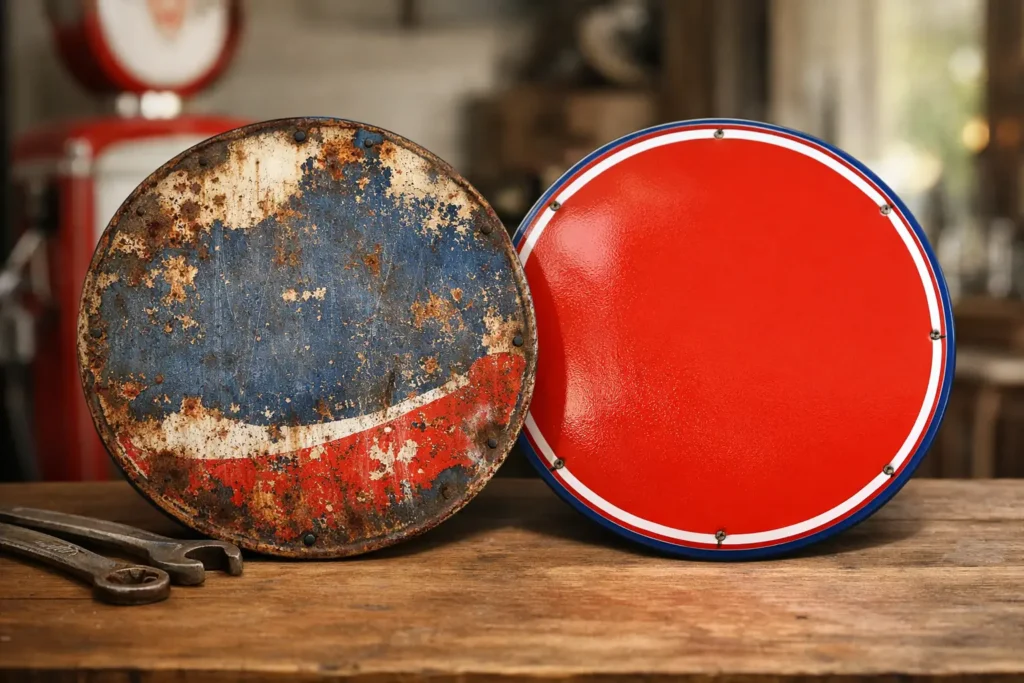
A sign tells on itself fast when you know what you are looking at. In the real vintage sign vs reproduction debate, the difference is not just age. It is value, history, construction, and whether you are buying a real piece of American advertising or a modern object made to imitate one.
That matters whether you are a serious collector chasing a scarce porcelain gas sign or a decorator trying to put one strong piece on the wall of a bar, showroom, garage, or office. Reproductions can look good from ten feet away. Originals still hold up when you get close, turn them over, study the mounting holes, and read the wear like a fingerprint.
Why real vintage sign vs reproduction matters
A reproduction is not automatically useless. If someone wants the look of an old Texaco, Coca-Cola, or dealership sign without paying collector money, a repro may serve that purpose. But it should be sold as exactly that. The problem starts when a reproduction is dressed up as an original, priced like an original, or aged just enough to confuse a buyer who has not handled many period pieces.
Original signs carry scarcity, provenance, and market strength that reproductions do not. They were company-issued display pieces made for service stations, general stores, bottlers, farm suppliers, and roadside businesses. They lived hard lives. They were exposed to weather, moved around, shot at, bent, rehung, and sometimes painted over. That history creates honest condition and collector interest.
A reproduction is usually made for decoration. Even when it copies the graphics well, it does not carry the same manufacturing traits, period materials, or age pattern. It also does not carry the same resale strength. A buyer may enjoy it on the wall, but it is not the same class of object.
The biggest signs of an original
When you have handled enough authentic signs, certain things stand out right away. The first is construction. Old porcelain signs tend to have real weight, a certain stiffness, and layered enamel over steel that feels different from modern decorative versions. The porcelain itself often shows depth and character, not just surface gloss. Older tin signs have a different gauge, edge treatment, and printing character than modern novelty pieces.
The second is wear. Real age rarely looks evenly distributed. Originals usually show use where use would happen – around mounting holes, along exposed edges, in areas where moisture sat, and on the backside where storage and weather did their work. Reproductions often have fake distressing that looks planned. The rust is too convenient. The chips are too artistic. The dirt sits on top instead of feeling earned.
The third is the backside. Plenty of buyers stare at the front and ignore the back, which is a mistake. The back of an original often tells a cleaner story than the front. You may see old oxidation, age to the metal, factory traits, stencil marks, old dealer inventory labels, or hardware wear that matches decades of handling. A reproduction may have a back that looks newly painted, artificially toned, or simply wrong for the supposed era.
Real vintage sign vs reproduction in porcelain signs
Porcelain signs deserve special attention because they are one of the most copied categories in the market. A real porcelain gas and oil sign, dealership sign, or soda sign was made for hard commercial use, not for gift shop décor. The porcelain was kiln-fired onto steel, and that process leaves clues.
On an original, chips often expose dark steel beneath the porcelain. The gloss can vary with age, use, and maker. The grommets or mounting holes often show real stress, edge wear, and oxidation that make sense with the sign’s life. Many originals also have manufacturer marks that fit the period, though marks alone do not prove anything. Repro makers know collectors check for marks, so they copy those too.
The trouble is that some reproductions are not crude anymore. They may use porcelain, copy the shape closely, and add convincing graphics. That is where experience matters. The color tone may be slightly off. The edge roll may be wrong. The hole placement may be too clean or just a little inconsistent with the original issue. Sometimes the sign simply feels too fresh, too balanced, too perfect in the wrong way.
If a supposed rare sign appears in quantity, that is another red flag. Truly scarce originals do not show up every week in matching condition from multiple sellers.
Age is not enough
A lot of people assume old equals original. Not always. Some reproductions are decades old themselves. There are 1970s, 1980s, and 1990s reproductions that now have age, wear, and even collector interest of their own. But they are still reproductions.
That is why dating a piece is only part of the job. You also need to ask whether the sign was made during the period it claims to represent and whether it was company-issued for actual use. A 1980s reproduction of a 1930s motor oil sign is older now, but it is not a 1930s sign.
This is where newer buyers get tripped up. They see surface wear and assume authenticity. Real collecting demands a narrower question: is this old, or is this right?
The role of rarity, condition, and price
Price can tell you a lot, but not everything. If a highly desirable original porcelain sign is offered at a bargain price, there is usually a reason. It may be damaged, heavily restored, or not original at all. Cheap and rare do not often belong in the same sentence.
Condition also needs context. Collectors do not expect untouched perfection on most period signs. Honest wear is normal and often preferable to harsh restoration or fake age. A sign with edge chips, fade, and surface wear may still be a very strong original piece if the graphics present well and the condition matches the era and use.
On the other hand, a suspiciously perfect sign in a category known for hard use deserves extra scrutiny. Some originals survived beautifully, of course. But a mint example of a scarce roadside sign should come with strong confidence in its history and construction.
What experienced buyers check first
A seasoned buyer usually looks at four things right away: construction, wear pattern, backside, and plausibility. That last one matters more than people admit. Does the piece make sense? Does the size match known originals? Does the design align with period branding? Does the condition fit the story being told?
Photos can help, but they also hide things. Lighting can flatten porcelain. Angles can conceal chips, warping, extra holes, or modern fasteners. If a seller avoids showing the back, close-ups of the edges, or detailed shots of problem areas, slow down.
Seller knowledge matters too. Someone who specializes in original advertising should be able to speak plainly about age, condition, damage, restoration, and why they believe the piece is authentic. Vague language is usually not your friend in this hobby.
When a reproduction makes sense
There is nothing wrong with buying a reproduction if you want decorative impact and the sign is represented honestly. For a restaurant wall, a themed basement, or a retail space that needs a vintage look without collector-level investment, a repro can do the job.
The key is knowing what you are paying for. Decorative value is one thing. Historical value is another. If you care about originality, market value, and owning a real piece of the roadside past, then reproductions are a compromise, not a substitute.
That is why specialist dealers matter. A business like Road Relics is built around original stock, not lookalikes, and that difference shows in how pieces are described, photographed, and guaranteed.
Buy the sign, but also buy the source
The safest buyers in this market are not just picking objects. They are picking sellers with a track record, a real eye, and enough experience to stand behind what they sell. Anyone can repeat a story about an old sign. Not everyone can back it up with category knowledge and a straight answer when questions get specific.
If you are spending serious money, trust your instincts and take your time. Study real examples. Compare construction. Learn what natural wear looks like. Ask for the backside. Ask about restoration. Ask why the sign is believed to be original. A good seller will not be annoyed by that. They will expect it.
The best vintage signs are more than wall décor. They are survivors from a different era of American business, built to advertise hard and built to last. Once you have owned a real one, the difference gets a lot easier to see.