
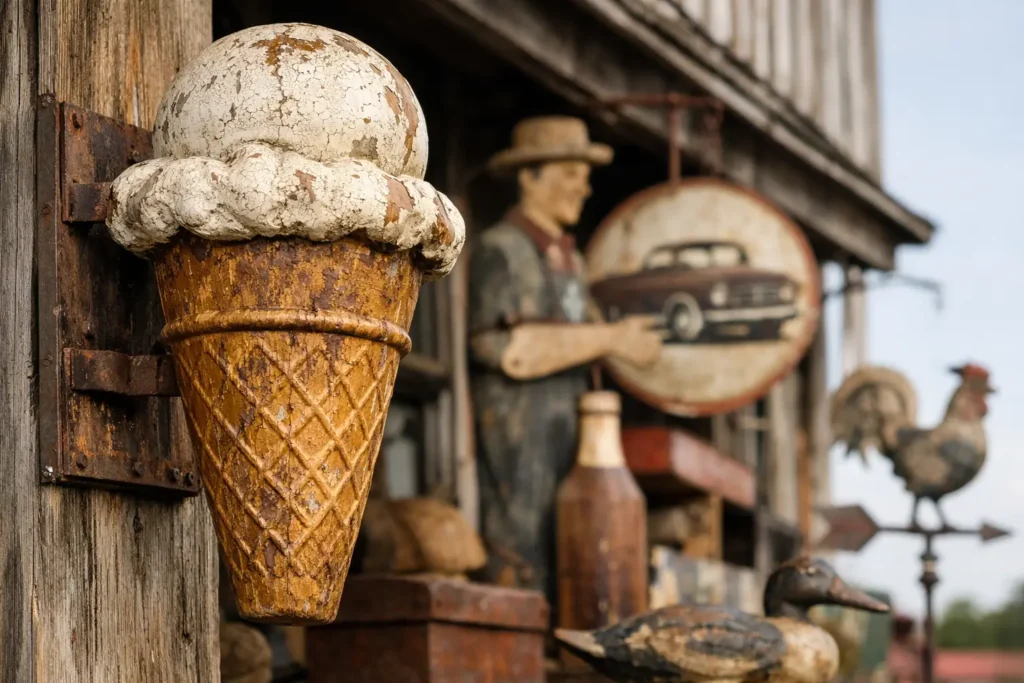
A real folk art advertising sign usually tells on itself within the first few seconds. Not with a tidy label or a perfect backstory, but with the small things collectors learn to trust – hand-cut wood, uneven brushwork, old surface wear, and the kind of lettering no modern decorator piece can fake for long. That is where the value starts. A genuine folk art advertising sign is not just old-looking wall decor. It is a survivor from a storefront, roadside stand, workshop, feed store, filling station, or local business that needed a sign made fast, made by hand, and made to work.
Why a folk art advertising sign stands apart
Folk art signage sits in a different lane than factory-made porcelain, embossed tin, or neon. Those signs were produced by companies with standardized graphics, known makers, and broad distribution. A folk art advertising sign was often local, one-off, and built with whatever materials and skill were available at the time. That can mean a cruder sign, but crude is not the same thing as weak. Some of the best pieces have more personality than any mass-produced sign ever could.
That individuality is exactly why serious collectors chase them. The lettering might be off-center. The spacing may wander. The paint may have been laid down by a house painter, a sign man, or the shop owner himself. None of that hurts the piece when it is right. In many cases, it is the point. These signs carry the hand of the maker in a way machine-made advertising simply does not.
They also cross over into more than one market. A strong folk art advertising sign can appeal to sign collectors, Americana buyers, interior designers, early trade sign collectors, and folk art specialists at the same time. That wider appeal helps explain why the best originals rarely sit around for long.
What collectors look for first
Originality comes before everything else. A rare sign with bad restoration, replaced boards, fantasy paint, or invented lettering is a problem no matter how attractive it looks from across the room. On the other hand, an honest example with age, wear, and untouched character can carry real weight even if it is rough.
The first thing to study is construction. Old wood should make sense for the period. Hand-planed surfaces, square nails, early fasteners, old mounting holes, and naturally aged backs all matter. If the front looks 100 years old and the back looks like it came out of a home center last month, you have your answer.
Paint is next. Original paint tends to age in layers. It dries hard, shrinks, crazes, flakes, and settles into the wood differently than modern decorative finishes. Repaint often sits on top too evenly, with a fresh confidence that gives itself away. Good blacklight work can help, but experience is better. You want to see whether the paint and the board have lived together for decades, not whether someone got clever in a workshop.
Lettering matters just as much. Period hand lettering has rhythm, but not perfection. It may show a sign painter’s skill, or it may show a local hand doing his best. What you do not want is a modern fake trying too hard to look charming. Many reproductions overplay the whimsy. Real signs were made to sell goods or identify a business. Even the odd ones had a job to do.
Age, wear, and the difference between honest and forced
Wear is one of the most abused parts of this category. Plenty of signs get sanded, scraped, beaten up, or stained to create instant age. That kind of work usually looks theatrical. The wear lands where a faker thinks wear should be, not where time and use would actually put it.
Honest wear has logic. A hanging trade sign may have stronger weathering on one side. A general store board sign may show edge wear from years of handling. A sign that lived outdoors might have paint loss on the upper edge, water staining at the bottom, and oxidation around old hardware. Those details need to work together.
Condition is always a trade-off. Collectors say they want untouched surface, and they do, but that does not mean every great sign must be pristine. Some of the best folk art pieces are rough, and they should be. The question is whether the condition supports the story of the object. Heavy wear can be a strength if the sign remains visually strong and unquestionably original.
Provenance helps, but the sign still has to speak for itself
A great story is welcome. A sign traced to a known store, farm, garage, butcher shop, or regional business has more depth than a piece with no history at all. Original photographs, family history, old invoices, and fresh-to-market ownership all help. They add confidence, and sometimes they add value.
Still, provenance should never be used to excuse a bad sign. We have seen too many pieces carried by a story that falls apart the minute you study the wood or paint. The object has to stand on its own. If the sign is right, provenance is a bonus. If the sign is wrong, provenance becomes a sales pitch.
This is where dealing with a specialist matters. Categories like porcelain gas and oil signs have long-established warning signs for fakes, but folk art can be trickier because no two pieces are exactly alike. That makes room for both real discoveries and bad inventions. A seller who understands period construction, paint, typography, and regional trade history is worth listening to.
Why rarity in folk art signage is different
Rarity in factory signs can often be measured by maker, variation, size, and known survival rates. With folk art, rarity is often more personal. You may be looking at the only surviving sign from a local business, or the only known example painted by a regional hand. There may be no catalog, no ad slick, and no corporate archive to confirm it.
That uncertainty is part of the appeal, but it also means collectors need discipline. Just because a sign appears unique does not mean it is old. True rarity is supported by believable materials, proper aging, regional consistency, and visual authority. A sign does not have to be famous to be important. It has to be right.
Size also plays a role. Large folk art signs with strong graphics and clear wording can transform a room, especially in garages, bars, retail spaces, and Americana-heavy interiors. Smaller signs, though, often have a tighter market because they fit more spaces and are easier to live with. It depends on the buyer. Decorative impact and collector demand do not always move in the same direction.
The market for a folk art advertising sign
Prices vary hard in this category because quality varies hard. A weak example with generic wording and suspect paint may sell on looks alone, but seasoned buyers tend to pass. A strong original with real age, great lettering, and undeniable presence can bring serious money, especially if it checks more than one box – unusual trade, great color, early date, strong size, and untouched surface.
This category has also benefited from buyers who want something less common than standard branded signs. Not everyone wants another reproduction-style diner look. A true folk art advertising sign gives a space more credibility. It feels found, not ordered. That matters to decorators, collectors, and business owners who want authenticity on the wall.
At the same time, the market is less forgiving when the sign is wrong. Collectors spending real money want confidence. They want original stock, clear photos, honest condition reports, and direct language about restoration, repairs, and repaint. That is one reason specialists like Road Relics put such weight on authenticity and back it with a real guarantee. In this end of the hobby, trust is part of the value.
Buying with your eyes open
If you are considering one, ask simple questions first. Is the construction period correct? Does the paint belong to the board? Does the wear make sense? Is the lettering convincing for the era and purpose? Has anything been strengthened, repainted, or rebuilt? A seller worth buying from should answer plainly.
Photos matter, but they are not enough when details are fuzzy or staged to hide surface issues. You want front, back, edges, close-ups of paint, and any hardware or damage. Measurements should be exact. Condition should be described directly, not softened with decorative language.
Most of all, buy the sign, not the fantasy. A real folk art advertising sign does not need a sales gimmick. If it has age, originality, visual punch, and honest condition, it will hold its ground on the wall and in the collection. That is usually the piece worth waiting for.
The best signs still do what they were made to do. They stop you in your tracks, make you look twice, and leave no doubt that they have lived a real life before landing in your hands.