
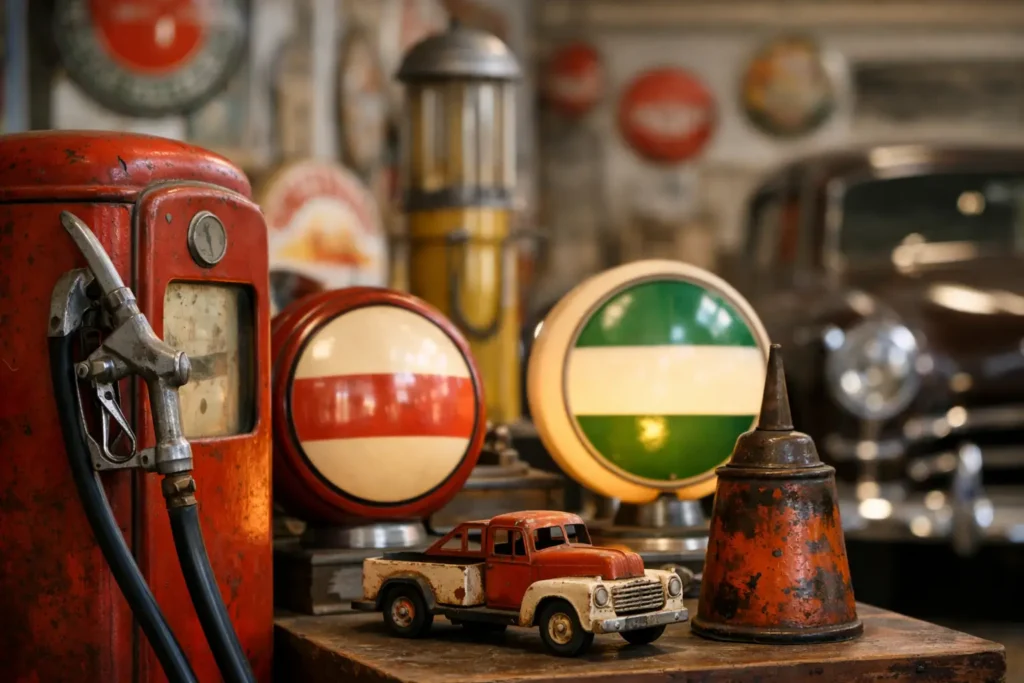
The first bad lesson in any guide to petroliana collecting usually comes from buying with your eyes before you buy with your experience. A bright gas sign on a clean wall can make almost anything look right. Under close inspection, that same piece may be a modern fantasy sign, a marriage of old parts, or a heavily restored item priced like untouched original stock. If you want to collect petroliana well, you need a sharp eye, a little patience, and a hard line on authenticity.
Petroliana pulls people in for good reason. The graphics are strong, the colors still hit, and the subject matter sits right at the center of American road culture. Gas, oil, service station, tire, and automotive advertising pieces were made to be noticed from a distance, and many still dominate a room the same way they once dominated a roadside station. That visual power is only part of the story, though. The serious value in this category comes from originality, rarity, condition, and brand demand.
What counts as petroliana
At its core, petroliana covers advertising and service station material tied to gas, oil, automotive service, and roadside fuel culture. That includes porcelain signs, tin signs, neon, gas pump globes, oil cans, clocks, thermometers, lubricants advertising, dealer signs, and display pieces from brands such as Texaco, Sinclair, Mobil, Gulf, Shell, Pure, and many others.
Not every old gas-related item belongs in the same lane. A common later promotional piece may still display well, but it does not carry the same collector weight as a period company-issued porcelain sign or an original neon from a known station brand. This is where beginners get tripped up. Age alone is not enough. You are not just buying something old. You are buying something real, scarce, and desirable within the hobby.
A guide to petroliana collecting starts with originals
If you remember one thing, make it this: original beats reproduction every time. A clean reproduction can look attractive on the wall, but from a collector standpoint it is decorative, not historic. That distinction matters a lot when prices move from hundreds into thousands.
Original petroliana usually shows the right kind of wear, not just any wear. Porcelain signs may have edge chips, stress marks around mounting holes, light surface scratches, and age-consistent gloss loss. Tin signs can show honest oxidation, fading, and handling wear that make sense for the piece and era. Neon can have transformer changes or tube repairs, but the base sign, can, housing, and construction details still need to line up with period manufacture.
Reproductions often give themselves away by trying too hard. Colors can be too loud. Gloss can look plastic. Artificial distress can appear random instead of natural. Mounting holes may be punched poorly. Lettering can be slightly off. Size is another giveaway. A sign that looks right in photos but measures wrong in person can be an immediate red flag.
Fantasy pieces are even worse for new buyers because they combine old brand names with designs that never existed in the period. They are made to feel plausible. That is why experience matters. If a piece is rare, expensive, and supposedly fresh to market, you need to ask hard questions.
Learn the categories before you chase the big names
Most collectors start with brand recognition. Sinclair dinosaurs, Texaco stars, Mobiloil gargoyles, and Gulf discs all have obvious pull. There is nothing wrong with that, but smart collecting starts by understanding category differences before chasing the headline brands.
Porcelain signs tend to be the backbone of advanced collections because they were durable, visually strong, and produced in many classic station formats. Condition matters tremendously here. Strong color, good gloss, and limited chipping can separate a premium example from an average one by a wide margin.
Neon brings presence that almost nothing else can match, but it also brings complexity. Repairs, replacement housings, modern tubing, and later electrics all affect value. A fully original neon is a different animal from a restored display piece, even if both look good lit up.
Tin signs are often a more accessible entry point, though top examples are far from cheap. They can offer great graphics and true period charm, but they are also commonly reproduced. Clocks, thermometers, pump plates, and globes open up more specialized lanes. Some collectors stay broad. Others go deep into one brand, one format, or one era. Either approach works if you buy with discipline.
Condition is not simple
Collectors love to say condition is everything. That is mostly true, but not always simple. In petroliana, rarity can outweigh flaws. A hard-to-find sign with edge chips, touch-up, or surface wear may still be far more desirable than a clean common piece.
The key is understanding what kind of condition problems you are looking at. Honest age is one thing. Heavy restoration is another. Porcelain signs may have professional repair, color added to chips, replaced grommets, or significant gloss enhancement. Neon may have later paint, replacement backing, or modern hardware throughout. Tin may be overpainted or clear coated to improve appearance.
None of those issues automatically make an item worthless. They do, however, change the price and the category it belongs in. A top-shelf original should be valued as a top-shelf original. A restored display piece should be priced as a restored display piece. Problems start when sellers blur that line.
Buy the seller as much as the sign
A good guide to petroliana collecting has to be blunt here. If the seller cannot clearly explain what the piece is, what has been done to it, and why they believe it is original, walk away. This hobby rewards knowledge, but it also punishes trust placed in the wrong hands.
A reliable seller should be able to speak plainly about age, construction, condition, dimensions, and provenance when known. They should not hide behind vague wording like old-style, vintage-look, or believed to be original. Those phrases are often used when certainty is missing. In a category with strong values and heavy reproduction pressure, certainty matters.
This is one reason experienced specialists have staying power. Shops like Road Relics built their reputation by knowing the difference between original stock and decorative knockoffs, and by standing behind what they sell. That kind of confidence is earned over years, not written into a listing overnight.
Start where your eye is strongest
There are two good ways to build a collection. One is to buy what you love and let the collection reveal itself over time. The other is to focus narrowly from the start. Both can work. The mistake is buying scattered pieces with no standards.
If porcelain station signs are what stop you in your tracks, start there. If you want your garage, showroom, or bar to have real period presence, maybe neon or a strong double-sided curb sign is the better fit. If budget matters, smaller service station pieces, pump plates, oil cans, or tin advertising can still build a serious collection with character.
Try to buy the best example you can afford rather than the cheapest version you can find. One strong original piece will usually hold attention and value better than a wall full of filler. Over time, quality tends to correct the mistakes made by quantity.
Price, rarity, and the trap of buying cheap
Cheap petroliana is often cheap for a reason. It may be common, damaged, restored, reproduced, or simply wrong. That does not mean every expensive piece is right, but low price should never be the main reason to buy.
Real rarity comes from survival rate, brand demand, graphics, size, and format. A large porcelain sign from a major oil brand with standout design will usually have stronger long-term demand than a small obscure piece, even if the obscure piece is technically scarcer. It depends on who wants it. Collector markets are driven by both rarity and recognition.
That is why comps only tell part of the story. Two signs from the same brand can bring very different money based on color, subject, condition, and display impact. Learn to judge the piece, not just the asking price.
Display matters, but preservation matters more
Petroliana was made to be seen, and good display is part of the pleasure of owning it. Still, these are historical objects, not just wall decor. Direct weather, harsh sunlight, moisture, and bad mounting can do real damage.
Hang porcelain securely through proper mounting points. Keep tin signs in stable indoor conditions. Be cautious with neon wiring and transformers. Do not overclean. Dirt can be removed carefully, but aggressive polishing, repainting, or improvised repairs often hurt originality more than they help appearance.
A collection should feel lived with, not used up.
The best collections have a point of view
The strongest petroliana collections are not always the biggest or the most expensive. They are the ones with conviction. Maybe that means prewar oil advertising only. Maybe it means one brand across multiple formats. Maybe it means a room built around original service station pieces that still carry the grit and color of the American roadside.
Collect long enough and your eye gets tougher. You stop chasing every shiny thing. You start noticing shape, fonts, mounting, gloss, can construction, and whether the wear makes sense. That is when collecting gets better. You are no longer buying an image. You are buying history you can read from across the room and confirm up close.
If you want one closing rule to keep you out of trouble, make it this: buy fewer pieces, buy better pieces, and never apologize for waiting on the right original.