
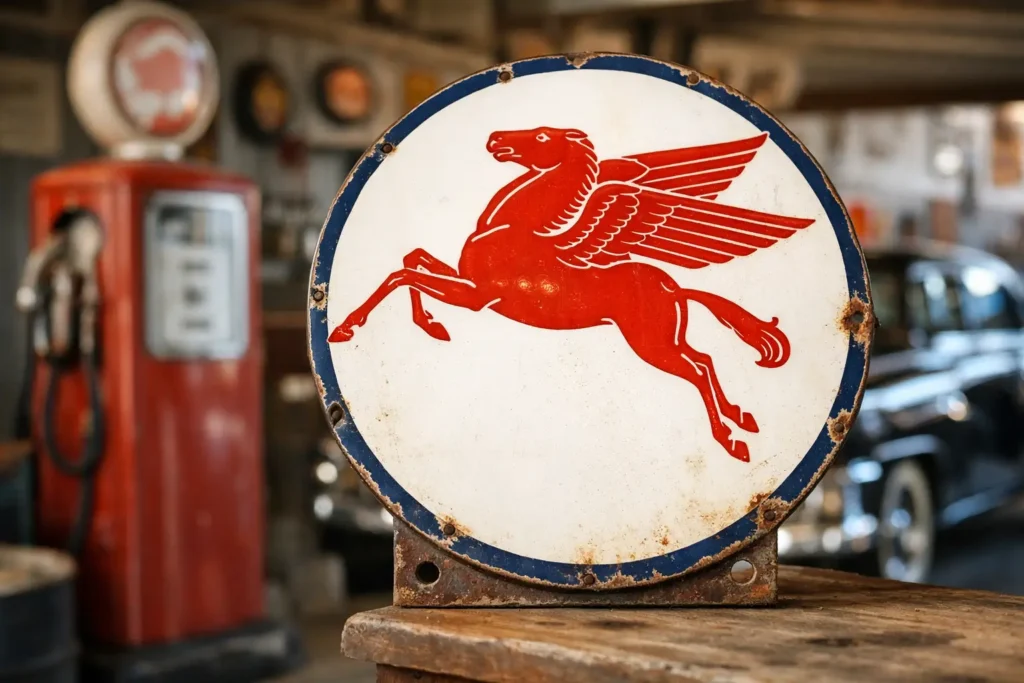
A real Mobilgas sign can bring strong money fast – or sit overpriced for months – and the difference usually comes down to details that casual buyers miss. If you are trying to understand mobilgas porcelain sign value, you have to look past the Pegasus logo and ask the harder questions: Is it original company issue, how much gloss is left, how much damage is honest wear, and how scarce is that exact version?
Mobilgas is one of those names that has never lost collector appeal. The brand sits right in the sweet spot of gas and oil advertising – great graphics, strong color, broad recognition, and real roadside history. That gives original porcelain signs a built-in market, but not every example lands in the same value range. Some are decorator pieces. Some are serious collector signs. Some are expensive only because somebody wants them to be.
What drives Mobilgas porcelain sign value
The biggest driver is originality. That comes first, every time. A 100 percent original Mobilgas porcelain sign with honest age, factory construction, and period wear will always have a different market than a cleaned-up piece with suspect touch-up, added holes, or reproduction traits. In this category, authenticity is not a side issue. It is the value.
After originality, condition carries enormous weight. Porcelain signs are tough, but they are not indestructible. Chips around the mounting holes, edge wear, surface scratches, fade, stain, and rust bleed all matter. The market usually forgives honest wear better than repair. A sign with scattered chips and strong gloss often outperforms a shinier example that has been worked on. Advanced collectors would rather buy damage they can see than restoration they cannot fully trust.
Rarity is the next major piece. Mobilgas made a range of signs over the years, and not all of them survive in equal numbers. Common dealer signs, pump plates, and smaller station pieces can still be desirable, but larger formats, early examples, unusual slogans, and signs with standout graphics tend to command the strongest prices. The red Pegasus is always popular, but the specific layout matters. A scarce variation can separate itself fast from a standard issue example.
Size also changes the market. A small pump plate may be affordable to a broad group of buyers, while a large double-sided porcelain station sign moves into a more serious collector bracket. Bigger signs usually bring more, but not automatically. If a large sign has heavy damage, poor color, or questionable originality, a smaller but cleaner and scarcer sign can outperform it.
Originality is where most value is won or lost
If you want a clean read on mobilgas porcelain sign value, you have to start by eliminating reproductions, fantasy pieces, and married-up signs. This is where inexperienced buyers get hurt. Mobilgas has been reproduced for years because the brand is known, the graphics are attractive, and the demand is steady.
A real sign usually tells on itself in the steel, the porcelain, the holes, and the wear pattern. The surface should show age that makes sense. The gloss should fit the era and use. The back should not look artificially aged in a way that feels staged. Mounting holes should show natural wear consistent with hanging, not fresh distressing. Colors should be right for the period issue, not just close enough to fool a photo buyer.
There is also the problem of partial originality. A sign may be old, but altered. It may have added grommets, paint enhancement, porcelain over chips, or a cleaned-up face that photographs stronger than it looks in hand. Those changes can cut value hard, especially at the higher end of the market. The better the sign is supposed to be, the less room there is for excuses.
That is why experienced collectors buy the piece, not the story. Provenance helps. Seller knowledge helps. A strong guarantee helps. But the sign itself has to stand up first.
Condition grades matter more than many sellers admit
Collectors often use broad condition language, but porcelain value lives in the small details. A sign described as “excellent” by one seller may be only mid-grade to a seasoned gas and oil buyer. Strong photos are useful, but they do not always show surface spidering, gloss loss, edge lifting, or old stabilization.
A top-tier Mobilgas sign usually has strong color, deep gloss, minimal field damage, and chips that stay mostly to the outer edge or mounting points. Those are the examples that bring competition. Mid-grade pieces with moderate wear still sell well if they display honestly and retain eye appeal. Lower-grade examples can remain valuable if the format is rare enough, but the buyer pool narrows.
This is where eye appeal comes in. It is not a technical grading term, but it matters in every real-world sale. A sign can have flaws and still look right on the wall. Another can have less total damage but look tired, flat, or off-color. Buyers pay for what the sign does in a room just as much as what a condition report says.
Which Mobilgas signs bring the strongest prices?
The short answer is early, large, graphic, and hard-to-find. Double-sided porcelain signs usually carry strong interest because they were expensive to produce, visually impressive, and more likely to have suffered damage in use. Surviving originals with good gloss and balanced condition are serious pieces.
Single-sided dealer signs can also bring excellent money, especially if they have bold Pegasus imagery, desirable shape, and strong color. Signs marked with station use, directional wording, or period service branding can appeal to collectors who want something more specific than a standard name sign. Pump plates and smaller attachments have a lower entry point, but rarity still moves the needle.
There is also a timing factor. Certain categories get hot when collectors shift focus toward gas and oil, Americana, or high-end garage decor. Mobilgas has broad crossover appeal. It works for serious petroleum collectors, but it also reaches buyers furnishing car showrooms, man caves, restaurants, and commercial spaces. That wider demand helps support prices.
Why two Mobilgas signs can be priced worlds apart
This is where newcomers get frustrated. They see two signs with the same brand name and assume the values should be close. In practice, one may be worth several times the other.
One sign may be original porcelain from the period, while the other is a later reproduction. One may have untouched gloss and clean color, while the other has restoration hidden in the white areas. One may be a common smaller issue, while the other is a scarce double-sided dealership sign. One may have all its damage at the perimeter, while the other has chips through the face of the Pegasus. That is not small stuff. That is the market.
Auction records can also confuse people because context matters. A sign sold at a major event with competitive bidding, strong presentation, and confirmed originality can outperform a similar sign sold poorly. Private sales vary too. A rare sign offered by a trusted specialist may bring more than the same sign sold by someone who cannot answer basic questions.
How to judge value before you buy
Start with originality, then compare condition, then ask how often that exact sign actually turns up. Do not rely on asking prices alone. Plenty of signs are listed at fantasy numbers and stay listed. Real value comes from what informed buyers will pay for a particular example in its current state.
Ask for close photos of the face, edges, holes, and back. Ask whether the sign has any restoration, porcelain repair, added holes, or repaint. Ask for dimensions and whether it is single-sided or double-sided. If the seller gets vague when the questions get specific, that tells you something.
It also helps to know your own goal. If you want an original wall piece for a garage or showroom, a mid-grade sign with honest wear may be the right buy. If you are building a serious petroleum collection, compromise gets expensive later. Better to buy one correct sign than two questionable ones.
For collectors who care about investment-grade originality, this is exactly why specialists matter. At Road Relics, the whole point is dealing in authentic old stock, not reproductions dressed up as opportunity. That difference shows up in value over time.
Mobilgas remains one of the strongest names in the porcelain sign market because the brand never stopped looking good, and the best originals never stopped being hard to replace. If you buy carefully, with your eyes open to authenticity and true condition, you will be a lot closer to owning the right sign than just the right logo.