
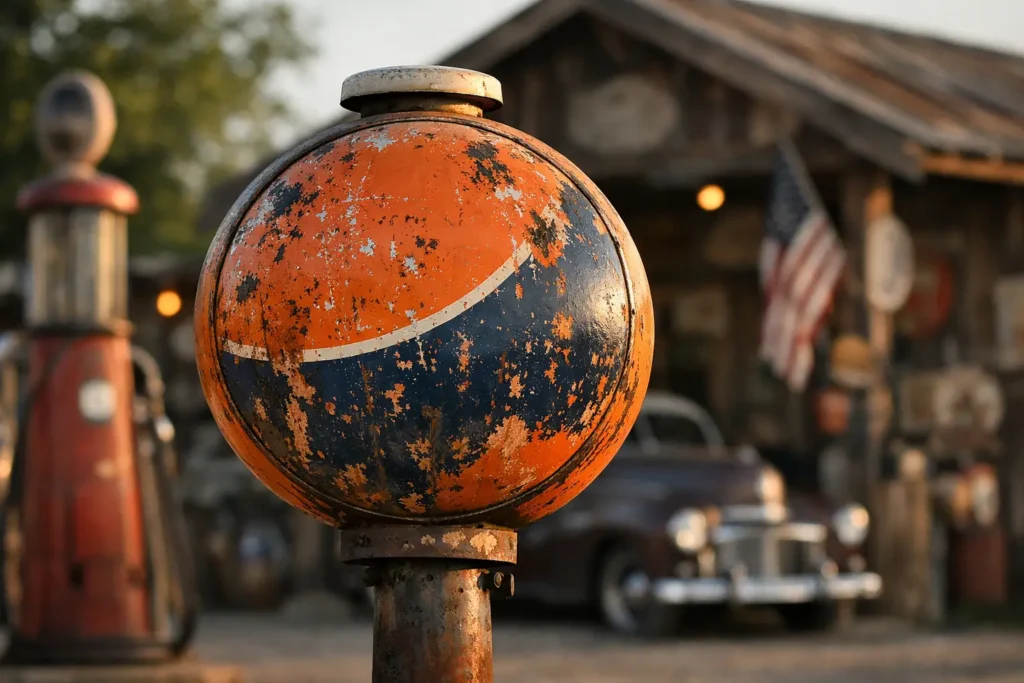
A real union 76 antique sign has a way of stopping people cold. It is not subtle. The orange ball, the bold numerals, the weight of porcelain or steel, the scars from decades outdoors – these signs carry real roadside history. That is exactly why they get copied, cleaned too hard, married together from parts, or dressed up as something they are not.
For serious collectors, decorators, and anyone buying with real money, the first question is not whether a Union 76 sign looks good on the wall. Most of them do. The question is whether the sign is original, period-correct, and honest in condition. That is where experience matters.
Why the Union 76 antique sign still gets attention
Union 76 is one of those gas and oil brands that crosses over. It speaks to petroleum history, West Coast service station culture, American road travel, and bold industrial design all at once. Even people who do not collect gas and oil know the logo the second they see it.
That broad appeal keeps demand strong. Collectors want them because they belong in serious petroliana collections. Designers want them because the color and shape read well in garages, bars, showrooms, and retail spaces. The trouble is that popularity brings fantasy pieces and reproductions right along with the genuine article.
A strong original example usually earns its place fast. A weak one, or a fake one, becomes expensive wall filler.
What makes a Union 76 antique sign original
When you handle enough old signs, the difference between original and made-to-look-old starts showing up in a dozen small places. Not one detail tells the whole story. It is the combination that matters.
Construction tells you a lot
Most sought-after Union 76 signs were made in porcelain on steel or painted metal, depending on era and format. On porcelain examples, the steel base, the gloss, the thickness of the enamel, and the edge wear all need to make sense together. Real age does not look sprayed on. It shows honest weathering, edge chips, oxidation where the steel was exposed, and wear around mounting holes that fits long-term use.
Reproductions often miss the balance. The porcelain may be too glossy in a modern way, too flat, or artificially distressed. Lettering can look slightly off. Colors may be close but not right. The orange field on a true period piece has presence. It is hard to fake that depth convincingly.
Mounting holes and shape matter
A lot of Union 76 signs were made in round form, but size, hole placement, flange construction, and edge profile can vary by age and maker. If a sign has unusual drilling, fresh holes, or signs of being cut down or reshaped, that needs a closer look. Collectors see altered mounting as a red flag, especially when the rest of the piece is being sold as untouched.
Flange signs deserve extra scrutiny. The bend, the seam, and the wear pattern should all line up with age. A flange that looks too crisp, too even, or recently formed is usually trouble.
Maker marks help, but they are not the whole answer
Some original signs carry manufacturer markings or production clues, and those can help support authenticity. Still, a stamp alone does not settle it. Marks can be copied, added, or misunderstood. Good sign people never rely on one feature in isolation.
That is the pattern across the entire category – original signs tell a consistent story. Reproductions usually break character somewhere.
Condition on a Union 76 antique sign
Condition is where value rises or drops hard. With gas and oil signs, collectors accept wear. In many cases they want it. Honest outdoor use is part of the appeal. But there is a big difference between strong original patina and damage that kills eye appeal.
Porcelain loss matters. Chips at the edge can be acceptable, even expected, especially on larger station signs. Deep hits through the field, heavy rust bleed, touch-up, or restoration can change the sign completely. A sign that still presents well from a few feet away may be fine for display, but serious collectors will price every flaw.
Color is another major factor. Union 76 signs win on graphic impact. If the orange is faded flat or the white numerals are compromised, the sign loses some of the punch that makes the brand so desirable. Sometimes a rough sign still has killer presence. Sometimes a technically cleaner sign looks dead on the wall. It depends on how the wear sits.
For buyers using one as statement decor, eye appeal often comes first. For long-term collectors, originality comes first, then eye appeal, then rarity. Those priorities can overlap, but not always.
Rarity is more than size
People often assume the biggest Union 76 antique sign is the most valuable. Not necessarily. Size helps, but rarity comes from a mix of format, survival rate, regional use, and how often a specific version reaches the market.
A common round station sign in average shape can still be a great piece, but it may not be scarce. On the other hand, an unusual flange, dealership-related variation, early example, or hard-to-find size may bring stronger interest even with wear. The market rewards pieces that seasoned collectors do not see every month.
That is why comparing one Union 76 sign to another can get sloppy fast. Two examples may share the same logo and still live in very different value brackets. Era, maker, dimensions, and condition all shift the conversation.
Buying a Union 76 antique sign without getting burned
This is where too many buyers get casual. They like the look, they hear the right words, and they move too quickly.
Ask direct questions. Is it original company-issued stock? Has it been restored, touched up, clear coated, or repainted? Are the mounting holes original? Are there condition issues not visible in the main photos? A trustworthy seller will answer plainly.
Photos matter, but they are not enough by themselves. You want close-ups of the edges, the mounting holes, the back, and any areas of porcelain loss or rust. The back of a sign can tell you a lot about age, storage, and whether the front story holds up.
Provenance helps when available, but in this field, expertise often matters more than paperwork. Many authentic signs have been in collections for decades without formal documentation. The key is buying from somebody who knows the category and stands behind originality. That is the reason collectors come back to specialists like Road Relics at https://roadrelics.com – not for polished talk, but for original stock and a real guarantee.
Display value versus collector value
A Union 76 sign can succeed in two different ways. It can be a top-shelf collector piece, or it can be a visually strong original sign chosen mainly for display. There is nothing wrong with either path, as long as the buyer knows which lane they are in.
For a high-end collection, rarity and untouched condition tend to lead. For a garage, showroom, restaurant, or loft, size and graphic strength may matter more. A sign with edge chips and field wear can look fantastic in the right room if the colors still hit and the surface reads as honest.
The mistake is paying top collector money for what is really a decorative-grade piece. That happens all the time when buyers shop on logo alone.
Why these signs hold their place
The best Union 76 antique signs still feel like the American road. They were built to be seen from a distance, under sun, rain, dust, and station lights. Good originals carry that history in the surface. You can fake the logo, but you cannot easily fake decades of real service.
That is why this category keeps its pull. A genuine piece is not just orange and white porcelain. It is period advertising, industrial design, and roadside memory in one object. If you buy carefully, a strong example will do more than fill a wall – it will hold attention for years.