
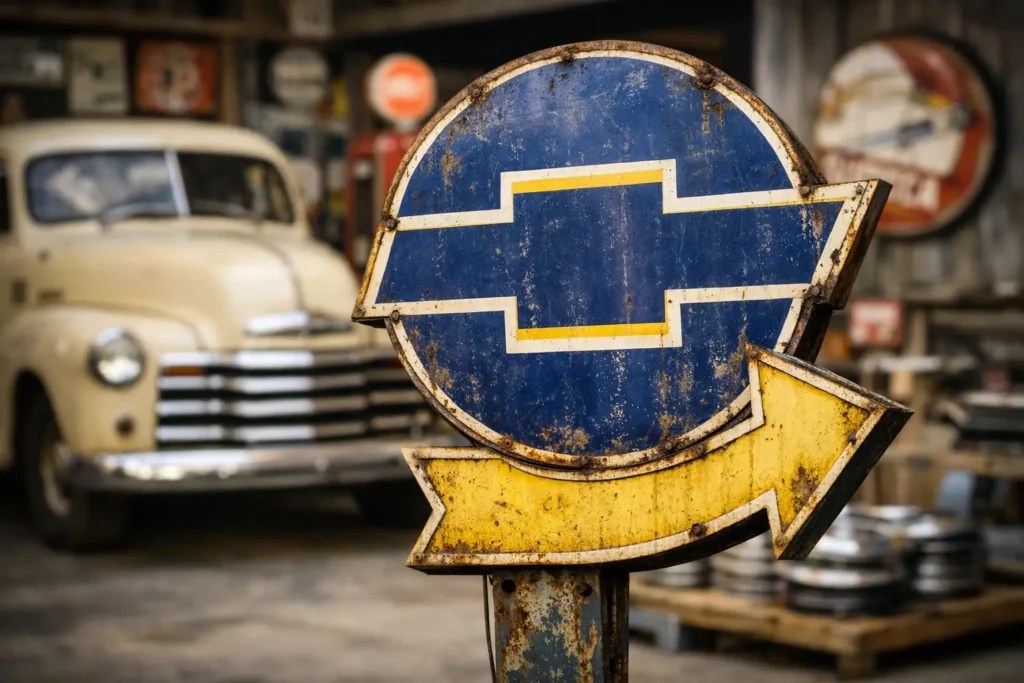
A real original Chevrolet advertising sign does not need much introduction once you are standing in front of it. The color, the scale, the wear, the way the porcelain lays on steel or the way old paint has settled into a tin surface – those things tell on themselves. The trouble starts when you are looking at photos, auction hype, or a seller who keeps saying “vintage style” when what they really mean is new.
Chevrolet signs have been heavily reproduced for years because the brand is strong, the graphics are familiar, and demand never really dries up. That makes the category attractive, but it also makes it risky. If you collect auto advertising, decorate a garage, or want a statement piece with real history behind it, you need to know what separates a company-issued Chevrolet sign from a modern fantasy piece.
Why an original Chevrolet advertising sign draws serious buyers
Chevrolet sits in a sweet spot for collectors. It carries broad American recognition, deep dealership history, and strong visual appeal across multiple eras. Early bowtie signs, dealership service signs, parts department pieces, and mid-century porcelain examples all speak to the rise of the American car culture that shaped highways, main streets, and service stations.
That matters because the best signs do more than advertise a car brand. They represent a period of American retail and roadside life that is long gone. A strong Chevrolet sign can work in a serious collection, but it also crosses over into design. It looks right in a period garage, a showroom, a restaurant, a loft, or a commercial space that wants actual character instead of manufactured nostalgia.
The strongest examples tend to be dealer-issued or factory-backed pieces with honest age, desirable graphics, and enough presence to command a wall. Size matters, but rarity matters more. A smaller, scarcer sign with excellent color and untouched surfaces can easily outshine a larger piece that is common or over-restored.
What makes an original Chevrolet advertising sign original
Original means period-made and company-issued. That is the line that matters. Not “old looking.” Not “made from an antique pattern.” Not “licensed reproduction.” If the sign was made decades later for decorator use, it is not original no matter how convincing the graphics may be.
With Chevrolet, originality usually comes down to a combination of construction, graphics, wear, and context. Porcelain signs should show the right steel base, the right enamel depth, and the right sort of chipping around mounting holes and exposed edges. Tin signs should show age that makes sense for the metal, paint, and storage history. Neon dealership signs should show proper period fabrication, not fresh tubing slapped onto a modern frame.
You also want the graphics to make sense for the era. Typography, logos, slogans, and colors changed over time. A bowtie logo that is wrong for the supposed age of the sign is a red flag. So is a slogan that did not appear until years later. Reproduction makers often get close, but close is not good enough in this category.
Provenance helps when it exists, but it is not always available. Many real signs came out of old dealerships, garages, service departments, or long-held collections without paperwork. That does not make them suspect. It just means the sign itself has to carry the proof.
Chevrolet sign types collectors chase
Chevrolet advertising covers more ground than many buyers realize. Porcelain dealership signs are usually the first thing people picture, and for good reason. They have color, durability, and strong wall power. Single-sided and double-sided examples both have a following, especially when the bowtie is bold and the condition is honest.
Tin signs have their own place in the market, especially early examples with strong graphics or dealer-specific text. They can be more affordable than top porcelain, but scarce originals still bring serious money. The same goes for embossed metal pieces and stamped service signs.
Neon Chevrolet signs are in another lane altogether. Original dealership neon with period cans, backing, or porcelain faces can be a major piece. They are harder to find, harder to ship, and often more condition-sensitive. But when they are right, they stop traffic.
Then there are clocks, parts department signs, service signs, and smaller dealership display pieces. These can appeal to collectors who want originality and brand history without needing a six-foot wall sign. They also tend to be less frequently available in strong untouched condition.
Condition matters, but so does the kind of condition
Collectors talk about condition constantly, but not all damage hurts a sign in the same way. Honest wear is expected. Edge chips, light staining, surface scratches, and age fade can all be acceptable, especially on pieces that survived decades of outdoor use. In fact, that natural wear often supports authenticity.
The bigger issue is bad restoration, concealed damage, and repairs that are not disclosed. Heavy touch-up, added gloss, patched metal, replaced grommets, or repainted fields can strip a sign of collector confidence. A sign can still have decorative value after restoration, but it enters a different pricing conversation.
This is where experience matters. A strong original surface with scattered chips usually beats a glossy “improved” example for serious collectors. If you are buying for investment, originality of finish often carries more weight than cosmetic perfection.
How to spot trouble before you buy
Most mistakes happen because a buyer wants the sign to be real. That is understandable. Chevrolet pieces are attractive, and the better fakes are made to trigger that exact response.
Start with construction. Look at the steel, the porcelain thickness, the mounting holes, and the back. Fresh-looking backs on supposedly early signs deserve scrutiny. So do perfectly uniform wear patterns and damage that looks staged. Real age is irregular.
Next, study the graphics. Reproductions often miss letter spacing, border proportions, or logo details. Sometimes the colors are too loud or too clean. Sometimes the layout is copied from a known original but lacks the crispness or fabrication quality of the real thing.
Size can also tell a story. Fantasy signs are often made in decorator-friendly sizes that did not exist in the period. If a sign looks unusual, ask whether that exact format is documented. Uncommon is good. Unknown can be a problem.
Finally, consider the seller. A trustworthy specialist should be able to talk plainly about age, construction, condition, and why the piece is right. If the answers stay vague, move on.
Value depends on more than age
People often ask what an original Chevrolet sign is worth, but there is no single answer. Value depends on scarcity, size, condition, subject matter, color, and how desirable the exact format is to collectors right now.
A common later piece with moderate wear may be bought mainly for display. A scarce early porcelain dealer sign with great color and untouched surfaces belongs in a different class entirely. Double-sided examples, oversized signs, and signs with strong dealership appeal usually sit higher, but there are exceptions. Sometimes a smaller sign with exceptional graphics and unquestioned originality brings more enthusiasm than a larger but ordinary piece.
Regional demand also plays a role. Chevrolet has broad appeal across the country, but certain signs perform especially well in markets where auto advertising, Americana, and garage décor overlap. That buyer pool is wide, which is part of what keeps strong examples moving.
Buying with confidence
If you are buying your first Chevrolet sign, buy the best original example you can afford instead of the biggest sign you can afford. That approach usually saves money in the long run. Quality holds up. Marginal pieces often get replaced.
Ask for clear photos of the front, back, edges, mounting holes, and any damaged areas. Ask direct questions about restoration, touch-up, and whether the sign is guaranteed as original. Those should not be uncomfortable questions. In this business, they are basic.
If you are buying from a specialist such as Road Relics, the key advantage is not just inventory. It is the ability to get a straight read on what the sign is, what condition it is in, and where it sits in the market. That matters far more than polished sales language.
A real Chevrolet sign earns its place over time. It carries history, brand power, and the kind of surface you cannot fake well enough to fool a collector who has handled the real thing. Buy with your eyes open, trust experience over hype, and wait for the piece that feels right when you see it. The good ones still have a way of speaking for themselves.